
Why Haven’t Loan Officers Been Told These Facts?
After Reversing Prior Rule Limiting Use of Consumer Medical Debt, CFPB Acts to Limit State Rights to Protect Consumers
Background
Medical debt reporting poses challenges for consumers, as it limits their credit opportunities and may impact their employment prospects. Recognizing this issue, various stakeholders continue to work on alleviating the burden of medical debt reporting and enhancing credit options for individuals. In January of this year, the CFPB took a big step by announcing a new rule aimed at restricting the reporting and use of medical debt. This rule was intended to create a more equitable financial landscape for consumers.
JANUARY 7, 2025, WASHINGTON, D.C. – Today, the Consumer Financial Protection Bureau (CFPB) finalized a rule that will remove an estimated $49 billion in medical bills from the credit reports of about 15 million Americans. The CFPB’s action will ban the inclusion of medical bills on credit reports used by lenders and prohibit lenders from using medical information in their lending decisions. The rule will increase privacy protections and prevent debt collectors from using the credit reporting system to coerce people to pay bills they don’t owe. The CFPB has found that medical debts provide little predictive value to lenders about borrowers’ ability to repay other debts, and consumers frequently report receiving inaccurate bills or being asked to pay bills that should have been covered by insurance or financial assistance programs.
“People who get sick shouldn’t have their financial future upended,” said CFPB Director Rohit Chopra. “The CFPB’s final rule will close a special carveout that has allowed debt collectors to abuse the credit reporting system to coerce people into paying medical bills they may not even owe.”
The CFPB’s research reveals that a medical bill on a person’s credit report is a poor predictor of whether they will repay a loan, and contributes to thousands of denied applications on mortgages that consumers would be able to repay. The CFPB expects the rule will lead to the approval of approximately 22,000 additional, affordable mortgages every year and that Americans with medical debt on their credit reports could see their credit scores rise by an average of 20 points.
The CFPB’s action follows changes made by the three nationwide credit reporting conglomerates – Equifax, Experian, and TransUnion – who announced that they would take certain types of medical debt off of credit reports, including collections under $500, after the CFPB raised concerns about medical debt credit reporting in early 2022. Additionally, FICO and VantageScore, the two major credit scoring companies, announced they have decreased the degree to which medical bills impact a consumer’s score.
The CFPB’s final rule brings regulations in line with Congress’s decision to safeguard consumers’ privacy by restricting lenders from obtaining or using medical information, including information about medical debts. Federal financial regulators later created an exception to this restriction, allowing creditors to consider medical debts. This carveout has enabled debt collectors to use the credit reporting system to coerce payments from patients for inaccurate or false medical bills.
The CFPB’s new rule amends Regulation V, which implements the Fair Credit Reporting Act (FCRA), to end this exception and establish guardrails for credit reporting companies, prohibiting them from including medical bills on credit reports sent to lenders, who are banned from considering them. The final rule:
- Prohibits lenders from considering medical information: The rule ends the special regulatory carveout that previously allowed creditors to use certain medical information in making lending decisions. This means lenders will also be barred from using information about medical devices, such as prosthetic limbs, that could be used to require that the devices serve as collateral for a loan for the purposes of repossession.
- Bans medical bills on credit reports: The rule bans consumer reporting agencies from including medical debt information on credit reports and credit scores sent to lenders. This will help end the practice of using the credit reporting system to coerce payment of bills regardless of their accuracy. Lenders will continue to be able to consider medical information to verify medical-based forbearances, verify medical expenses that a consumer needs a loan to pay, consider certain benefits as income when underwriting, and other legitimate uses.
Today’s rule advances the CFPB’s work to protect consumers from harms from medical debt and coercive debt collection practices. In October, the CFPB issued guidance clarifying that debt collectors violate federal law when they collect on inaccurate or legally invalid medical debts. Previously, the CFPB published in 2022 a report describing the extensive and debilitating effects of medical debt along with a bulletin on the No Surprises Act to remind credit reporting companies and debt collectors of their legal responsibilities under that legislation.
Federal Judge Stays and then Vacates CFPB FCRA Rule
The CFPB rule, initially scheduled to take effect in March 2025, was postponed due to a 90-day stay issued by U.S. District Judge Sean Jordan of the Eastern District of Texas. Both the Bureau and the industry groups that challenged the rule now agree that creditors can report medical debt to consumer reporting agencies.
Then, in July, Judge Jordan permanently vacated the CFPB rule, stating, “In sum, [the] FCRA expressly allows creditors to obtain and use properly coded medical-debt information in credit decisions, but the Medical Debt Rule would prohibit them from doing so,” Judge Jordan wrote. “As it now recognizes, the Bureau was powerless to promulgate such a rule that flouts a federal statute by functionally rewriting it.”
Double Blow For Consumers
In October 2025, the CFPB went one step further, seeking to assert federal preemption in relation to state statutes aimed at curbing the use of medical debt records.
The Supremacy Clause
The Constitution’s Supremacy Clause states that federal law is “the supreme Law of the Land,” meaning it takes precedence over any conflicting state law. This principle lays the groundwork for the doctrine of federal preemption, which establishes that federal law overrides state laws that are in conflict. The Supreme Court has identified two primary ways in which federal law can preempt state law.
First, federal law can explicitly preempt state law when a federal statute or regulation includes clear preemptive language. Second, federal law can implicitly preempt state law when the intent of Congress to preempt is evident in the structure and purpose of the relevant federal law.
Some federal consumer protection laws permit state laws to exceed federal restrictions, such as RESPA.
12 USC §2616 (RESPA). State laws unaffected; inconsistent Federal and State provisions
This chapter does not annul, alter, or affect, or exempt any person subject to the provisions of this chapter from complying with, the laws of any State with respect to settlement practices, except to the extent that those laws are inconsistent with any provision of this chapter, and then only to the extent of the inconsistency. The Bureau is authorized to determine whether such inconsistencies exist. The Bureau may not determine that any State law is inconsistent with any provision of this chapter if the Bureau determines that such law gives greater protection to the consumer.
The FCRA is not RESPA
The developing debate between states and the federal government centers on whether states have a claim under the FCRA to enact laws that foreclose or limit medical debt reporting. Currently, fifteen states have passed laws restricting the reporting of medical debt. Of these, nine new state statutes take effect in 2025 or on January 1, 2026. The other state statutes became effective in either 2023 or 2024.
State laws that prohibit including medical debt in credit reports include various types of restrictions that govern different groups of entities involved, including:
- Prohibitions on consumer reporting agencies (CRAs) inserting medical debts in credit reports.
- Prohibitions on providers and debt collectors (called “furnishers”) reporting or furnishing medical debt to CRAs.
- Prohibitions on creditors using medical debts on credit reports in their credit decisions.
The CFPB: The Lion and The Lamb
The CFPB has shifted significantly in its mission. The agency has a mandate that is lion-like when repealing or negating consumer protections. Still, these days, it has become lamb-like regarding consumer protection, which isn’t to say that they are wrong in reversing some rules and policies.
On July 11, 2022, the CFPB published an interpretive rule purporting to analyze section 1681t(b)(1) of the Fair Credit Reporting Act (FCRA), finding that it has “a narrow sweep,” which allows for substantial State regulation of consumer reports and consumer reporting agencies. The 2022 interpretive rule declared that “section 1681t(b)(1) does not preempt all State laws relating to the content or information contained in consumer reports. The interpretive rule concluded that unless a State law specifically concerned a requirement or obligation addressed in the enumerated FCRA provision, it was not preempted.
For example, section 1681t(b)(1)(E) preempts State laws “with respect to any subject matter regulated under” section 1681c “relating to information contained in consumer reports.” Section 1681c states requirements on four topics relating to information contained in consumer reports: obsolescence, certain information about medical information furnishers, certain information about veterans’ medical debt, and certain information that must be included in a consumer report. The interpretive rule reasoned that section 1681t(b)(1)(E) does not preempt State laws about subject matter regarding the content of or information on consumer reports beyond these topics. Applying this logic, the interpretive rule specifically identified a number of areas in which States could regulate consistent with the interpretive rule’s view of the FCRA, including medical debt, rental information, and arrest records.
The Lion
In addition to withdrawing the 2022 interpretive rule, the Bureau now clarifies that its prior interpretation of the FCRA was manifestly incorrect in relation to conflict with state laws. The 2022 interpretive rule contradicted the plain text of section 1681t(b)(1), ignored the legislative history of the preemption clause, and reflected “a misguided policy choice that would undermine the credit reporting system and credit markets.” [Hogwash! – LOSJ Editor]
The Consumer Financial Protection Bureau is issuing this October 2025 interpretive rule to clarify that the Fair Credit Reporting Act (FCRA) generally preempts State laws that touch on broad areas of credit reporting, consistent with Congress’s intent to create national standards for the credit reporting system. This interpretive rule replaces a July 2022 interpretive rule that the Bureau withdrew in May 2025.
The Law
While the mortgage industry has much to lose from a return to the previous system of medical debt reporting, it seems the CFPB may be justified in its updated interpretation of the FCRA, as Judge Jordan pointed out. Medical debt reporting indeed needs improvement. Congress, rather than federal bureaucrats, should address this issue as required by law.

BEHIND THE SCENES: Goodbye CFPB Nonbank Registry
Excerpts from the Federal Register 90 FR 48760
The Consumer Financial Protection Bureau (Bureau or CFPB) is issuing a final rule to rescind its rule requiring certain types of nonbank covered persons subject to certain final public orders obtained or issued by a government agency in connection with the offering or provision of a consumer financial product or service to report the existence of the orders and related information to a Bureau registry.
The Bureau published the NBR Rule in the Federal Register on July 8, 2024, and it took effect on September 16, 2024. The Bureau stated that it was issuing the NBR Rule, as described below, because it believed the statutory purposes of the Bureau’s market monitoring and nonbank supervision responsibilities would be furthered by the collection and publication of information about the existence of covered orders at covered nonbanks, and in the case of supervised registered entities, steps taken to comply with those covered orders. Specifically, it believed that the Bureau’s establishment of a centralized system for collecting and publishing information about covered orders against covered nonbanks would lead to more efficient and effective monitoring, detection, assessment, public awareness, and mitigation of the risks posed to consumers by violations of Federal consumer financial law, including repeat violations. The NBR Rule generally found that such outcomes, if achieved, would be beneficial to consumers.
The Bureau is concerned that the costs the NBR Rule imposes on regulated entities, and that may be passed on to consumers, are not justified by the speculative and unquantified benefits to consumers discussed in the NBR Rule’s analysis. Despite specifically seeking input from commenters pertaining to non-speculative and methodologically rigorous analysis of the NBR Rule’s purported benefits, the Bureau received none. Accordingly, and because the Bureau concludes that the NBR Rule is not necessary as a tool to effectively monitor and reduce potential risks to consumers from bad actors, the Bureau is finalizing the rescission in its entirety.
Tip of the Week – Sign Up for 2025 CE
Expanding your product offerings is an effective way to enhance your business’s vitality. This year, the Loan Officer School is surveying non-government financing options for construction and renovation projects.
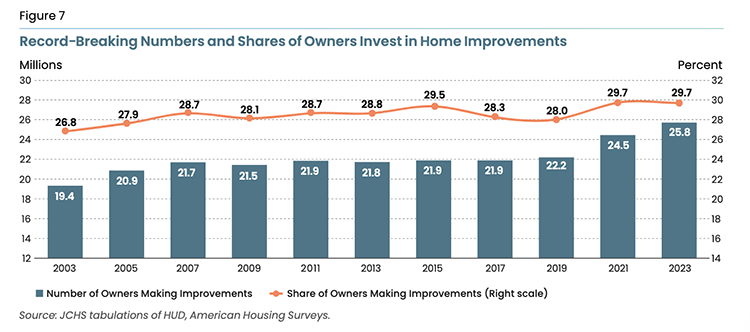
The shortage of affordable housing is unlikely to be resolved anytime soon. As affordable, move-in-ready housing solutions remain hard to find, the demand for construction and renovation loans is expected to increase. According to the JCHS, Harvard University, the US remodeling market soared above $600 billion in the wake of the pandemic and, despite recent softening, remains 50 percent above pre-pandemic levels.
Discover how to enhance borrower advantages through construction and renovation financing.
- Enhanced housing affordability.
- Housing options for aging or disabled borrowers.
- Housing solutions for borrowers caring for aging or disabled family members.
- Multi-generational housing solutions.
For any questions or inquiries regarding state education needs, please feel free to call.
Call Us Today! (866) 314-7586
Sign up for a 2025 CE Webinar
Online self-study classes are available.