
Why Haven’t Loan Officers Been Told These Facts?
Down Payment Assistance: Rethinking Down Payment
A recent article by Down Payment Resource® highlighted findings from a New American Funding survey that underscore a concerning fact familiar to mortgage professionals: many entry-level homebuyers remain uninformed about common mortgage solutions, even in our modern information-dense environment. Disturbingly, the survey suggests that, after closing, many homebuyers still possess only a limited understanding of financing options, showing little improvement over their pre-closing knowledge. This lack of financial literacy and preparedness is troubling and underscores the need for greater education and support for entry-level homebuying.
In todays marketplace, entry-level homebuyers’ lack of financing awareness has its pros and cons. If these buyers were informed that they often require little to no cash to buy a home, the number of committed homebuyers could increase significantly. After all, cash-to-close is still the number one barrier to homeownership, at least in the minds of those in the dark.
If all prospective entry-level buyers were equally knowledgeable about low- or no-down payment programs, the resulting increase in homebuyers would be beneficial for markets experiencing a housing surplus. Conversely, an influx of qualified buyers in areas already facing a supply shortage would not be ideal.
The survey, which included responses from over 1,000 homeowners, revealed that approximately 85% wished they had known more before starting their homebuying journey. Notably, nearly 21% specifically expressed a desire to have been informed about down payment assistance programs. Surprisingly, 13% of respondents still believe that a 20% down payment is necessary.
The Down Payment Resource article makes several interesting points. Perhaps most notable is the all-too-common predicament many buyers face: Do we have to significantly deplete our rainy-day fund to buy a home? For many, the answer is of course not. Or at least that should be the answer. Yet, the inevitability of a cash drain is often the option presented by too many lenders. Only when the lender has no other recourse than down payment assistance might the MLO feel it is appropriate to present the no-down-payment options.
The article makes another interesting point that, “Part of the challenge is the word we keep using. The word assistance implies that down payment programs are a safety net for buyers who cannot afford to participate in the market any other way. That framing is both inaccurate and counterproductive.”
What about the applicants who get a ham-handed DAP presentation? Do stakeholders feel unsure about these programs because of the lender’s presentation? When we present DAP, do prospects ever feel embarrassed or uncomfortable because of how the solution is introduced?
Example: Mr. and Mrs. Prospect, we have a perfect program for you! It’s a loan designed for low-income and disadvantaged families. Let me say that louder: it’s a loan for people who are financially unsuccessful and can’t manage their money! Its State money, welfare for people who can’t save for a down payment. You are a perfect fit! Make sure and tell your friends how we helped you accomplish the impossible dream of homeownership!
From the article, Down Payment Resource ponders this idea: “The industry needs a structured forum for this discussion. A panel at MBA Annual on how lenders and agents can systematically integrate affordability tools into every buyer conversation would be a meaningful step. Not a session about why affordability matters, something we all know, but a practical, data-driven debate about how to drive this change. What does it look like operationally to make down payment program eligibility a standard workflow step? What does the evidence say about conversion when buyers are presented with program options versus when they are not? What are the lenders and agents already doing this well, and what can everyone else learn from them?” These are great questions. Here are a few more: Why wait for others? Can DAP transactions springboard a lender to greater successes?
Let’s be frank, DAP programs are not the most profitable to implement. Let’s also be blunt: it can be a struggle coordinating transactions with a single mortgage close. And now two are suggested? For many transactions, lenders find that not only is the listing agent allergic to offers with DAP contingencies, but the buyer’s agent is equally opposed. Real estate brokers and builders will readily share their aversion to these financing contingencies, usually based on some negative experience they had 10 years ago with some DAP-Quack. No wonder the adoption and implementation of the DAP program have faced such headwinds over the years.
Does the Buyer Need Seller Cooperation When Using DAP?
A lender can offer the Down Payment Assistance Program (DAP) to all eligible applicants. If a buyer wishes to utilize the DAP, they generally have the option to make an offer without including a DAP contingency. This is permissible as long as the buyer is both able and willing to proceed with the purchase without depending on the DAP. If the DAP manufacture requires contract amendments or constraints, that may debar use of a DAP.
It’s important for both the lender and the buyer to assess the risk of closing the transaction without the intended DAP. This is a decision that should be made in advance.
An Argument That Must Be Heard
For many years, the housing industry has systematically and often unnecessarily placed consumers in precarious housing situations. While the subprime mortgage crisis garnered significant attention in the past, another more obscure issue continues to affect far too many in the entry-level homeownership market. This issue concerns the practice of unnecessarily placing individuals living paycheck to paycheck into their first homes without any cash reserves or unnecessarily consuming the buyers’ available cash, leaving them susceptible to overreliance on credit cards to maintain their new home. Although one might argue that achieving homeownership is preferable to remaining a renter, the prevalence of this practice raises questions, especially when better, more viable financing options are readily available. It is troubling that this is the norm, resulting in needlessly high rates of delinquency and default. It must be said that there are many exceptions to this norm. Many lenders and individual loan officers are nobly and tirelessly working to adopt and implement better mortgage solutions. Hats off to them!
In a report published by JP Morgan Chase in 2019, titled “Bank Data on the Relationship Between Liquidity and Mortgage Default,” the findings provide substantial evidence supporting a fundamental principle that industry professionals utilize as a primary risk management strategy for higher-risk transactions: requirements for cash reserves.
Instead of the transaction impoverishing new homeowners, using DAP allows buyers to keep a rainy-day fund for the specific homeownership expenses they will incur. Instead of running up their credit cards, a reserve account may encourage more prudent ownership expenditures.
But isn’t 102.5% financing a return to risky, unsustainable, and foolish subprime practices of yesteryear? Not quite. Folks who have saved 3.5% for a down payment while maintaining good credit are hardly the stuff of subprime foolishness. Lenders must still make loans that make sense. Nothing new here; avoid payment shock, monitor income stability, and insist on reasonable debt ratios and residual income.
From the Report
- Finding 1: Borrowers with little post-closing liquidity defaulted at a considerably higher rate than borrowers with at least three mortgage payment equivalents of post-closing liquidity.
- Finding 2: Borrowers with little liquidity but more equity defaulted at considerably higher rates than borrowers with more liquidity but less equity.
- Finding 3: Default closely followed a loss of liquidity regardless of the homeowner’s equity, income level, or payment burden.
- Finding 4: Homeowners with fewer than three mortgage payment equivalents of liquidity defaulted at higher rates regardless of income level or payment burden.
- Finding 5: Mortgage modifications that increased borrower liquidity reduced default rates, whereas modifications that increased borrower equity but left them underwater did not impact default rates.
The Conversation
But what about the forces against DAP adoption? Once, while conversing with a senior executive of a large national lender, the executive commented on their efforts to limit the percentage of DAP transactions per loan officer and branch due to the costs. I was floored by the admission but sympathetic to the problem. I’ve heard the same thing from individual producers who are getting pushback from management for pipelines that are too heavy with DAP.
What about sellers who stand to be injured if the transaction fails to close because DAP financing could not be obtained?
These are critical issues that demand thoughtful and effective solutions. Lenders should proactively address challenges as they arise rather than waiting for them to become bigger problems. While experiencing losses on DAP at the loan level is part of the business, it’s essential to recognize that strategically implementing DAP can yield substantial net benefits. While federal or state incentives for mortgage companies remain a distant prospect, imagine the impact if these lenders received subsidies to support DAP for first-time homebuyers. These unconventional times open the door to new possibilities, and we must embrace that potential.
Discussing the DAP Option Without the DAP Mortgage Contingency
First, don’t betray the trust of referral partners. Discuss DAP with them, apart from any transaction-specific conversation. Lay the groundwork for how the loan presentation might incorporate DAP without overcomplicating things. For example:
**Lender:** “Listen, this market is perfect for the state Housing Finance Agency’s Down Payment Assistance (DAP) program.”
**Referral Partner:** “As we discussed, it is unlikely that many sellers will accept an offer contingent on HFA secondary financing for 102.5% combined financing. It sounds suspect and won’t compete against more typical mortgage contingent offers.”
**Lender:** “That’s likely true based on what you’ve said. How about we consider presenting DAP as a potential financing enhancement? However, the buyer must agree to proceed without the DAP loan if necessary. Is that something you’d like to present to the buyer together? I can explain the basics of DAP-free financing, and then discuss the benefits of the DAP. After that, Mr. Buyer’s Agent, you get the fun job of explaining the transaction constraints and how the DAP might not work. What do you think?”
Transaction-Specific Conversation
**Lender:** “Listen, this transaction is perfect for the state Housing Finance Agency’s Down Payment Assistance (DAP) program.”
**Buyer’s Agent:** “As we discussed, it is unlikely that the seller will accept an offer contingent on HFA secondary financing for 102.5% combined financing.”
**Lender:** “That’s probably true from what you tell me. Mr. and Mrs. Buyer, you have enough funds to put down 3.5% plus cover your closing costs. It’s possible that we can secure the additional DAP financing for you. However, if it becomes necessary to proceed without the DAP loan, you’ll need to move forward with the purchase or risk losing the home.”
**Buyer:** “We will proceed without the DAP and will close as agreed in the contract if we don’t qualify for the financing or if it becomes unavailable.”
Risk
Yes, there are risks involved in this approach. Uncertainties and complications may arise from conducting the transaction this way. Proper risk management is absolutely necessary. Risk management is an art. As uncertainties and significant consequences associated with risk increase, so too must the investment in risk management.
There are also risks associated with sticking to old, worn-out financing methods, failing to adapt to the market, or failing to develop better solutions. With well-managed DAP offerings, you can empower many buyers with superior options while doing what is right. You can also stand out as a mortgage pro that makes a difference in your community. And that can justify accepting the associated risks.
Down Payment Resource Article
New American Funding Survey Results
Chase Bank: Prevent Mortgage Default, Three Months of Cash is Key
BEHIND THE SCENES: Seriously Underwater Mortgages Increasing
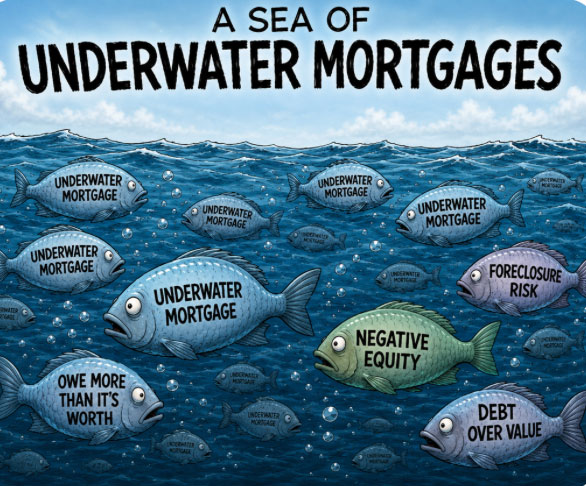
A recent report published by data broker ATTOM indicates a rising trend in seriously underwater mortgages. While this development may not pose significant concerns for most markets, in certain regions it represents one of several factors that may contribute to increased market instability and downward pressure on property prices.
From the Report:
Nationwide, 3.2 percent of mortgaged residential properties were considered seriously underwater in the first quarter of 2026, meaning the combined estimated balances of loans secured by the properties were at least 25 percent more than the properties’ estimated market value. That was up from 3 percent in the previous quarter and 2.8 percent in the first quarter of 2025.
“Homeowner equity remains relatively strong overall, but we’re seeing signs of moderation,” said Rob Barber, CEO at ATTOM. “As mortgage rates have risen and home prices have cooled, the share of equity-rich homes has declined in most markets while the rate of seriously underwater properties is edging up across much of the country.”
The findings indicate that seriously underwater mortgage rates remain low across the U.S., but the first quarter of 2026 showed continued upward movement both quarterly and annually. Nationally, seriously underwater homes accounted for 3.2 percent of mortgaged properties, up from 3 percent in the prior quarter and 2.8 percent a year earlier, while the highest state-level rates were in Louisiana, Kentucky, Mississippi, Oklahoma, and Arkansas.
Top Ten States With Seriously Underwater Mortgages
Percentage of Seriously Underwater Rates by State – Q1 2026
Below is a truncated ranking for the first quarter of 2026, listing the Top Ten states with seriously underwater properties and the top four counties with the highest percentages of seriously underwater homes. ATTOM defines seriously underwater as a loan-to-value ratio of 125 percent or higher, meaning the property owner owes at least 25 percent more than the property’s estimated market value.
1. Louisiana
11.8% seriously underwater, up from 10.7% last quarter and up from 10.5% last year
Counties: Vernon, Webster, Iberville, De Soto
2. Kentucky
8.5% seriously underwater, up from 7.9% last quarter and up from 7.3% last year
Counties: Adair, Pike, Greenup, Hopkins
3. Mississippi
8% seriously underwater, down from 8.3% last quarter and up from 6.6% last year
Counties: Washington, Lauderdale, Tate, Pike
4. Oklahoma
6.6% seriously underwater, up from 5.4% last quarter and up from 5.5% last year
Counties: Okmulgee, Pontotoc, Stephens, Garfield
5. Arkansas
6.4% seriously underwater, up from 5.6% last quarter and up from 5.8% last year
Counties: Columbia, Arkansas, Union, Hot Spring
6. Iowa
6% seriously underwater, up from 5.8% last quarter and up from 5.7% last year
Counties: Lee, Tama, Henry, Black Hawk
7. Kansas
5% seriously underwater, down from 5.3% last quarter and up from 4.7% last year
Counties: Dickinson, Finney, Wyandotte, Johnson
8. Missouri
4.9% seriously underwater, up from 4.6% last quarter and up from 4.7% last year
Counties: Butler, Dunklin, Saint Louis City, Scott
9. Illinois
4.9% seriously underwater, up from 4.7% last quarter and up from 4.8% last year
Counties: Mcdonough, Saline, Mason, Warren
10. West Virginia
4.5% seriously underwater, up from 4.4% last quarter and up from 4.2% last year
Counties: Harrison, Mercer, Wayne, Cabell
ATTOM Home Equity Continues to Decline
ATTOM Underwater Mortgages, State-Level

Tip of the Week: Sign up for 2026 CE
The LOSJ is celebrating five years of exceptional service to the mortgage industry, offering insights you won’t find anywhere else. To celebrate, enjoy our gift to you! Use the promo code “newsletter” when placing your class order.
Expanding your product offerings is an effective way to enhance your business’s vitality. This year, the Loan Officer School is surveying non-Qualified Mortgage (non-QM) financing options. We will review the various types of underwriting required for non-QM financing, including higher-priced mortgage loans (HPML), balloon-payment features, and interest-only options.
Presenting non-QM solutions to consumers improperly can lead to serious consequences. Understand the essentials of compliant and ethical subprime mortgage origination. Attend the Loan Officer School 2026 continuing education classes.
Please use the promo code “newsletter” when you sign up.
Have a Question About Operations, Sales, Marketing, or Compliance? Email Your Questions to the Loan Officer School Journal.
We invite LOSJ readers to submit questions on any topic to the editor. Topics can include compliance, sales, marketing, implementation, and other areas that may be helpful to our customers. If we use your question, we will include only your first name in our response. Please send your questions to: losjmailbag@gmail.com.
Necessary Mailbag Disclosure: The LOSJ is a periodic publication from LoanOfficerSchool.com designed to educate and inform our readers. Please note that we do not provide legal advice, and nothing in the LOSJ should be construed as a legal opinion on specific facts or circumstances. The content serves strictly for informational purposes. We strongly advise readers to consult legal counsel regarding any legal matters or specific questions.