

Why Haven’t Loan Officers Been Told These Facts? What is the Chief Aim of a Mortgage Loan Originator?
A mortgage prospect’s buying process can vary depending on the type of transaction, the product, and the services required. For example, a first-time buyer who contacts mortgage loan officers (MLOs) referred by their real estate agent will have different felt needs than a homeowner seeking a limited cash-out refinance. When exploring mortgage options, many prospective borrowers feel unsure about how to optimize their financing and what steps to take to achieve their goals. During this process, most people come to recognize the importance of having a trusted advisor to guide them. Choosing a trusted advisor requires a buying decision in its own right.
As if moving through a darkened room with outstretched arms, the prospect navigates forward with only vague ideas of what lies ahead. When meeting an MLO for the first time, how does the prospect select the right MLO for the job? The MLO must illuminate the path for the prospect by turning on the lights and establishing the smaller buying decisions necessary to feel confident about selecting the right originator. The applicant is feeling the way forward on two fronts. First and foremost, the prospect must buy the MLO. They won’t hear much about the mortgage solution if they don’t buy the MLO. Second comes the mortgage solution. Loan officers should prioritize buying decisions in a proper order to avoid putting the cart before the horse.
How does the MLO handle getting to know a prospect? Typically, the prospect isn’t an expert in evaluating MLOs. Building trust and rapport is a discussion in itself. In general, an excellent place to begin is for the MLO to listen carefully to what the prospect is saying. Many buyers will tell you what is necessary to move forward if you’re listening. It’s important to remember that what people express verbally or in writing may not fully capture their true thoughts or feelings. For instance, when someone asks, “What is your interest rate?” the question often stems from a lack of discussion alternatives. The prospect doesn’t necessarily know what to say or do to get their needs met. While the interest rate is a significant factor, it’s crucial to understand what lies behind the question. Generally, when asked about the interest rate, the prospect has already created a mental checklist for qualifying the lender. And as many experienced MLOs will tell you, that checklist comprises a single litmus test. The all too common. “What is your interest rate?” What are they really trying to convey? What actual need must the MLO address, and quickly?
Asking the right questions in the appropriate manner can help. Making assumptions about what they need is sometimes necessary but should be a secondary approach. Consider the importance of the prospect feeling respect from the MLO. If the MLO can convey respect successfully, that is always a positive turn. What do most people need to feel respected?
This is a powerful opportunity for MLOs to shine and showcase their skills and professionalism to stakeholders, including prospects and referral partners. When MLOs take the time to understand where a prospect is in the buying journey, they can transform the loan manufacture and closing process into a well-lit, well-managed experience rather than a scramble in the dark, as is so often the case in loan manufacturing.
To create a successful loan experience that delights potential clients, it’s essential to start with the MLO orientation. If the MLO is unsure of their direction, they will struggle to guide the prospect effectively. Without a clear path or even knowing that a path exists, the MLO’s efforts to illuminate the process for the client will feel random, unhelpful, and, at the bottom of it, unprofessional. Unless the MLO gets lucky, this approach may fail to provide what is needed to help both the buyer and the MLO achieve their goals.
Too often, the MLO comes across as trying to sell the prospect. The failure to understand what needs to be bought leads to misalignment between the MLO and the prospect. While this misalignment can work at times—since the needs of many prospects in similar transactions are generally predictable—it largely relies on the MLO making significant, unnecessary assumptions about each prospect. This practice typically lacks a consistent methodology. Just as a broken clock is right occasionally, the MLO may experience varying degrees of success using this method.
A more effective approach is to validate assumptions about what will delight the prospect by discussing them with the prospect before offering specific solutions. This step ensures that the MLO starts on the right foot, showing clear respect and concern for the prospect. When the prospect feels respected, heard, and understood, the MLO is well on their way to making a strong initial impression.
The “Big D-Deliverable” is often seen by MLOs as simply completing the Uniform Residential Loan Application (URLA) or obtaining the required deposits. This mindset misses the bigger picture and will lead to falling short of the real goal. The idea of the Big D stays the same no matter what the transaction looks like; it doesn’t depend on the type of deal, the prospects’ personality, or any other details. In the end, the Big D isn’t about completing the URLA, collecting deposits, or even funding and closing the transaction.
What’s truly powerful is that the “Big D” is equally important to both the MLO and the prospect. Embracing and clearly expressing this shared vision is the first step in understanding where the prospect is in their journey and how to help them reach their desired destination. What is the Big D? The “Big D” represents the prospect’s complete satisfaction, or more accurately, their delight with your services.
You might wonder, “Isn’t the prospect concerned with more substantial issues than whether the loan officer did a good job?” Not really. If you get that right, everything else will fall into place. The MLO must own this concern. Good things follow.
Numerous smaller decisions come into play before the prospect fully buys into the MLO and their value proposition. It’s important to note that there are multiple buying decisions, not just one. The MLO must know what these are, as they will vary in degree from prospect to prospect. Several steps take place before finalizing the sale. Fortunately for MLOs, there is a recognizable sequence and process that leads to achieving the Big D.
Understanding that a path exists to succeed with a prospect is the starting point. Does this work 100% of the time? Of course not. Ted Williams, arguably the greatest batter of all time, garnered a .344 lifetime average. Patience, sound mechanics, and developing a good eye for your prospects’ needs are essential for MLO success. Understanding that your success is tied to your customers’ success is key. Discover your prospect’s success story.
BEHIND THE SCENES:
21st CENTURY ROAD TO HOUSING ACT
In today’s era of partisan politics, what does it signify when a bill passes through Congress with a House vote of 390-9 and a Senate vote of 89-10? It could indicate either that the bill is an exceptional piece of legislation or, more often than not, a mix of political payoffs and posturing.
At first glance, the law may not seem particularly exciting unless you are a real estate developer or builder. It encourages better zoning practices that aim to expand available land for housing units and increase housing density, but it does not mandate them.
The law attacks the housing affordability problem for both renters and homebuyers. Much of the legislation focuses on cutting red tape for developers using federal funds for housing.
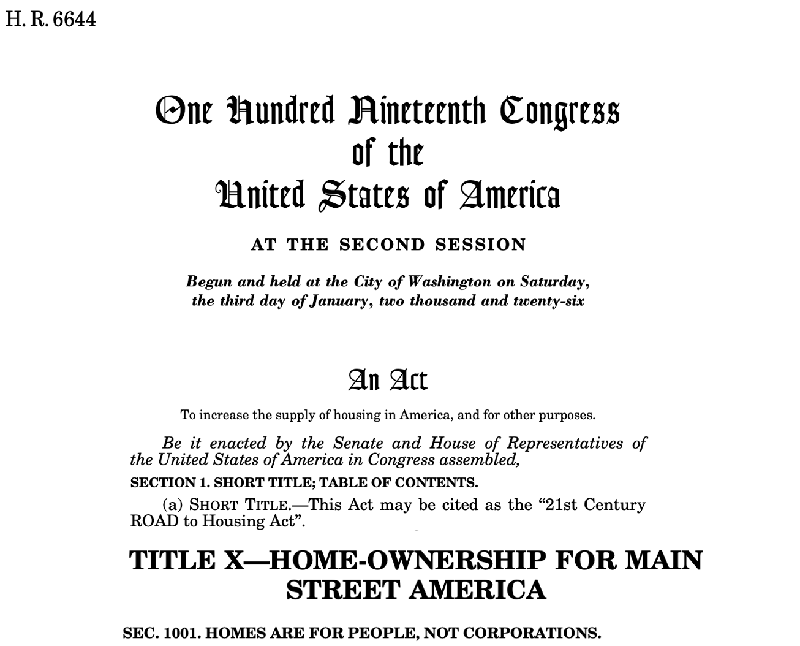
For years, stakeholders have complained about homebuyers competing with professional real estate investors for everything from entry-level housing to luxury homes. Title X of the Act addresses this issue in a somewhat half-hearted fashion, allowing for substantive exceptions. The law applies to 1- and 2-unit properties. Smaller real estate investors with fewer than 350 units are exempt. So don’t hope for an immediate end to the flipping reality TV shows.
The law does not require large institutional investors to divest holdings acquired before the Act’s effective date.
SEC. 1001. HOMES ARE FOR PEOPLE, NOT CORPORATIONS.
PROHIBITION ON PURCHASES BY LARGE INSTITUTIONAL INVES-
TORS.
(1) IN GENERAL.—No large institutional investor may purchase, or enter into a contract to directly or indirectly purchase, any single-family home.
Title X includes excessive exemptions and loopholes that will allow major real estate investors to continue reducing the housing stock available for purchase, thereby driving up housing costs, making the American Dream less tenable for entry-level buyers. If Congress were serious about making housing more affordable, they would tighten these loopholes and lower the threshold from 350 units to around 10 units. It’s essential to push larger investors out of the entry-level housing market. If public outrage over the housing crisis intensifies, we may see Title X amendments and restrictive regulations.
Lawmakers often use a strategy known as incremental legislation or incrementalism, in which, instead of attempting to pass legislation aimed at achieving an ultimate goal, they make small adjustments that lay the foundation for more significant changes over time.
Stay tuned.

Tip of the Week: Sign up for 2026 CE
The LOSJ is celebrating five years of exceptional service to the mortgage industry, offering insights you won’t find anywhere else. To celebrate, enjoy our gift to you! Use the promo code “newsletter” when placing your class order.
Expanding your product offerings is an effective way to enhance your business’s vitality. This year, the Loan Officer School is surveying non-Qualified Mortgage (non-QM) financing options. We will review the various types of underwriting required for non-QM financing, including higher-priced mortgage loans (HPML), balloon-payment features, and interest-only options.
Presenting non-QM solutions to consumers improperly can lead to serious consequences. Understand the essentials of compliant and ethical subprime mortgage origination. Attend the Loan Officer School 2026 continuing education classes.
Please use the promo code “newsletter” when you sign up.
Have a Question About Operations, Sales, Marketing, or Compliance? Email Your Questions to the Loan Officer School Journal.
We invite LOSJ readers to submit questions on any topic to the editor. Topics can include compliance, sales, marketing, implementation, and other areas that may be helpful to our customers. If we use your question, we will include only your first name in our response. Please send your questions to: losjmailbag@gmail.com.
Necessary Mailbag Disclosure: The LOSJ is a periodic publication from LoanOfficerSchool.com designed to educate and inform our readers. Please note that we do not provide legal advice, and nothing in the LOSJ should be construed as a legal opinion on specific facts or circumstances. The content serves strictly for informational purposes. We strongly advise readers to consult legal counsel regarding any legal matters or specific questions.