
Why Haven’t Loan Officers Been Told These Facts? Private Action: Understated Escrows
Part I
The Loan Officer School Journal provides examples of enforcement actions for informational purposes only. The veracity of the complainant’s allegations is unknown, and such allegations should in no way be construed as legal facts. LoanOfficerSchool.com does not intend to imply that the Complainee has violated any laws or ethical boundaries, nor does it suggest that the Complainant possesses evidence of misconduct by the Complainee.
Last year, the LOSJ wrote about a class action lawsuit filed in Florida against the nation’s largest homebuilder, D.R. Horton, and its mortgage company subsidiary, DHI Mortgage. “The lawsuit alleges that D.R. Horton targets prospective homeowners by promising low, affordable monthly payments, and then works with DHI Mortgage to suppress the actual cost of the home by illegally excluding the majority of required property taxes from the initial monthly payment.” -Statement from Plaintiff’s counsel
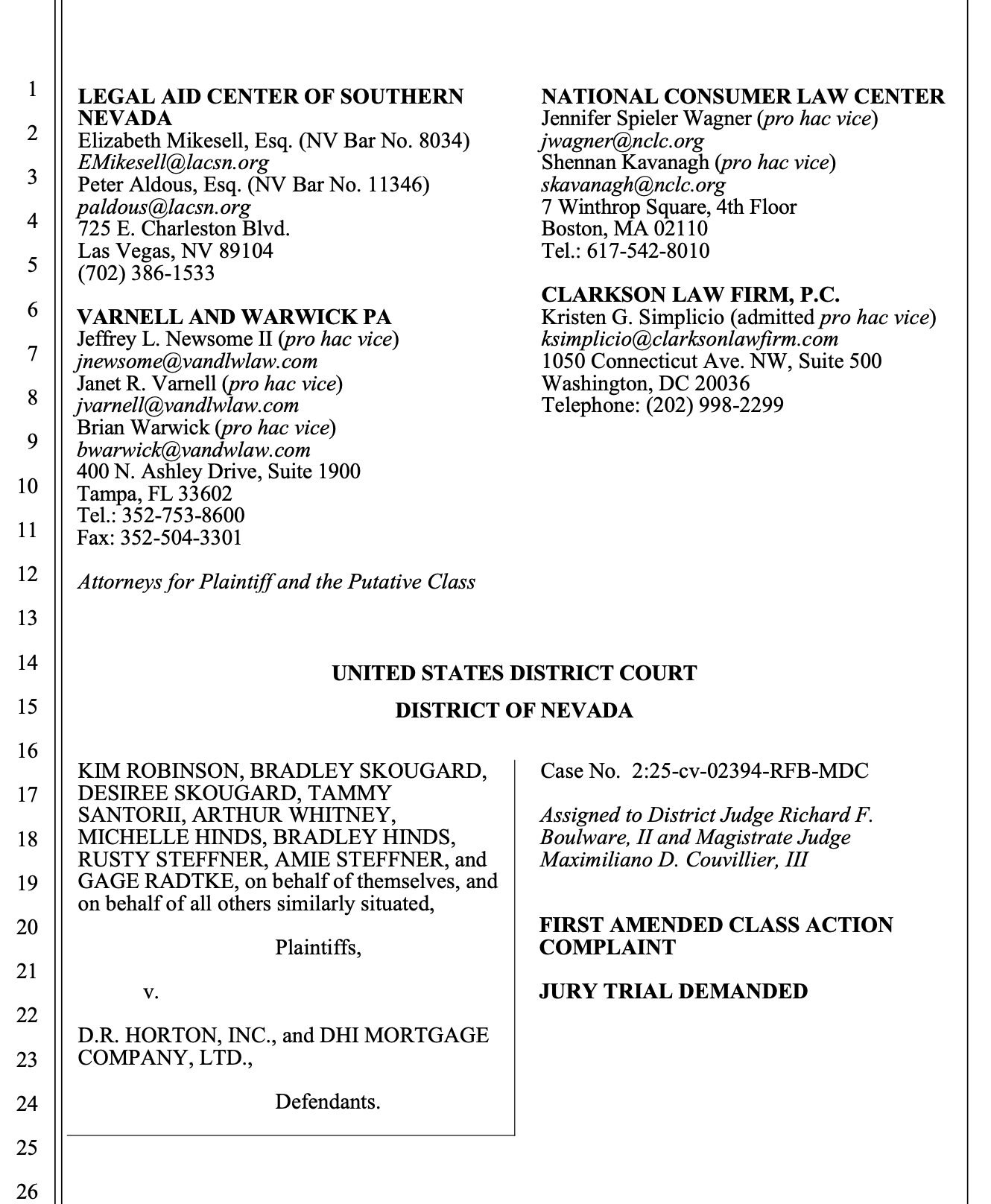
“On December 4, 2025, this case was voluntarily dismissed. A new case, Robinson v. D.R. Horton, has been filed in the District of Nevada pursuing similar claims for a broader group of homeowners who were harmed by the Defendants’ conduct nationwide.” – Announcement from Plaintiff’s counsel
The plaintiff’s strategy in withdrawing the Florida complaint is unknown. Not long after dropping the matter in Florida, the plaintiffs filed a similar complaint in Nevada. Like the Florida complaint, the plaintiffs’ Nevada filing includes allegations of violations of Nevada’s consumer protection law, the Nevada Deceptive Trade Practices Act, which is similar to the FTC Act’s Section 5 prohibitions against unfair or deceptive acts and practices.
Santiago v D.R. Horton and DHI Mortgage Company, Ltd., 6:25-cv-01904 (M.D. Fla.)
“This class action lawsuit seeks relief from a deceptive home-selling and financing scheme employed by D.R. Horton Inc., the nation’s largest homebuilding company, and its mortgage lending subsidiary, DHI Mortgage Co. The lawsuit alleges that D.R. Horton targets prospective homeowners by promising low, affordable monthly payments, and then works with DHI Mortgage to suppress the actual cost of the home by illegally excluding the majority of required property taxes from the initial monthly payment. Months later, payments skyrocket – often by hundreds of dollars – when a new mortgage servicer recalculates the payment to include the full amount of taxes.”
The lawsuit alleges various violations of state and federal laws, including the Truth in Lending Act (TILA), the Real Estate Settlement Procedures Act (RESPA), FHA and VA regulations, the RICO Act, and consumer protection laws in Florida and Nevada.
New Construction: Property Tax Escrows
Escrows for new construction can be complex. Different tax jurisdictions have disparate rules and methods for assessing newly improved properties. For enterprises like D.R. Horton and its subsidiary mortgage company, creating a consistent and comprehensive policy for establishing and disclosing property taxes under the TRID framework has its challenges.
Property Tax Escrow Governance: Law, Investor and Insurer Requirements
The TRID framework derives chiefly from two federal consumer protection laws, the TILA and RESPA. Escrow administration is governed by RESPA and Regulation X. Escrow disclosure is governed by TILA, RESPA, and the implementing Regulations Z and X. Additionally, government guarantors, such as the FHA and VA, under the Federal Code of Regulations, may impose additional escrow and disclosure requirements for government-insured loans.
The issue at hand concerns allegedly inaccurate housing cost estimates, particularly the underestimation of property taxes. This situation has led to borrower payment shock and associated negative consequences. At its core, the case raises questions about the originating lender’s legal obligations to furnish timely and accurate information that enables prospective homebuyers to make informed assessments of the financing options presented. The plaintiff’s allegation that the builder colluded with its mortgage subsidiary to intentionally misrepresent the transaction’s housing costs by understating property taxes is difficult to believe. One would expect that, of all persons, the most prolific builder in the country would understand and carefully adhere to federal and local laws regarding escrows and disclosure. In the upcoming weeks, the LOSJ will examine some of these claims in greater detail.
The 30,000 Foot View: Federal Disclosure Law
Congress mandated that the CFPB create disclosures to simplify the required RESPA and TILA disclosures (15 U.S.C. § 1604)
TILA Disclosure Requirements
The Bureau shall publish a single, integrated disclosure for mortgage loan transactions (including real estate settlement cost statements) which includes the [TILA] disclosure requirements in conjunction with the disclosure requirements of the RESPA that, taken together, may apply to a transaction that is subject to both or either provisions of law. The purpose of such model disclosure shall be to . . . aid the borrower in understanding the transaction by utilizing readily understandable language to simplify the technical nature of the disclosures.
The 30,000 Foot View: Federal Escrow Law
RESPA, 12 U.S.C. §2609. Limitation on requirement of advance deposits in escrow accounts
a) In general, a lender, in connection with a federally related mortgage loan, may not require the borrower or prospective borrower to deposit in any such escrow account in any month beginning with the first full installment payment under the mortgage a sum (for the purpose of assuring payment of taxes, insurance premiums and other charges with respect to the property) in excess of the sum of (A) one-twelfth of the total amount of the estimated taxes, insurance premiums and other charges which are reasonably anticipated to be paid on dates during the ensuing twelve months which dates are in accordance with the normal lending practice of the lender and local custom, provided that the selection of each such date constitutes prudent lending practice, plus (B) such amount as is necessary to maintain an additional balance in such escrow account not to exceed one-sixth of the estimated total amount of such taxes, insurance premiums and other charges to be paid on dates, as provided above, during the ensuing twelve-month period: Provided, however, That in the event the lender determines there will be or is a deficiency he shall not be prohibited from requiring additional monthly deposits in such escrow account to avoid or eliminate such deficiency.
Regulation X, 12 CFR § 1024.17(c)(7)
Servicer estimates of disbursement amounts.
To conduct an escrow account analysis, the servicer shall estimate the amount of escrow account items to be disbursed. If the servicer knows the charge for an escrow item in the next computation year, then the servicer shall use that amount in estimating disbursement amounts. If the charge is unknown to the servicer, the servicer may base the estimate on the preceding year’s charge, or the preceding year’s charge as modified by an amount not exceeding the most recent year’s change in the national Consumer Price Index for all urban consumers (CPI, all items). In cases of unassessed new construction, the servicer may base an estimate on the assessment of comparable residential property in the market area.
§ 1024.17(c)(1)(i) Escrow accounts.
Charges at settlement or upon creation of an escrow account.
At the time a servicer creates an escrow account for a borrower, the servicer may charge the borrower an amount sufficient to pay the charges respecting the mortgaged property, such as taxes and insurance, which are attributable to the period from the date such payment(s) were last paid until the initial payment date.
What do Government Insurers Say?
FHA and VA defer to federal law, specifically RESPA, regarding property tax escrows.
What Do the GSE’s Say?
In determining the housing costs for qualification, the guides are explicit.
FNMA B3-6-03, Monthly Housing Expense for the Subject Property (12/16/2020)
Calculating Monthly Real Estate Tax Payment
The lender must base its calculation of real estate taxes for borrower qualification on no less than the current assessed value. However, the lender must project the real estate taxes if one of the following applies:
For purchase and construction-related transactions, the lender must use a reasonable estimate of the real estate taxes based on the value of the land and the total of all new and existing improvements. This policy also applies to properties in jurisdictions where a transfer of ownership typically results in a reassessment or revaluation of the property and a corresponding increase in the amount of taxes.
FHLMC 5401.1 Monthly housing expense-to-income ratio Effective 05/06/2026
Establishing the monthly housing expense for Mortgages secured by Primary Residences
For Mortgages secured by a Primary Residence, the following expenses must be included in the calculation of the monthly housing expense-to-income ratio:
- Principal and interest payments on the Mortgage
- Property hazard insurance premiums
- Real estate taxes
- New construction: When the actual real estate tax amount is not yet available, the real estate tax amount included in the monthly housing expense must be based on the value of the improvements and the land.
In Determining Escrows
From the FNMA Announcement SEL 2020-02:
On Dec. 4, 2019, we announced changes to the calculation of property taxes as a component of monthly housing expense for qualifying and escrow account purposes. In Feb. 2020, we suspended applicability of the Dec. changes due to issues raised by our lenders.
This update is to notify you that after further review, we have removed the prior policy update that would have required the use of estimated property taxes for the establishment of the escrow account, and replaced it with a requirement that lenders comply with applicable law and regulations. We have retained the prior clarifications that a reasonable estimate of property taxes based on the value of the land and all new and existing improvements must be used for purchase and construction-related transactions, including jurisdictions where a transfer of ownership typically results in a reassessment of property taxes.
Originating Lenders Between a Rock and a Hard Spot
The RESPA and TILA have distinct yet overlapping objectives. RESPA Section 10 governs the management of mortgage escrow accounts. In the past, it was common for lenders to overcollect escrow amounts, which served as a cushion against potential shortfalls in escrow distributions. Escrow shortages are significant threats to a borrower’s financial well-being, as such shortfalls can jeopardize a borrower’s ability to comply with their loan agreements or otherwise manage their finances. RESPA strictly limits the methods lenders can use to determine the appropriate amounts to collect for property taxes and other escrowed items. Failure to comply with these limitations can result in severe sanctions imposed by the federal government on lenders or servicers.
In contrast, TILA primarily aims to protect consumers from the uninformed use of credit. The Dodd-Frank Act amended TILA to include Ability-to-Repay (ATR) provisions, which protect against a borrower’s inability to repay or lack of capacity to repay the proposed financing at the time of consummation.
While RESPA and TILA both intend to protect consumers from harm, their effects diverge and can at times conflict regarding escrow account management. A common grievance among borrowers, as highlighted in the lawsuit, is “payment shock,” which results from inadequate property tax collection. Some stakeholders may be inclined to blame RESPA requirements for many instances of escrow-related payment shock.
Understated Escrows Part II Next Week
BEHIND THE SCENES: FORECLOSURES RISING, CREATING CONCERNS IN SOME MARKETS WHILE CONSIDERED A RETURN TO NORMAL IN OTHERS
IRVINE, Calif. — July 16, 2026
ATTOM, the leading provider of property data, AI-powered intelligence, and real estate analytics solutions, today released its Mid-Year 2026 U.S. Foreclosure Market Report, which shows there were a total of 227,548 U.S. properties with foreclosure filings— default notices, scheduled auctions or bank repossessions — in the first six months of 2026. That figure is up 21 percent from the same time period a year ago and up 28 percent from the same time period two years ago.
“Foreclosure activity continued to increase in the first half of 2026, but the broader picture remains one of a market that is gradually returning to more typical patterns,” said Rob Barber, CEO at ATTOM. “The combination of rising foreclosure starts, increased foreclosure completions, and shorter timelines points to a continued normalization of the foreclosure process, although the increases also suggest that some homeowners may be facing greater financial strain than they were a year ago.”
Among states with at least 500 foreclosure filings in the first half of 2026, the largest year-over-year increases in foreclosure activity were recorded in Idaho (up 59 percent), Colorado (up 57 percent), Georgia (up 52 percent), North Carolina (up 47 percent), and Mississippi (up 45 percent).
Worst Foreclosure Rates: Florida, South Carolina, and Indiana
Nationwide, 0.16 percent of all housing units (one in every 632) had a foreclosure filing in the first half of 2026.
States with the worst foreclosure rates in the first half of 2026 were Florida (0.27 percent of housing units with a foreclosure filing); South Carolina (0.26 percent); Indiana (0.25 percent); Delaware (0.25 percent); and Illinois (0.23 percent).
Other states with first-half foreclosure rates among the 10 worst nationwide were Nevada (0.22 percent); New Jersey (0.22 percent); Ohio (0.20 percent); Maryland (0.19 percent); and Utah (0.19 percent).
Worst Metro Foreclosure Rates: Punta Gorda, Lakeland, and Columbia Post
Among the 227 metropolitan statistical areas with a population of at least 200,000, those with the worst foreclosure rates in the first half of 2026 were Punta Gorda, FL (0.50 percent of housing units with foreclosure filings); Lakeland, FL (0.48 percent); Columbia, SC (0.43 percent); Macon, GA (0.36 percent); and Fayetteville, NC (0.36 percent).
Other major metro areas with foreclosure rates ranking among the top 10 worst in the first half of 2026 were Cape Coral, FL (0.35 percent of housing units with a foreclosure filing); Cleveland, OH (0.33 percent); Jacksonville, FL (0.31 percent); Ocala, FL (0.31 percent); and Jacksonville, NC (0.31 percent).
Foreclosure Starts Up 18 Percent Annually
A total of 164,566 U.S. properties started the foreclosure process in the first six months of 2026, up 18 percent from the first half of last year and up 66 percent from the first half of 2020.
States that saw the greatest number of foreclosure starts in the first half of 2026 included Texas (20,739 foreclosure starts); Florida (20,358 foreclosure starts); California (16,040 foreclosure starts); Georgia (8,164 foreclosure starts); and Illinois (7,424 foreclosure starts).
First Half of 2026: Bank Repossessions Up From Year Ago
Lenders foreclosed (REO) on a total of 27,983 U.S. properties in the first six months of 2026, up 33 percent from the first half of 2025 but down 26 percent from the first half of 2020.
States that posted the greatest number of REOs in the first half of 2026 included Texas (3,322 REOs); California (2,644 REOs); Florida (2,070 REOs); Pennsylvania (1,893 REOs); and Illinois (1,543 REOs).
Average Foreclosure Timelines Continue to Shorten
Properties foreclosed in Q2 2026 had been in the foreclosure process for an average of 563 days, the lowest level since 2013. That figure was down 2 percent from the previous quarter and down 13 percent from a year ago.
States with the longest average foreclosure timelines for homes foreclosed in Q2 2026 were Louisiana (3,491 days); Hawaii (2,293 days); New York (2,007 days); Connecticut (1,626 days); and Nevada (1,507 days).
States with the shortest average foreclosure timelines for homes foreclosed in Q2 2026 were Texas (155 days); New Hampshire (157 days); Wyoming (173 days); West Virginia (196 days); and Alaska (199 days).
Worst Foreclosure Rates in Q2 2026: South Carolina, Florida and Delaware
There were a total of 115,714 U.S. properties with a foreclosure filing during the second quarter of 2026, down 3 percent from the previous quarter but up 15 percent from a year ago.
Nationwide one in every 1,242 housing units had a foreclosure filing in Q2 2026. States with the worst foreclosure rates were South Carolina (one in every 723 housing units with a foreclosure filing); Florida (one in every 726 housing units); Delaware (one in every 805 housing units); Indiana (one in every 839 housing units); and Nevada (one in every 871 housing units).
Among 110 metropolitan statistical areas with a population of at least 500,000, those with the worst foreclosure rates in Q2 2026 were Lakeland, FL (one in every 421 housing units with a foreclosure filing); Columbia, SC (one in every 463 housing units); Cape Coral, FL (one in every 512 housing units); Bakersfield, California (one in every 616 housing units); and Jacksonville, FL (one in every 635 housing units).

Tip of the Week: Sign up for 2026 CE
The LOSJ is celebrating five years of exceptional service to the mortgage industry, offering insights you won’t find anywhere else. To celebrate, enjoy our gift to you! Use the promo code “newsletter” when placing your class order.
Expanding your product offerings is an effective way to enhance your business’s vitality. This year, the Loan Officer School is surveying non-Qualified Mortgage (non-QM) financing options. We will review the various types of underwriting required for non-QM financing, including higher-priced mortgage loans (HPML), balloon-payment features, and interest-only options.
Presenting non-QM solutions to consumers improperly can lead to serious consequences. Understand the essentials of compliant and ethical subprime mortgage origination. Attend the Loan Officer School 2026 continuing education classes.
Please use the promo code “newsletter” when you sign up.
Have a Question About Operations, Sales, Marketing, or Compliance? Email Your Questions to the Loan Officer School Journal.
We invite LOSJ readers to submit questions on any topic to the editor. Topics can include compliance, sales, marketing, implementation, and other areas that may be helpful to our customers. If we use your question, we will include only your first name in our response. Please send your questions to: losjmailbag@gmail.com.
Necessary Mailbag Disclosure: The LOSJ is a periodic publication from LoanOfficerSchool.com designed to educate and inform our readers. Please note that we do not provide legal advice, and nothing in the LOSJ should be construed as a legal opinion on specific facts or circumstances. The content serves strictly for informational purposes. We strongly advise readers to consult legal counsel regarding any legal matters or specific questions.