
Why Haven’t Loan Officers Been Told These Facts? A Loan Industry Mired in Outdated Mortgage Laws
It is no surprise that, after the fiasco that was the mortgage industry leading to the subprime meltdown and ensuing Great Recession, our federal overlords vowed this would never happen again. Voilà, Dodd-Frank.
However, in retrospect, the federal evisceration of the subprime loan market may have been an overreaction. Where a scalpel was required, the feds used a sledgehammer. The result was the proverbial tossing the baby out with the bathwater. Case in point: Was it necessary to eliminate no-income-verification (NIV) loan manufacturing?
When limited-documentation mortgages emerged in the early 1980s, the product was designed to accommodate financially stronger prospects who could not readily document sufficient stable income to qualify for mortgage financing. In many cases, there is a sound argument for using two years’ tax returns to establish an applicant’s income stability and capacity to repay. In other instances, this is inappropriate and unnecessary.
U.S. tax code is structured to encourage certain financial behaviors. For many taxpayers, wealth planning is not what you earn but what you may keep, which shapes their tax planning. Tax strategies can get very complicated. Most residential lenders and their employees aren’t qualified to interpret a balance sheet, let alone assess complex returns, financial statements, or a business’s viability.
Beyond lenders’ inability to assess income viability, not all borrowers need a lender to determine how much they can repay; for some borrowers, the idea seems somewhat absurd. While expert judgment and guidance can be valuable—especially for first-time buyers, who may find the costs of homeownership unclear—many consumers manage these uncertainties without professional assistance. It’s as though you need an expert to demonstrate how to tie shoelaces these days. Homeownership involves both known and unknown expenses, and expert guidance can help navigate these complexities, especially in financial management. However, seasoned buyers with strong mortgage applications generally don’t need these safeguards.
Current laws and regulations could use some adjustments. For instance, a first-time buyer who is living paycheck to paycheck can qualify for financing that many responsible buyers would avoid. For example, borrowers with moderate income, a debt-to-income (DTI) ratio of 45-50%, and little or no reserves are common and lawful transactions. Without subsidized risk transfer, these loans would not meet private lenders’ acceptable risk levels. In contrast, a self-employed borrower who puts down 25% and has 36 months’ worth of ready reserves often faces an intrusive and often inaccurate assessment of their ability to repay. Which is the stronger borrower? Which borrower can better self-assess their financing limits? Without fail, the latter.
Show Me the Money
The wooden application of 20th-century affordability tests not only bars qualified applicants from homeownership opportunities, but also artificially inflates financing costs for well-qualified borrowers. By raising compliance risk for lenders, the government raises costs for borrowers who don’t fit archaic credit molds.
The first iteration of NIV was similar to today’s bank statement loans. However, instead of using shaky assessment formulas (arbitrary cash-flow discounts) to extrapolate stable monthly income, borrowers with outstanding credit records who put at least 25% down didn’t need to provide tax returns or establish income from source documents. Instead, if the applicant could show they had a large down payment from acceptable sources, the money talked. Lenders verified the 25% down payment from acceptable sources much like today. The principle behind this lending philosophy was that most people accumulating 25% down payments demonstrated financial acumen sufficient to convince the lender of their repayment capacity.
The Poorly Designed Regulation Z “Seasoned-QM” Rule
For subprime or non-QM transactions, Regulation Z, Section 1026.43(e)(7)(i)(A) provides that for a covered transaction to become a qualified mortgage as a seasoned loan, a mortgage must meet certain product requirements and be a fixed-rate mortgage with fully amortizing payments. Only loans whose scheduled periodic payments do not require a balloon payment can become seasoned loans.
To be a qualified mortgage under the seasoned-QM rule, the covered transaction must have no more than two delinquencies of 30 or more days and no delinquencies of 60 or more days at the end of the seasoning period. That is an unreasonable standard for establishing ATR over 36 months. FNMA considers an “excessive prior mortgage delinquency is defined as any mortgage tradeline that has one or more 60-, 90-, 120-, or 150-day delinquency reported within the 12 months prior to the credit report date.” What’s sauce for the goose is sauce for the gander.
For a covered transaction to become a seasoned QM, a creditor generally must hold the transaction in portfolio until the end of the seasoning period. The seasoning period measures loan performance for 36 months starting with the first payment due after consummation. The loan must otherwise meet all QM requirements, such as the point and fee test.
Why This Rule Does Nothing Good For Consumers
Disallowing loan sales during the seasoning period, thereby rendering the loan illiquid, makes this type of loan less attractive for most mortgage enterprises to originate. Furthermore, the interest-rate risk tied to a long-term fixed rate would require a substantial upfront premium, or a relatively high interest rate, making the financing much more expensive for the borrower than, say, a seven-year balloon or ARM.
If the federal government wants to lower housing costs, it must broaden the market for this type of loan. The risk of noncompliance with ATR requirements stifles greater market participation. A few simple tweaks would vastly expand market participation in non-QM lending.
– Reduce the seasoning period from 36 months to between 12 and 24 months.
– Align loan performance stipulations with FNMA credit policy requirements.
– Eliminate the portfolio retention requirement.
– Allow for terms of 7 to 40 years and balloon payments after 7 years.
– Allow for hybrid-ARM financing.
Depending on the servicing portfolio, reserve requirements can readily mitigate several types of early defaults or seriously late payments. Many of these early performance issues result exclusively from a lack of reserves.
Booth Business School Article
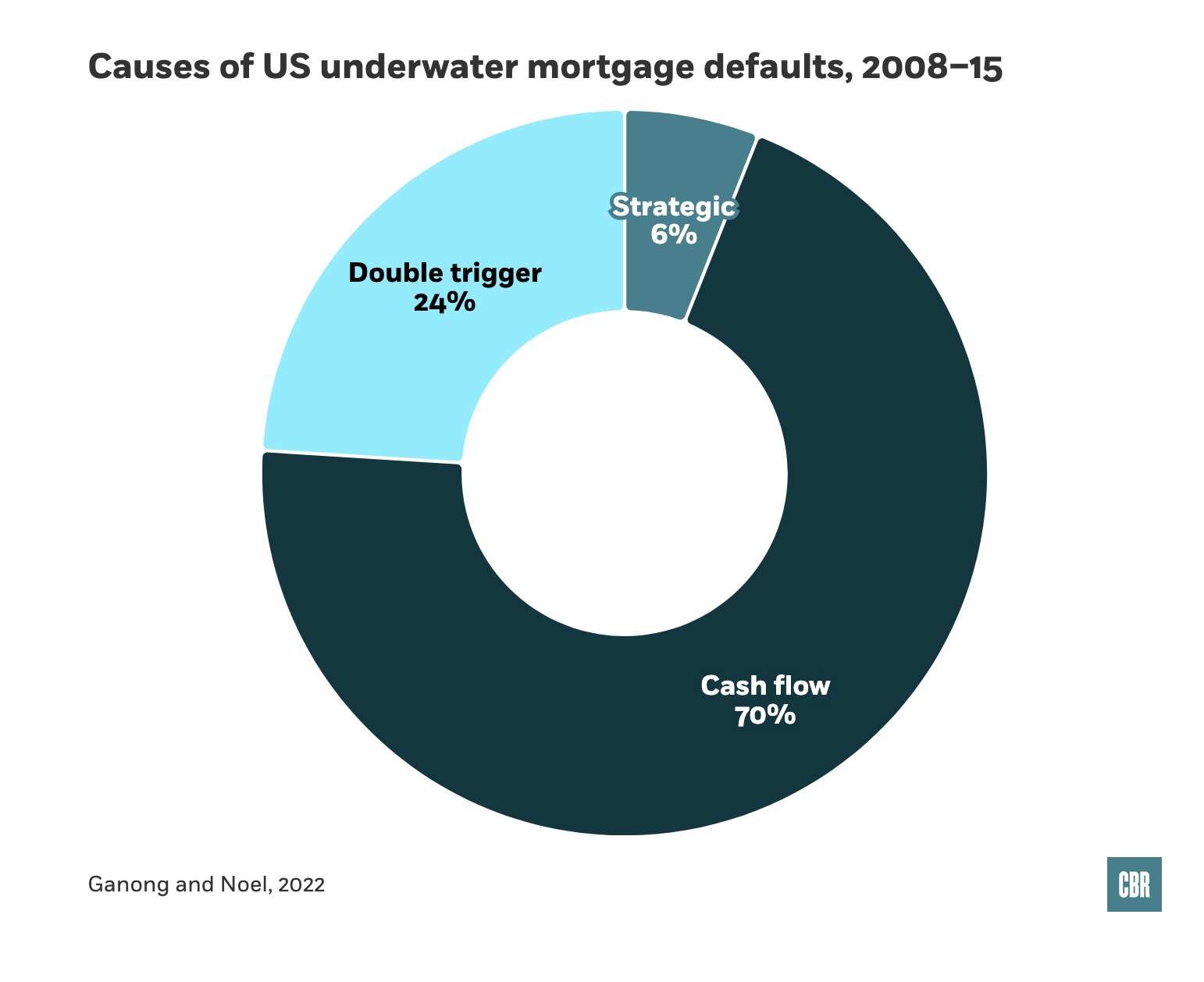
Researchers cited in a recent University of Chicago Booth School of Business article identify cash-flow issues from negative life experiences as the primary driver of serious mortgage lates and defaults. What fixes temporary cash-flow problems? Reserves.
The article states what is axiomatic to a degree: “By their calculations, 94 percent of the defaults can be explained by negative life events. This suggests cash flow plays a far bigger role in people losing their homes than previously thought. Economists have three main theories as to why people default on home loans.
– There’s cash-flow default, triggered by a life event such as the homeowner losing a job and no longer being able to afford the monthly payment.
– Then there’s strategic default, which is a function of the house’s value, not the borrower’s financial situation.
– The third theory is a double-trigger default, a combination of the two.”
Incremental Changes are Appropriate
For non-first-time buyers putting down 25% or more with at least 12 months’ reserves, why worry about cash-flow analysis? Prospects with this much cash have already demonstrated their ability to repay through cash accumulation.
The mass defaults of the Great Recession constituted a perfect storm of credit foolishness. It’s time to reevaluate mortgage credit and develop better data-driven solutions.
Booth Article
BEHIND THE SCENES: STATE ENFORCEMENT OF FEDERAL LAW
Last year, the LOSJ commented on the CFPB’s burgeoning deregulatory efforts. Regulation and deregulation are nothing new; they have shaped federal mortgage industry regulation for over 40 years. However, the atmosphere in 2026 differs from past deregulatory cycles. Increasingly divergent federal and state interests have led many states to ramp up their legislation and rulemaking in response to the federal government’s relinquishment of its historic fair lending enforcement role. This could be problematic for compliance. Lenders with national footprints must navigate a patchwork of state laws, prompting responses that may not align with states’ intent.
Last year, California’s Senate Bill 825 (SB 825) granted the California Department of Financial Protection and Innovation (DFPI) the authority to enforce state consumer financial protection laws on the entities it currently regulates. This includes state banks, state credit unions, independent mortgage companies, nonbank lenders, and payment service providers. Under the California Consumer Financial Protection Law (CCFPL), it is illegal for any covered person or service provider, as defined by the law, to engage in deceptive or abusive acts or practices related to consumer financial products or services.
The law mirrors Dodd-Frank Title X, making it unlawful for a covered person or service provider, to the extent not preempted by federal law, to engage, have engaged, or propose to engage in any unlawful, unfair, deceptive, or abusive act or practice with respect to consumer financial products or services. Furthermore, the law prohibits offering consumers financial products or services that do not conform to enumerated federal consumer financial protection law.
A covered person that offers or provides to a consumer any financial product or service not in conformity with any consumer financial law or otherwise commits any act or omission in violation of a consumer financial law violates the California law. Additionally, any person who knowingly or recklessly provides substantial assistance to a covered person or service provider that violates the CCFPL 90003(a) UDAAP prohibitions may also violate the law to the same extent as the perpetrator. This could make wholesale providers to third-party California originators squeamish.
New York State also stepped up its primary consumer protection laws. Reflecting the abuse provisions of 12 USC 5531(d), the FAIR Act amendment adds an “abusive act or practice” as one that materially interferes with a person’s ability to understand the terms of a transaction or takes unreasonable advantage of persons’ 1) Lack of understanding of the material risks, costs or conditions of a product or service, 2) Inability to protect their interests in selecting a product or service, or 3) Reasonable reliance on a business to act in their best interests.
Restoring Equality of Opportunity and Meritocracy
Mortgage deregulation began in earnest last year. As part of the federal government’s ongoing deregulation efforts, on May 12, 2025, the Consumer Financial Protection Bureau (CFPB) withdrew 67 distinct policy statements, interpretive rules, and other forms of guidance affecting financial services, including the mortgage industry. The CFPB states, “The Bureau intends to continue reviewing all guidance documents to determine whether they should ultimately be retained. However, the Bureau has determined that the guidance identified in section III should not be enforced or otherwise relied upon by the Bureau while this review is ongoing.
To date, as far as has been publicly broadcast, the CFPB has not retained any of its prior guidance documents, leaving stakeholders wondering whether this is a semi-permanent state of affairs. Semi-permanent, at least until the changing of the guard. Because of this uncertainty, many stakeholders continue to operate as though the pre-2025 CFPB rules are still in place. Meanwhile, states continue to ramp up enforcement activities while the CFPB and other federal regulators nap.

Tip of the Week: Sign up for 2026 CE
The LOSJ is celebrating five years of exceptional service to the mortgage industry, offering insights you won’t find anywhere else. To celebrate, enjoy our gift to you! Use the promo code “newsletter” when placing your class order.
Expanding your product offerings is an effective way to enhance your business’s vitality. This year, the Loan Officer School is surveying non-Qualified Mortgage (non-QM) financing options. We will review the various types of underwriting required for non-QM financing, including higher-priced mortgage loans (HPML), balloon-payment features, and interest-only options.
Presenting non-QM solutions to consumers improperly can lead to serious consequences. Understand the essentials of compliant and ethical subprime mortgage origination. Attend the Loan Officer School 2026 continuing education classes.
Please use the promo code “newsletter” when you sign up.
Have a Question About Operations, Sales, Marketing, or Compliance? Email Your Questions to the Loan Officer School Journal.
We invite LOSJ readers to submit questions on any topic to the editor. Topics can include compliance, sales, marketing, implementation, and other areas that may be helpful to our customers. If we use your question, we will include only your first name in our response. Please send your questions to: losjmailbag@gmail.com.
Necessary Mailbag Disclosure: The LOSJ is a periodic publication from LoanOfficerSchool.com designed to educate and inform our readers. Please note that we do not provide legal advice, and nothing in the LOSJ should be construed as a legal opinion on specific facts or circumstances. The content serves strictly for informational purposes. We strongly advise readers to consult legal counsel regarding any legal matters or specific questions.