
Why Haven’t Loan Officers Been Told These Facts? Privacy Laws: How to Get in Front of Difficult Situations
Most Mortgage Loan Officers (MLOs) have faced the uncomfortable challenge of responding to legitimate inquiries or concerns from the seller’s agent about applications in process. Things can get tense and out of hand quickly. Discussing an application with a listing agent is a slippery slope. Not knowing if you have violated the law, the buyer’s privacy, or your referral partners’ trust can have damaging consequences.
For those unfamiliar with the privacy laws governing loan applications, not knowing what information can be shared—or how to handle the situation—can put the MLO and their sponsor in a difficult position. Beyond privacy laws that regulate the disclosure of consumers’ Nonpublic Personal Information (NPI), the buyer and their agent may have specific tactical concerns about revealing the applicant’s loan status or qualifications.
The consumer has the prerogative to share loan documents or preapproval letters with anyone they choose. However, just because the buyer has given your preapproval letter to the seller does not authorize or create any obligation for the lender to disclose NPI to the seller or their agent.
Lenders and MLOs can navigate and improve difficult situations, such as seller-agent inquiries, by anticipating the needs of legitimate stakeholders who depend on the lender to help the contract parties fulfill the terms of the agreement. Because lenders are central to achieving the seller’s goal, they have an ethical responsibility to guide and facilitate the flow of information so the transaction proceeds smoothly and without unnecessary anxiety.
As seller’s markets shift to buyer’s markets, the demands on listing agents intensify. Listing agents feel significant pressure from sellers when deciding whether to accept an offer. If you haven’t experienced a strong buyer’s market, consider asking an experienced real estate agent how they manage listings over six months or longer, and how that differs from listing services in a seller’s market.
By being proactive, lenders can anticipate sellers’ and listing agents’ genuine concerns and address them legally and ethically with proper consideration. Lenders must diligently guide and support MLOs in all areas; in privacy, failing to do so is reckless.
Essential Steps to Create or Improve the Process
First, a well-structured workflow is essential. The best time to address a seller’s inquiry is before it arises. A lender can collect the buyer’s authorization to release NPI to the seller or their agent. However, it would be unwise to do so without an expert attorney who can carefully craft each stipulated release. Why take an unnecessarily complicated approach when a better solution exists? Instead, it is more than sufficient to make the buyer the funnel for all seller inquiries and lender responses.
The buyer’s agent acts as the buyer’s coach and advocate with the lender, specifically translating what the buyer needs to address the seller’s concerns. The MLO reinforces this role before and throughout the transaction.
In most cases, before application, the MLO briefs the referral partner on the lender’s relevant legal requirements and statutory concerns. These include Regulation P, the FTC Safeguards Rule, the Fair Credit Reporting Act (FCRA), Section V of the FTC Act regarding Unfair or Deceptive Acts or Practices (UDAP), and Title 10 of the Dodd-Frank Act addressing Unfair, Deceptive, or Abusive Acts or Practices (UDAAP). The lender can create a simple handout that outlines its compliance requirements under each statute and provide it to the buyer’s agent. The lender must impress on the buyer’s agent its absolute priority in complying with the law. At the same time, the lender also informs the buyer’s agent how to facilitate appropriate information to the listing agent.
The lender and the buyer’s agent share an interest in managing how the buyer’s non-public information (NPI) is distributed. Lenders should view the referral partner as a collaborator. Before the application process begins, ask the buyer’s agent which specific documents might help alleviate the listing agent’s concerns. Lenders may need to create new documents or modify existing ones, such as simple checklists, Loan Origination System outputs, or commitment and approval letters.
It’s a good idea to structure a Notice of Incompleteness (NOI) that the buyer can distribute effectively. For instance, a proper NOI should specify that the application may be declined if the applicant fails to respond within a specified period. However, such a warning might send the wrong signal to the seller. The NOI can include the denial warning in a “Part A,” along with a reference to an attached addendum outlining the required documentation, information, or artifacts needed to advance the loan. This might make the buyer’s distribution more appropriate and helpful.
I Know Nothing!
MLOs should know that a consumer’s financing application is NPI under the FTC Safeguards Rule. What happens when the listing agent won’t play ball? MLOs should never argue this concern with any stakeholder. Always escalate the matter to management.
“Mr. Listing Agent, I completely understand your concerns. What time would be convenient for my supervisor to reach out and discuss them?”
Be aware that even the fact that a consumer has applied for mortgage financing is NPI under the FTC Safeguards Rule.
16 CFR 314.2(o)(1)
Personally identifiable financial information means any information:
(i) A consumer provides to you to obtain a financial product or service from you;
(ii) About a consumer resulting from any transaction involving a financial product or service between you and a consumer; or
(iii) You otherwise obtain about a consumer in connection with providing a financial product or service to that consumer.
(C) The fact that an individual is or has been one of your customers or has obtained a financial product or service from you;
Failing to follow privacy requirements can have serious consequences. There are numerous areas of concern, including the following laws:
– Dodd-Frank Title X, Unfair, deceptive, or abusive acts and practices (UDAAP).
– The FTC Act Section V prohibiting ‘‘unfair or deceptive acts or practices.
– Regulation P, disclosure concerning the sharing of nonpublic personal information (NPI).
– The FTC Safeguards Rule concerning the protection and restricted use of NPI.
– The Fair Credit Reporting Act concerning legitimate use of a consumer credit report.
Safeguards Rule Crash Course
How To Comply with the Privacy of Consumer Financial Information
BEHIND THE SCENES: STATE FAIR LENDING ENFORCEMENT; HE’S BACK! CHOPRA’S REVENGE!
Beyond hard-hit federal consumer protections, the federal dismantling of fair lending protections continues to alarm a wide assortment of stakeholders. As reported in last week’s LOSJ, state legislatures and other stakeholders are acting to fill the federal law enforcement void that has become the norm under federal reprioritizations.
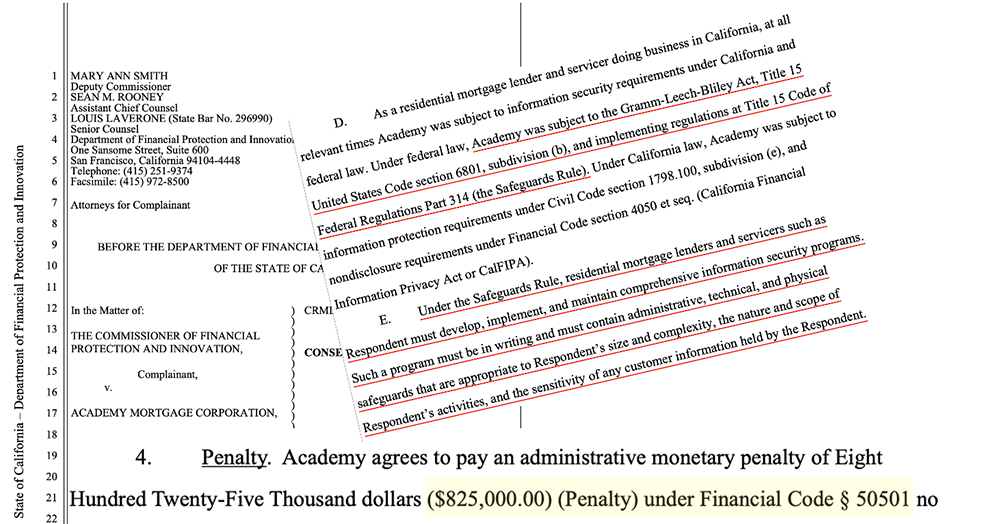
It is no surprise that California, true to its ground-breaking traditions, has stepped up to prepare the landscape for state-enforcement action. But California is hardly alone. At least a dozen states are seeking to implement, or have already implemented, stronger consumer protections in response to the federal withdrawal.
California Fair Lending Examination Act (Enrolled)
The California Legislature has successfully passed AB801, the California Fair Lending Examination Act. The bill is awaiting Governor Gavin Newsom’s signature, which leaves little doubt that this bill, or even stronger fair lending legislation, will soon become California law.
The California Fair Lending Examination Act would require, under a variety of California laws including the CRMLA, the DFPI commissioner to, at least once every 4 years, examine, as prescribed, the books and records of certain entities subject to the commissioner’s examination authority under those laws for compliance with any nondiscrimination law applicable to mortgage lending.
The New California Business & Consumer Services Agency (BCSA)
On July 1, 2026, California finalized a plan to reorganize state agencies to better address emerging challenges faced by families and businesses. The new Business & Consumer Services Agency (BCSA) will oversee dozens of boards, bureaus, and departments (Including the Department of Financial Protection and Innovation) charged by the Legislature with administering and enforcing laws that protect families and businesses, while also promoting a fair and dynamic economy for all Californians.
The Agency’s work touches a broad range of sectors of California’s economy, including financial services, health care, real estate, retail and hospitality, agriculture, professional services, higher education, and more.
Meet The New Cabinet-Level BCSA Secretary
Rohit Chopra serves as California’s inaugural Secretary of Business & Consumer Services. In 2021, he was confirmed by the United States Senate to serve as the Director of the Consumer Financial Protection Bureau, the unit of the Federal Reserve System charged with overseeing mortgage, credit card, student loan, payments, and data companies. During Chopra’s tenure from 2021 to 2025, the CFPB recovered nearly $10 billion in refunds and penalties from companies that broke the law. Chopra also served on the Board of Directors of the Federal Deposit Insurance Corporation, where he played a major role in the response to the bank failures in the spring of 2023.
In 2017, Chopra was nominated by President Trump and subsequently confirmed by the Senate unanimously to serve as a Commissioner on the Federal Trade Commission, where he served until 2021. Chopra led a number of efforts to reform the FTC, which was routinely failing to fairly enforce antitrust, privacy, and consumer protection laws enacted by Congress.
New York’s Disparate Impact Reminder
Federal assertions about the constitutionality of disparate impact remain hotly debated. Many stakeholders confuse the current federal approach to law enforcement priorities with dictates that could govern or positively influence federal courts or state law enforcement interests. In reality, the opposite is true. Stakeholder reactions to shifting federal priorities have led to the creation of a confusing patchwork of local laws and enforcement actions, which could make compliance more expensive. Consequently, consumers will bear the brunt of increased compliance costs, and many businesses will likely be caught in the middle.
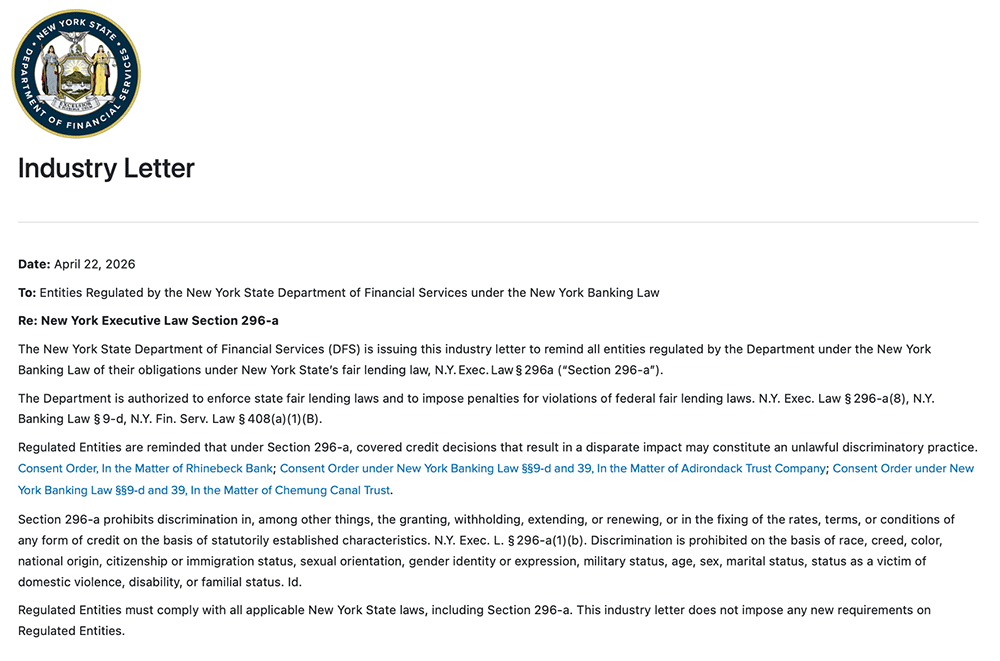
Like other states, in response to the Consumer Financial Protection Bureau (CFPB) and other federal regulators stepping back from enforcing fair lending laws, the New York State Department of Financial Services (DFS) issued an “industry letter.” The letter reminded all entities regulated by the Department under the New York Banking Law of their obligations under New York State’s fair lending law, N.Y. Exec. Law § 296-a (“Section 296-a”).
The Department emphasized that under Section 296-a, any covered credit decisions that result in disparate impact may be considered an unlawful discriminatory practice.
Massachusetts Fair Lending Enforcement
Massachusetts made headlines by combining fair lending practices and artificial intelligence (AI) in an enforcement action. This move addresses concerns among many states regarding the rapid deployment of AI, which allegedly outpaces adequate testing and proper safeguards. In this case, under existing Massachusetts law, the defendant was accused of creating disparate impacts through algorithmic credit decisions. The state also alleged that the defendant failed to issue compliant adverse action notices.
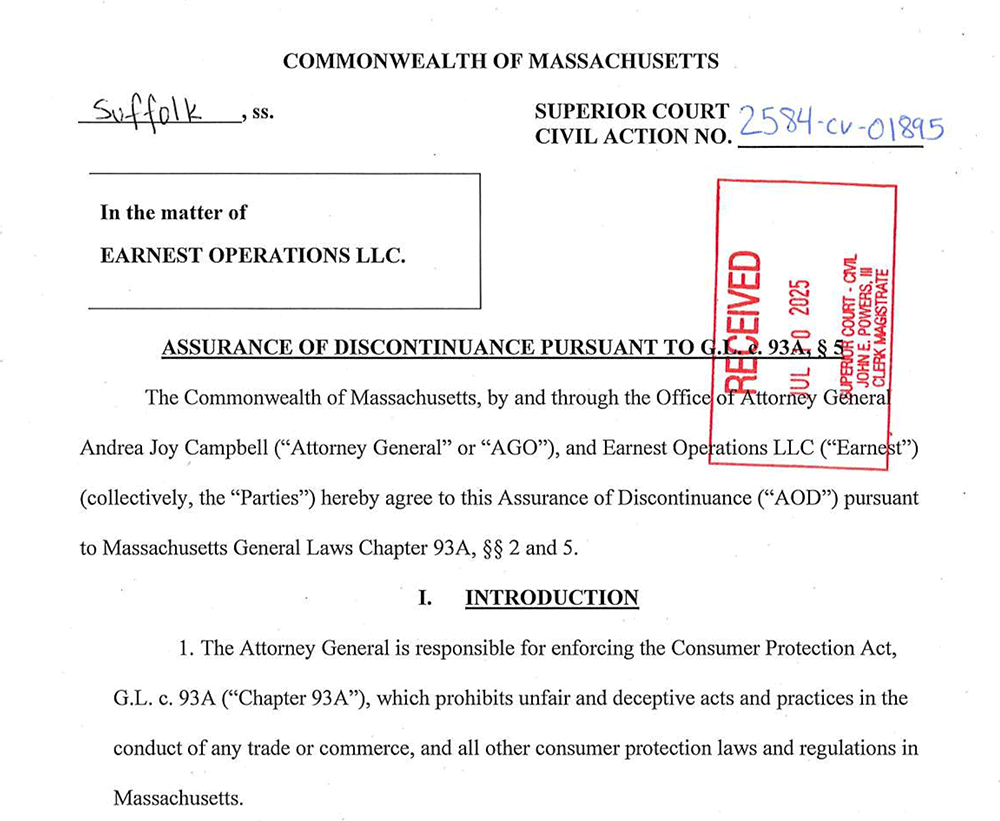
BOSTON — Attorney General Andrea Joy Campbell today announced that her office has reached a $2.5 million settlement with Earnest Operations LLC (Earnest), a Delaware-based student loan company, resolving allegations that the company’s lending practices violated various consumer protection and fair lending laws, including through the use of artificial intelligence (AI) models that could lead to disparate harm to Black, Hispanic, and non-citizen applicants and borrowers.
As part of the settlement, Earnest will pay $2.5 million to the Commonwealth and implement extensive changes to its business practices, including taking steps to mitigate risks of unfair lending and ensure compliance with state and federal laws. Additionally, the company must regularly report on its compliance to the Attorney General’s Office (AGO).
“Earnest’s failure to comply with consumer protection and fair lending laws, including through its AI models, unfairly put historically marginalized student borrowers at risk of being denied loans or receiving unfavorable loan terms – impeding their chances of economic growth and opportunity,” said AG Campbell. “I am proud to announce this settlement, which will put lenders on notice that Massachusetts will not tolerate unlawful practices that harm our consumers.”
According to the AGO, Earnest uses artificial intelligence models, specifically algorithmic models, to make lending decisions, including determinations on loan applicants’ eligibility and loan terms and pricing.
The AGO alleged that Earnest failed to take reasonable measures to mitigate fair lending risks in its underwriting practices, including failing to test its models for disparate impact and training its models based on arbitrary, discretionary human decisions.
The AGO alleged that Earnest engaged in other unfair and deceptive practices in violation of state and federal consumer protection and fair lending laws. This included the company’s use of the “Cohort Default Rate” – an average rate of loan defaults associated with a specific educational institution – variable in its algorithmic model, which resulted in disparate impact in approval rates and loan terms for a certain product, with Black and Hispanic applicants more likely to be penalized than White applicants.
The AGO further alleged that Earnest’s unfair and deceptive conduct included making arbitrary human-based loan assessments; using a “Knockout Rule” to automatically deny applications based on immigration status; sending inaccurate adverse action notices that prevented applicants from understanding their own creditworthiness; and failing to implement policies and procedures to comply with fair lending laws and mitigate risks to consumers.
Under the terms of the settlement, amongst other changes, Earnest will implement a detailed corporate governance structure and develop and maintain robust written policies to ensure responsible and legally compliant use of AI. Earnest will also discontinue use of both the “Cohort Default Rate” variable and “Knockout Rule” based on immigration status.
The settlement, reached via an assurance of discontinuance filed in Suffolk County Superior Court, may be viewed in its entirety here.
This matter was handled by Assistant Attorney General Alda Chan, Division Chief Yael Shavit, and Paralegal Noam Miller of the AGO’s Consumer Protection Division, which is tasked with enforcing Massachusetts’ nation-leading consumer protection laws. Investigator Anthony Crespi of the AGO’s Civil Investigations Division also assisted with this matter.
In April 2024, AG Campbell issued an advisory clarifying that existing state consumer protection, anti-discrimination, and data security laws apply to emerging technology, such as artificial intelligence and algorithmic decision-making systems, just as they would in any other applicable context.
Consumers who believe they have been subjected to an unfair or deceptive business practice, including by a student loan lender, may file a consumer complaint with the AGO by visiting mass.gov/ago/consumercomplaint.

Tip of the Week: Sign up for 2026 CE
The LOSJ is celebrating five years of exceptional service to the mortgage industry, offering insights you won’t find anywhere else. To celebrate, enjoy our gift to you! Use the promo code “newsletter” when placing your class order.
Expanding your product offerings is an effective way to enhance your business’s vitality. This year, the Loan Officer School is surveying non-Qualified Mortgage (non-QM) financing options. We will review the various types of underwriting required for non-QM financing, including higher-priced mortgage loans (HPML), balloon-payment features, and interest-only options.
Presenting non-QM solutions to consumers improperly can lead to serious consequences. Understand the essentials of compliant and ethical subprime mortgage origination. Attend the Loan Officer School 2026 continuing education classes.
Please use the promo code “newsletter” when you sign up.
Have a Question About Operations, Sales, Marketing, or Compliance? Email Your Questions to the Loan Officer School Journal.
We invite LOSJ readers to submit questions on any topic to the editor. Topics can include compliance, sales, marketing, implementation, and other areas that may be helpful to our customers. If we use your question, we will include only your first name in our response. Please send your questions to: losjmailbag@gmail.com.
Necessary Mailbag Disclosure: The LOSJ is a periodic publication from LoanOfficerSchool.com designed to educate and inform our readers. Please note that we do not provide legal advice, and nothing in the LOSJ should be construed as a legal opinion on specific facts or circumstances. The content serves strictly for informational purposes. We strongly advise readers to consult legal counsel regarding any legal matters or specific questions.