

The 21st Century loan team. Clockwise from center: Senior leadership, underwriter, processor, branch manager, loan officer.
Why Haven’t Loan Officers Been Told These Facts?
AI, AUS, and Automated Workflow – The New Loan Team
Last week, the LOSJ wrote about substantive changes for FNMA and FHLMC credit policy. Specifically, the elimination of minimum credit score requirements for the enterprises’ automated underwriting systems (AUSs).
The fact that no minimum credit score is required does not necessarily mean that credit standards are being eased. Additionally, while FNMA and FHLMC allow scoreless AU submissions, some lenders may not be on board with the change and still require minimum scores. The credit score change is due to technological advancements, including database integrations and artificial intelligence (AI), that enable FNMA and FHLMC to further automate credit decisioning. The GSEs are increasingly less dependent on credit scores as a touchstone for predicting timely payments.
Traditional FICO scores, such as those used in the mortgage industry, lack the predictive power of more sophisticated scoring models and other credit algorithms, which offer better indicators of future on-time performance, for example, by automating trended-data analysis.
Payment Shock
For consumers, an increase in debt, coupled with minimal cash reserves, often signals potential trouble ahead. For lenders to add to a consumer’s housing costs when the applicant has little savings and shows a rising debt trajectory is an unfounded decision. Underwriters have been making credit decisions based on these same principles long before automated underwriting systems (AUS), artificial intelligence (AI), and database integrations became widespread.
Correlations between problematic consumer spending, particularly excessive credit use, can be readily identified without advanced computing power or complex algorithms. Detecting the consumer practice of using credit to supplement income is not new. However, today’s technology, such as automated trended data analysis, allows for the instant identification of consumers who may be experiencing financial difficulties or are likely to face them soon.
Who Will Benefit from the New Technologies
However, developments in AUS algorithms could mean that certain thin-file applicants, who may be excellent credit risks, are less likely to go without mortgage financing.
In brief, AUS provides lenders with protection against the risks associated with manual underwriting. As long as data integrity is sound (accurate data inputs into the AUS), lenders experience less uncertainty about quality control, warranties, and loan performance issues.
The focus is now on improving decision-making heuristics and algorithms to include factors that previously led to good loans being excluded from Automated Underwriting System (AUS) approvals. The reporting of nontraditional credit, also known as alternative data, is making this possible. As mentioned last week in the LOSJ, timely rent payments have long been regarded as a reliable indicator of potential mortgage performance. The industry overlooked this powerful indicator in AUS until recent years.
To identify populations that may benefit from these enhancements, market segmentation helps loan originators consider which types of applicants will benefit from these developments.
Thin-file applicants come in many shapes and sizes.
- Younger applicants with limited tradelines in their own name. Many college students and young professionals rely on credit lines for which they are authorized users.
- Recent immigrants who may not yet have established credit histories.
- Applicants with cultural aversions to traditional Western credit practices.
- Previously incarcerated individuals reestablishing themselves.
- Applicants with past financial or credit challenges.
When Automated Underwriting Systems (AUS) incorporate more alternative data into their decision-making, the probability of loan approval increases. To enable the reporting of nontraditional credit data into conventional credit reports, some engineering is necessary. Several vendors are now offering services that report alternative data to the major consumer reporting agencies: Equifax, Experian, and TransUnion. Once this data is included in the credit report, the AUS can analyze nontraditional tradelines, thereby enhancing the likelihood of AUS approval.
From the Vendor Website, “SELF”
Another option that can help to build your credit is having rent and utility payments reported to the credit bureaus. If you pay your monthly rent and utility bills in full and on time, having them reported to the credit bureaus may impact your credit score in a positive way.
If you sign up for a rent reporting service like Self, your payments get reported to the credit bureaus, which can be factored into certain FICO® and VantageScore® credit scoring models. Keep in mind that while rent reporting impacts FICO® 9 and 10 scores as well as VantageScore®, these models aren’t the most commonly used. However, adding your rental history to your credit report may help if you’re seeking credit from a financial institution that relies on these models.[5]
Self reports your rent to all three bureaus for free with signup. If you have an active subscription and meet certain eligibility requirements, you can also pay a one-time fee of $49.95 to have up to two years of past rental history reported.
- You can report in the same way for utilities, using a service like Self, but bear in mind it costs $6.95 per month to report utilities payments, and these are only reported to TransUnion. Your payment history is the most important credit score factor, so making on-time payments and getting them reported helps to build a positive credit history.[3]
From FNMA, Rent Payment History B3-2-03, Risk Factors Evaluated by DU (02/05/2025)
For certain loan casefiles, DU can consider a borrower’s rent payment history identified on a 12-month third-party asset verification report or a credit report. When DU logic can identify rent payments in the asset verification report or credit report, it will use the rent payment history to positively supplement the credit risk assessment.
The following requirements apply when using rent payment history in DU:
At least one borrower must have been renting for at least 12 months with a monthly rent payment of $300 or more and one of the following:
- Have no mortgage reported on their credit report,
- Have a limited credit history, or
- Have no credit score.
When the rent payment history does not appear on the credit report, for DU to be able to identify rent payments using an asset verification report, the lender must:
- Enter the monthly rent paid by the borrower in the online loan application,
- Obtain an asset verification report with 12 months of bank statement data through an authorized DU validation service asset verification report vendor, and
- Confirm the borrower is an account holder and that the account provided in the asset verification report is the one from which the borrower pays rent.
At the time of loan origination, the originating lender must have access to the full asset verification report containing the data covering the period of time provided to DU for assessment.
When an asset verification report is used for both rent history and asset documentation, including asset validation through the DU validation service, only the most recent 60 days of account activity must be reviewed in accordance with the requirements in B3-4.2-02, Depository Accounts and B3-2-02, DU Validation Service, and retained in the loan file.
SELF Website: Rent and Utility Bill Reporting
BEHIND THE SCENES: More Whackiness from the CFPB
According to the CFPB, it has no means of lawfully funding itself.
Washington, D.C.—Today, the Consumer Financial Protection Bureau (CFPB) filed a notice informing the court in NTEU v. Vought that the Department of Justice’s Office of Legal Counsel (OLC) has determined that the Bureau may not legally request funds at this time from the Federal Reserve under Dodd-Frank.
OLC made this conclusion on the basis that the Federal Reserve System currently lacks any “combined earnings” from which the Bureau may draw funding, as required by Dodd-Frank. OLC opinions are binding upon Executive Branch agencies including the Bureau.
The Bureau anticipates having sufficient funds to continue operations until at least December 31, 2025.
The New CFPB Humility Pledge, Examiner Obeisance Required
“The statement below will be provided to all examiners to be read to a supervised entity at the beginning of the examination.”
“In sum, the Bureau’s goal is to work collaboratively with the entities to review entities’ processes for compliance and/or remedy existing problems. The Bureau is doing so by encouraging self-reporting and resolving issues in Supervision, where feasible, instead of via Enforcement. ” Excerpts from CFPB Humility Pledge
In a bizarre development that would be almost comical were the stakes not so high, CFPB examiners are required to recite a “Humility Pledge” to supervised entities before commencing any examination activity. On the surface, this could be a positive change, with a return to a more collegial supervision environment.
In the past, many stakeholders highlighted the effectiveness of collaborative relationships that supervised entities had with their regulator, rather than relying solely on enforcement actions, for which the CFPB has often been criticized. However, stakeholders remain concerned about regulatory capture—that term describing the interests of regulators and the regulated getting a little too chummy.
Regulatory Capture
In 1971, economist George Stigler noted that “regulation is acquired by the industry and is designed and operated primarily for its benefit.” This observation led to the coining of the term “regulatory capture,” which describes the tendency of industry interests to influence regulators unduly. Much of the Dodd-Frank legislation was aimed at correcting regulatory capture.
Regulatory Enslavement
If the original robber barons were alive, men like John D. Rockefeller and J.P. Morgan, they couldn’t have been more delighted by the recent about-face by the CFPB. How far the agency has fallen. From Richard Cordray, the pinstriped crusader, to industry bootlickers at the helm. What a fall. Take a look at the new “Humility Pledge” for CFPB examiners. A special unauthorized video of the humility pledge administration is found below.
CFPB Humility Pledges
CFPB Examiner Humility Pledge
Tip of the Week – Sign Up for 2025 CE
Expanding your product offerings is an effective way to enhance your business’s vitality. This year, the Loan Officer School is surveying non-government financing options for construction and renovation projects.
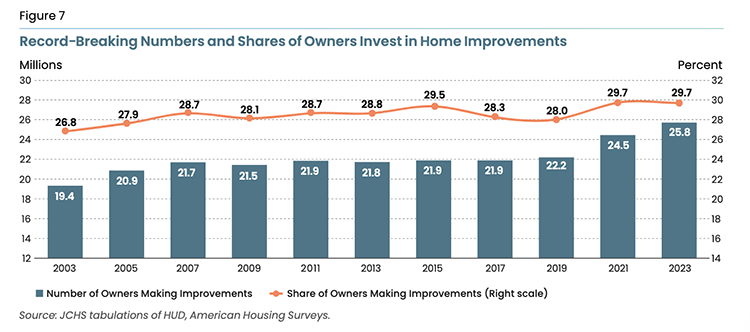
The shortage of affordable housing is unlikely to be resolved anytime soon. As affordable, move-in-ready housing solutions remain hard to find, the demand for construction and renovation loans is expected to increase. According to the JCHS, Harvard University, the US remodeling market soared above $600 billion in the wake of the pandemic and, despite recent softening, remains 50 percent above pre-pandemic levels.
Discover how to enhance borrower advantages through construction and renovation financing.
- Enhanced housing affordability.
- Housing options for aging or disabled borrowers.
- Housing solutions for borrowers caring for aging or disabled family members.
- Multi-generational housing solutions.
For any questions or inquiries regarding state education needs, please feel free to call.
Call Us Today! (866) 314-7586
Online self-study classes are available.
Sign up for 2025 Online self-study CE