

Why Haven’t Loan Officers Been Told These Facts?
Reverse Occupancy Fraud
This type of fraud has multiple causes, but it typically begins when a consumer fails to qualify for owner-occupied mortgage financing during the preapproval or prequalification process. Various disqualifying factors can contribute to this, such as credit score or income issues.
Under the Truth in Lending Act (TILA), lenders must evaluate an applicant’s ability to repay a loan. Unlike pre-Dodd-Frank collateral-dependent lending practices, this standard ensures that mortgage lenders do not approve loans solely on the basis of collateral liquidation, without considering the applicant’s capacity to repay.
The Truth In Lending Act Minimum Standards for Residential Mortgages
15 USC 1639c (a) Ability to repay In accordance with regulations prescribed by the Bureau, no creditor may make a residential mortgage loan unless the creditor makes a reasonable and good faith determination based on verified and documented information that, at the time the loan is consummated, the consumer has a reasonable ability to repay the loan, according to its terms, and all applicable taxes, insurance (including mortgage guarantee insurance), and assessments.
Just One Obstacle
Many a credit-based adverse action have one thing in common: the Truth in Lending Act (TILA) minimum standards for residential mortgages. Consequently, if an unqualified applicant can circumvent the TILA minimum standards, they can obtain a mortgage.
Business or Residential Use: Not As Clear As You Might Think
Regulation Z’s official commentary details specific TILA exemptions. Many originators are unaware of the lesser-known exemptions. For example, in some cases, transactions secured by a one-to four-unit owner-occupied residential property are not covered by the TILA. Consider the purchase transaction for a three- or four-unit property to be owner-occupied. Such transactions are exempt from the TILA: no TRID, no waiting periods, no minimum standards.
If the lender, investor, or insurer wants to treat a transaction as though it were TILA-covered, that is their prerogative. Still, why more non-QM lenders do not offer cash-flow loans for three- and four-unit owner-occupied purchases remains a mystery to this observer.
Regulation Z Exempt Transactions
12 CFR 1026.3 Comment 3(a)-4 Non-owner-occupied rental property. Credit extended to acquire, improve, or maintain rental property (regardless of the number of housing units) that is not owner-occupied is deemed to be for business purposes. This includes, for example, the acquisition of a warehouse that will be leased or a single-family house that will be rented to another person to live in. If the owner expects to occupy the property for more than 14 days during the coming year, the property cannot be considered non-owner-occupied and this special rule will not apply. For example, a beach house that the owner will occupy for a month in the coming summer and rent out the rest of the year is owner occupied and is not governed by this special rule. (See comment 3(a)-5, however, for rules relating to owner-occupied rental property.)
5. Owner-occupied rental property. If credit is extended to acquire, improve, or maintain rental property that is or will be owner-occupied within the coming year, different rules apply:
i. Credit extended to acquire the rental property is deemed to be for business purposes if it contains more than 2 housing units.
ii. Credit extended to improve or maintain the rental property is deemed to be for business purposes if it contains more than 4 housing units. Since the amended statute defines dwelling to include 1 to 4 housing units, this rule preserves the right of rescission for credit extended for purposes other than acquisition. Neither of these rules means that an extension of credit for property containing fewer than the requisite number of units is necessarily consumer credit. In such cases, the determination of whether it is business or consumer credit should be made by considering the factors listed in comment 3(a)-3.
The Anatomy of a Reverse Mortgage Fraud
Reverse occupancy fraud occurs when individuals misrepresent their intended use of a property, specifically by claiming it as an investment property rather than their primary residence. This is the opposite of the more common type of occupancy fraud, where a non-owner-occupied transaction is falsely presented to obtain better terms for owner-occupied loans.
These reverse fraudsters are trying to evade the TILA minimum standards requirements. For example, one borrower intended to use a property as their primary residence, but instead purchased it as an investment property. To qualify for the mortgage, they even went so far as to fabricate a rental agreement for subject rents.
The fraud issue also opens the door to the abuse of debt service coverage ratio (DSCR) loans. This type of financing originates from commercial mortgage lending and is commonly used for commercial and high-density residential income-producing properties. Many non-QM lenders provide DSCR financing. With DSCR underwriting, instead of focusing on the applicant’s ability or willingness to repay, the lender ensures that the subject property’s income covers all or part of the loan payment.
Non-QM residential loans secured by a dwelling (as defined under TILA) are subject to the ATR. Reverse fraud is effective because business purposes or investor transactions are not subject to TILA or any other federal capacity tests, such as those in Regulation Z under ATR requirements.
Mortgage fraud is a serious offense and can result in severe penalties under federal law.
From FNMA
Sales transactions involved in reverse occupancy schemes often have several common denominators, including, but not limited to:
- The subject properties are sold as investment properties.
- Purchasers are first-time home buyers with minimal or no established credit.
- Purchasers have low income but significant liquid assets that are authenticated by bank statements.
- Purchasers make large down payments.
- The appraisal has a comparable rent schedule (to show expected rental income from the subject property).
- Purchasers present “rent free” letters stating they are not paying rent to live in their primary residence.
From FHLMC
Potential Indicators of Owner Occupancy
There are many potential indicators that a borrower intends to occupy a property and not use it as a rental.
One indicator is the use of tax credits intended to provide qualified homeowners with a tax exemption on a primary residence. Through our investigations, we’ve found that some borrowers who obtained investment property loans also applied for those tax credits, implying that they would occupy the properties securing those loans.
Another potential indicator is the type of insurance coverage obtained for these properties. Freddie Mac’s Single-Family Fraud Risk (SFFR) team confirmed with insurance agents and Servicers that, for many of these loans, the coverage in place at origination was owner-occupied, not rental.
Servicers of these loans further confirmed that these borrowers maintained that same type of homeowner’s insurance coverage for their purported investment properties since origination.
In other instances, the borrowers changed insurance coverage shortly after closing. In fact, one borrower changed coverage from rental to owner-occupied within 10 days of closing.
We’ve also seen an additional alert to possible occupancy misrepresentation when many borrowers called their servicers shortly after closing and requested a change of their billing/mailing address to the subject investment properties.
While some borrowers recounted detailed conversations with their loan officers about the type of loan for which they were applying, others were not aware they had applied for investment loans.
Borrowers frequently stated that they had always intended to occupy the properties and reiterated that their loan officers knew it. One borrower even indicated that her loan officer encouraged her to apply for an investment loan to get her loan approved.
While reverse occupancy isn’t a new scheme, it still occurs − as recent SFFR investigations attest. Any time borrowers are qualified for loans they aren’t truly eligible for, whether through misrepresented income, occupancy, insurance or something else, they create substantial risk to Freddie Mac and our lenders.
BEHIND THE SCENES: CFPB Proposing Substantive Changes to Regulation B
The CFPB (Consumer Financial Protection Bureau) is proposing amendments to Regulation B. These changes impact:
-
Special-purpose programs
-
Disparate impact under the ECOA
-
Discouraging an applicant or potential applicant
Lender disparate impact and discouragement are established legal theories under the Equal Credit Opportunity Act (ECOA) and Fair Housing Act. The theories are articulated and advanced by various stakeholders, including lawmakers and federal regulators responsible for implementing the Fair Housing Act and the ECOA.
Discouragement and disparate impact (disparate effect) theories are incorporated into the implementing regulations, such as Regulation B (ECOA) and HUD’s 24 CFR 100.500 (FHA).
24 CFR § 100.500 Discriminatory Effect Prohibited
Liability may be established under the Fair Housing Act based on a practice’s discriminatory effect, as defined in paragraph (a) of this section, even if the practice was not motivated by a discriminatory intent.
(a) Discriminatory effect. A practice has a discriminatory effect where it actually or predictably results in a disparate impact on a group of persons or creates, increases, reinforces, or perpetuates segregated housing patterns because of race, color, religion, sex, handicap, familial status, or national origin.
A New Sheriff
In 2025, President Trump issued several Executive Orders relevant to the CFPB and HUD administration of fair lending laws. Executive Order 14173, entitled “Ending Illegal Discrimination and Restoring Merit-Based Opportunity,” states in part that “The Federal Government is charged with enforcing our civil-rights laws. The purpose of this order is to ensure that it does so by ending illegal preferences and discrimination.” Executive Order 14281, entitled “Restoring Equality of Opportunity and Meritocracy,” states in part that “It is the policy of the United States to eliminate the use of disparate-impact liability in all contexts to the maximum degree possible to avoid violating the Constitution, Federal civil rights laws, and basic American ideals.”
What to Do Next
Many stakeholders, including members of the U.S. Supreme Court, have firmly supported various aspects of disparate impact theory under the Fair Housing Act (FHA) and the Equal Credit Opportunity Act (ECOA). However, most stakeholders would agree that Congress should address the significant risk of overbroad applications of this theory. While Congressional amendments might be introduced to restrict disparate impact enforcement, there are still varying opinions on the Constitutionality of the theory. In the absence of legal precedents or Congressional amendments, stakeholders will have to make do with regulatory interpretations.
The Old Disparate Impact Interpretation (Adapted From Federal Register FR Doc No: 94-9214, Friday, April 15, 1994)
When a lender applies a racially or otherwise neutral policy or practice equally to all credit applicants, but the policy or practice disproportionately excludes or burdens certain persons on a prohibited basis, the policy or practice is described as having a “disparate impact.”
Example: A lender’s policy is not to extend loans for single family residences for less than $60,000.00. This policy has been in effect for ten years. This minimum loan amount policy is shown to disproportionately exclude potential minority applicants from consideration because of their income levels or the value of the houses in the areas in which they live.
The fact that a policy or practice creates a disparity on a prohibited basis is not alone proof of a violation. When an Agency finds that a lender’s policy or practice has a disparate impact, the next step is to seek to determine whether the policy or practice is justified by “business necessity.” The justification must be manifest and may not be hypothetical or speculative. Factors that may be relevant to the justification could include cost and profitability. Even if a policy or practice that has a disparate impact on a prohibited basis can be justified by business necessity, it still may be found to be in violation if an alternative policy or practice could serve the same purpose with less discriminatory effect. Finally, evidence of discriminatory intent is not necessary to establish that a lender’s adoption or implementation of a policy or practice that has a disparate impact is in violation of the FHAct or ECOA.
Goodbye Redlining Prosecutions?
“Redlining” is one type of discrimination prohibited under the FHA and ECOA. Redlining occurs when lenders discourage loan applications, deny equal access to home loans and other credit services, or avoid providing home loans and other credit services to neighborhoods based on the race, color, or national origin of the residents of those neighborhoods. – Excerpted from a 2023 DOJ fair lending complaint against a mortgage lender.
HUD and the CFPB Discriminatory Impact Guidance and Regulations
The CFPB’s action comes as HUD has shifted its focus from addressing discrimination at broad levels, such as neighborhoods or census tracts, to focusing on prohibited conduct in direct interactions with individuals. See the HUD memo here: September 16, 2025, HUD Memo
The New CFPB Disparate Impact Interpretation (Rule Proposal) Excerpt (90 FR 50901, November 13, 2025)
Current § 1002.4(b) [Regulation B] prohibits creditors from making “any oral or written statement” to applicants or prospective applicants that would discourage a reasonable person from making or pursuing an application for credit. The regulation text itself does not define “oral or written statement.” Comment 4(b)-1, which the Board added to Regulation B in 1985 without substantive explanation, states, in part, that § 1002.4(b) covers “acts or practices” by creditors that could discourage on a prohibited basis a reasonable person from applying for credit.
The Bureau preliminarily determines that the inclusion of the phrase “acts or practices” in comment 4(b)-1 has resulted in § 1002.4(b) being interpreted overly broadly to apply to business practices that, though they may have some communicative effect, do not reflect the circumvention or evasion of ECOA’s prohibition against discrimination that the discouragement provision was designed to address. Such practices include, for example, business decisions about where to locate branch offices, where to advertise, or where to engage with the community through open houses or similar events. In the Bureau’s view, such practices do not constitute “oral or written statements” to applicants or prospective applicants within the meaning of § 1002.4(b) and do not, in and of themselves, demonstrate prohibited discouragement. The Bureau proposes to revise § 1002.4(b) to reflect this interpretation.
Specifically, the Bureau proposes to add language to § 1002.4(b) clarifying that “oral or written statement” means spoken or written words, or visual images such as symbols, photographs, or videos. This would include any visual images used in advertising or marketing campaigns. The Bureau also proposes to align the text of comment 4(b)-1 with the text of current § 1002.4(b) by replacing current references in the comment to “acts or practices” or “practices” with references to “oral or written statements” or “statements,” respectively.
Under the proposed revisions, the business practices noted above would not constitute prohibited discouragement even if they had some communicative effect that some consumers could arguably find discouraging. Instead, the discouragement provision would cover only actual oral or written statements by creditors to applicants or prospective applicants. The Bureau has preliminarily determined that clarifying the discouragement provision as described would facilitate compliance with ECOA and Regulation B and result in more targeted and effective enforcement of conduct designed to circumvent the statute’s prohibition against discrimination. The Bureau requests comment on the proposed revisions.
The Supreme Court’s 2015 Ruling on Disparate Impact
In 2015, the Supreme Court ruled on the legality of disparate impact enforcement actions, holding that “even when courts do find liability under a disparate-impact theory,” remedial orders must “concentrate on the elimination of the offending practice” through “race-neutral means.” While acknowledging disparate impact as a legitimate inference under the Fair Housing Act (FHA), the Court emphasized the need for careful measures to limit disparate-impact liability as appropriate.
The Court was concerned about the overly broad application of disparate-impact claims and, in the ruling, outlined safeguards to protect potential defendants from abusive claims.
The Court’s disparate-impact limitations appeared to conflict with the federal Department of Housing and Urban Development’s then description of the theory outlined in its 2013 disparate-impact rule (24 CFR 100.500). However, as mentioned, HUD has backed away from its 2013 rule and is finalizing new discrimination regulations that are not yet public.
Stay tuned for updates on the CFPB’s proposed regulation.
Tip of the Week – Sign Up for 2025 CE
Expanding your product offerings is an effective way to enhance your business’s vitality. This year, the Loan Officer School is surveying non-government financing options for construction and renovation projects.
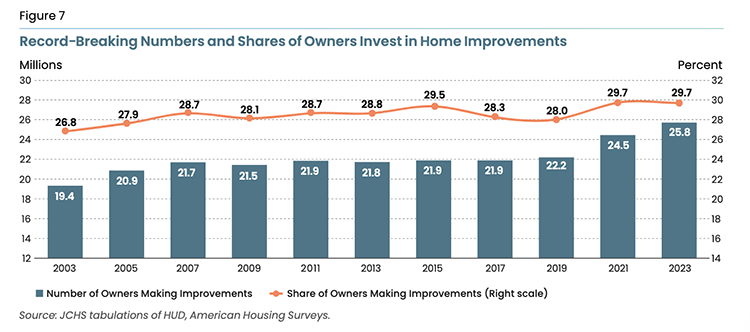
The shortage of affordable housing is unlikely to be resolved anytime soon. As affordable, move-in-ready housing solutions remain hard to find, the demand for construction and renovation loans is expected to increase. According to the JCHS, Harvard University, the US remodeling market soared above $600 billion in the wake of the pandemic and, despite recent softening, remains 50 percent above pre-pandemic levels.
Discover how to enhance borrower advantages through construction and renovation financing.
- Enhanced housing affordability.
- Housing options for aging or disabled borrowers.
- Housing solutions for borrowers caring for aging or disabled family members.
- Multi-generational housing solutions.
For any questions or inquiries regarding state education needs, please feel free to call.
Call Us Today! (866) 314-7586
Online self-study classes are available.
Sign up for 2025 Online self-study CE