

Image Courtesy of FNMA
Why Haven’t Loan Officers Been Told These Facts?
FNMA Offers Consumer Resources For Alternative Data Prospects
Recently, we have been evaluating the impact of FNMA and FHLMC’s decision to eliminate the Automated Underwriting Systems (AUS) requirement for credit scores. It is important to note that allowing credit submissions without scores does not eliminate the need to assess applicants’ payment history. Instead, the credit score change is due to technological advances that allow the AUS to consider nontraditional tradelines, also known as alternative data. Examples of common nontraditional tradelines include cell phone, utility, and rent payments.
Research into nontraditional credit demonstrates its effectiveness in predicting timely mortgage payments. When Automated Underwriting Systems (AUS) incorporate more alternative data into their decision-making processes, the likelihood of loan approval increases.
Facilitating the inclusion of nontraditional credit data in conventional credit reports or electronic credit analysis requires some engineering, as was discussed in LOSJ V5 I47.
Alternative data is a valuable topic for presentations aimed at referral partners. Loan officers could consider presenting to real estate agents and other stakeholders who work with underbanked communities. Mortgage originators should share strategies with these stakeholders to convert prospective borrowers without a traditional credit history into pre-approved buyers.
For loan officers who feel uneasy about making public presentations, FNMA offers excellent resources that you can share with consumers and referral partners. These include brief video vignettes that explain the basics of alternative data and the inclusion of rent payments in Automated Underwriting Systems (AUS).
AUS submissions without a credit score may be expensive for some applicants. As mentioned in LOSJ V5 I47, the loan-level price adjustments (LLPAs) for submitting without a credit score can be high. Credit score requirements are determined by the “representative” credit score for the mortgage loan, as outlined in the Selling Guide. If a loan is submitted without a credit score, it will be assessed using the lowest credit score range indicated in the relevant Loan-Level Price Adjustment (LLPA) tables.
For scoreless applicants who are exempt from credit fees, this represents a significant opportunity. There are various exemptions available for different types of transactions and borrowers; please refer to LL-2022-05 and the Seller Guide for more information. These Loan Level Price Adjustment (LLPA) exemptions create excellent market segments to target.
FNMA Make Rent Count Consumer Page
BEHIND THE SCENES: CFPB Top Enforcer Resigns In Protest
According to Bloomberg Law, the top enforcement official of the Consumer Financial Protection Bureau has resigned, reflecting complaints voiced by his predecessor that the Trump administration is preventing the agency from fulfilling its responsibilities.
Excerpted From Evan Weinberger, Bloomberg Law Correspondent, Bloomberg Law, December 4, 2025.
Michael Salemi, the CFPB’s principal deputy enforcement director and a longtime staff member, expressed his frustration at a Thursday all-hands meeting with the CFPB’s enforcement team over the Trump administration’s move to stop virtually all agency enforcement and investigative activities, according to multiple people with knowledge of the situation who requested anonymity to discuss internal CFPB matters.
Salemi said in a Thursday email to the team that he had hoped to be able to lead an enforcement division that would continue the agency’s work even with new priorities and reduced staff.
“In the last several weeks, it’s become clear to me that, if things proceed as planned, there is no path to an effective future enforcement program at the Bureau,” Salemi said in the email, obtained by Bloomberg Law.
His last day at the CFPB will be Dec. 12, according to the email.
Salemi in a Nov. 25 email obtained by Bloomberg Law had told the CFPB’s enforcement team that some investigations would restart. The email, which came as the CFPB was preparing to head to court over renewed questions about its funding, didn’t provide specifics about which investigations would reopen or when.
“No longer is the Enforcement Division one of thuggery and unprofessional behavior,” a CFPB spokesman said. “Under Director Vought’s leadership, Enforcement will now be done respectfully, properly, and professionally.”
“Don’t let the door hit you on the way out, Mr. Salemi,” the spokesman said.
Salemi didn’t immediately respond to a request for comment.
Salemi’s complaints about acting CFPB Director Russell Vought and other agency leaders echo those raised by his predecessor, Cara Petersen, when she resigned in June.
“It has been devastating to see the Bureau’s enforcement function being dismantled through thoughtless reductions in staff, inexplicable dismissals of cases, and terminations of negotiated settlements that let wrongdoers off the hook,” Petersen’s June 10 email said.
Vought has paused virtually all CFPB enforcement investigations and lawsuits since taking charge in February.
The CFPB has filed only one enforcement action—against Synapse Financial Technologies Inc.—since Vought took over, and there are questions as to whether the agency will be able to complete payments to harmed consumers through its Civil Penalty Fund.
The CFPB under Vought has canceled around 20 enforcement cases and terminated several enforcement actions early. In some cases, such as enforcement actions against Navy Federal Credit Union and Toyota Motor Credit Corp., companies were able to escape millions of dollars in payments to consumers.
Tip of the Week – Sign Up for 2025 CE
Expanding your product offerings is an effective way to enhance your business’s vitality. This year, the Loan Officer School is surveying non-government financing options for construction and renovation projects.
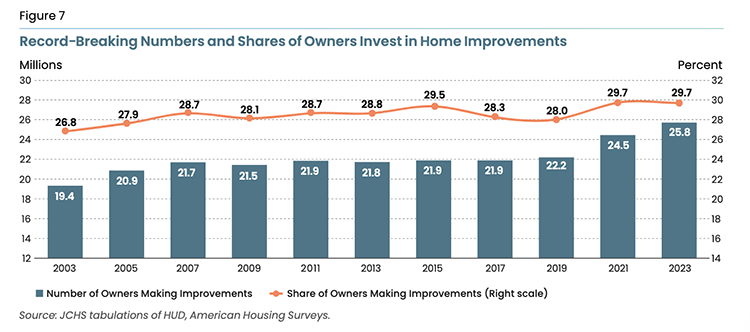
The shortage of affordable housing is unlikely to be resolved anytime soon. As affordable, move-in-ready housing solutions remain hard to find, the demand for construction and renovation loans is expected to increase. According to the JCHS, Harvard University, the US remodeling market soared above $600 billion in the wake of the pandemic and, despite recent softening, remains 50 percent above pre-pandemic levels.
Discover how to enhance borrower advantages through construction and renovation financing.
- Enhanced housing affordability.
- Housing options for aging or disabled borrowers.
- Housing solutions for borrowers caring for aging or disabled family members.
- Multi-generational housing solutions.
For any questions or inquiries regarding state education needs, please feel free to call.
Call Us Today! (866) 314-7586
Online self-study classes are available.
Sign up for 2025 Online self-study CE