

Why Haven’t Loan Officers Been Told These Facts?
HUD Office of Inspector General Continues to Caution Borrowers About Home Improvement Frauds
Beware of Targeted Reverse Mortgage Schemes
Mortgage professionals usually have their customers’ ear. This makes an excellent opportunity to serve and protect our more vulnerable neighbors. While it may sound a bit Grinch-like, it’s vital to remind people that not all messages of comfort and joy are sincere.
Mortgage originators, like other professionals, should seek to shield the vulnerable in their community from grifters and charlatans masquerading as Santa’s Helpers.
As home values have increased, more vulnerable homeowners have become attractive targets for fraudsters. One common form of this abuse is home repair fraud. Fraudsters often target the elderly because they tend to have significant equity in their homes. However, the recent increase in home values has significantly expanded the number of potential victims, including both young and elderly individuals.
Recently, we discussed a type of fraud known as reverse occupancy fraud. This occurs when a lender persuades the owner-occupant to classify the property as a rental on the loan application. This scheme typically arises from a legitimate or fabricated reason that prevents the applicant from qualifying for an agency loan (e.g., FNMA, FHA). For instance, the lender may suggest that the credit application is not viable, or they may claim that the applicant cannot meet minimum property standards or zoning requirements for traditional financing. By labeling the application as a business purpose loan (non-owner-occupied), the dishonest lender misleads homeowners into obtaining a hard money loan.
Enter the co-conspirator, the fraudulent “contractor.” While many reputable contractors exist in most communities, some are not legitimate. Often, these fraudsters are not even licensed contractors. Often, both the “lender” and the “contractor” are unlicensed.
The lender then hands the victim over to the vampire contractor for a significant finder’s fee. If the vampire contractor identifies a target, the process is reversed. The contractor refers the homeowner to the vampire lender for hard-money financing. These vampires mistakenly believe they can evade accountability because non-owner-occupied transactions are exempt from consumer protection laws such as the Truth in Lending Act (TILA).
This conduct breaches several fraud laws and consumer protection regulations, including the Truth in Lending Act (TILA) and the Consumer Financial Protection Act of 2010 (Title X of Dodd-Frank).
From the U.S. Department of Justice
PROVIDENCE – An Irish national residing illegally in the United States has been ordered detained on wire fraud and conspiracy charges related to an alleged scheme to defraud homeowners in Rhode Island and Massachusetts, announced Acting United States Attorney Sara Miron Bloom.
Prior to making an initial appearance today in U.S. District Court on a federal criminal complaint charging him with wire fraud and conspiracy to commit wire fraud, John O’Brien, 28, had been held on an immigration detainer following his arrest by Homeland Security Investigations (HSI) on March 28, 2025, for overstaying a tourist visa issued to him in 2021, but which expired in October 2021.
Charging documents allege that O’Brien and others defrauded property owners by inducing them into paying for home repairs that were not needed and often not completed. O’Brien misrepresented the need for the repairs and services, as well as the qualifications of his purported construction business, Traditional Masonry & Construction.
O’Brien’s alleged fraud scheme came to the attention of law enforcement when an 83-year-old Warwick, RI, resident, identified in court documents as Victim 1, contacted the Warwick Police Department to complain that he had been defrauded by a contractor. Victim 1 reported that O’Brien told him that, while doing work in the neighborhood, he observed cracks in Victim 1’s foundation. O’Brien offered to professionally repair the damage to the foundation. O’Brien collected $9,500 from Victim 1. As work proceeded, O’Brien allegedly claimed that further damage was discovered. O’Brien allegedly revised the costs for repairs and sought an additional $80,000 from the victim. A home inspector hired by the United States Attorney’s Office later reviewed the property and found no evidence of a need for these extensive foundation repairs.
As described in court documents, other alleged victims have been identified who described similar interactions with O’Brien that began with initial, unsolicited recommendations for small home repairs, followed by O’Brien’s purported discovery of major repairs needed, and often a representation that the homeowner’s foundation was in urgent need of repairs. It is estimated that this scheme has defrauded homeowners out of over $1,000,000.
At the time of O’Brien’s arrest, investigators allegedly seized from his vehicle hundreds of Traditional Masonry & Construction flyers, identical to the ones handed out to the victims in this case, and four binders containing quotes, contracts, and invoices for Traditional Masonry & Construction. The documents and contracts are dated between April 2024 through March 2025, and range from $300.00 to $205,000.00. The approximate value of the contracts contained within the binders totaled $1,987,650.00.
The scheme O’Brien is alleged to have been executing is becoming increasingly common throughout the United States. It has come to be known as Traveling Conman Fraud. According to the FBI’s Terrorist Screening Center, Conmen Travelers are groups of Irish or U.K. nationals who entered the United States on pleasure or tourist visas and overstayed their visits or, more commonly, entered the United States illegally. Once in the United States, they go to different cities and states, soliciting construction work. The members often quote a low price, and then, after further inspection, demand much more money and/or convince the homeowner that their property is in need of major repairs. The fraudsters often hire day laborers; do not have work authorization documents or pull permits; and do low quality, unnecessary, or incomplete work, sometimes damaging homeowners’ residences.
A federal criminal complaint is merely an accusation. A defendant is presumed innocent unless and until proven guilty.
From HUD
Reverse mortgages, also known as Home Equity Conversion Mortgages (HECM), can be an important financial resource through which homeowners aged 62 and older can borrow against the equity in their home. Unfortunately, fraudsters can take advantage of older adults by pressuring or helping them obtain funding for home repairs by applying for a reverse mortgage and then stealing the funds from the reverse mortgage. Fraudsters target the elderly, hoping that they have higher home equity to draw on and are not familiar with reverse mortgages. Fraudsters often prey upon their victim’s trust and use high-pressure tactics to coerce elderly victims into obtaining the reverse mortgage which they may not fully understand or want.
Tragic Effects of Reverse Mortgage Fraud
Mark Diamond was an Illinois contractor that orchestrated a home repair and reverse mortgage loan fraud scheme that targeted financially vulnerable, elderly homeowners by getting them to sign up for repair work that was, in some instances, falsely promised to be funded by the government. In reality, Diamond duped victims into applying for a reverse mortgage on their homes. Other times, the elderly homeowners would be informed they were obtaining a reverse mortgage and Diamond would convince them to sign over the entirety of their loan proceeds but then never completed the promised work. Because of Diamond’s schemes and false pretenses, at least 110 victims in vulnerable populations on the West-side of Chicago suffered significant financial and emotional hardship. Diamond pocketed more than $6 million in victim loan proceeds and, in most cases, never performed substantive repairs. On January 16, 2025, Mark Diamond was sentenced to 205 months in prison and ordered to pay $2.7 million in restitution.
Fraud By Contractors Scheme Explained
This type of reverse mortgage scam often involves an unsolicited contractor approaching a homeowner about “urgently needed” repairs, who then provides an inflated repair estimate to the homeowner. The fraudster pressures vulnerable seniors into applying for loans without fully explaining the commitment these victims are making. Victims are often told the reverse mortgage is free money that can be used for their home repairs, omitting the loans come with fees, closing costs, and repayment requirements. Unfortunately, the homeowner might not realize they were scammed until well after the fraudster obtains the borrowed funds and the
senior’s home-equity has been drained.
How Senior Homeowners Can Avoid Reverse Mortgage Scams by Purported Contractors
Fear of fraud should not deter seniors from accessing reverse mortgages as an important financial resource. To protect themselves, seniors can take simple steps to avoid reverse mortgage scams by contractors.
- Be skeptical of unsolicited advertisements, phone calls, emails, or in-person solicitations offering easy money for urgent repairs using your home equity.
- Beware if someone approaches you and offers you home repair services where you do not have to pay for the work directly.
- Do not meet with the contractor alone.
- Make sure you understand everything before signing forms, contracts, or loan documents. Ask questions and have a trusted loved one or attorney review the documents before you sign them.
- Do not sign over or allow anyone to directly take your loan proceeds. Make sure you maintain control of your reverse mortgage funds.
- Don’t rush into a reverse mortgage. Talk to trusted experts, including a reverse mortgage counselor and a financial advisor, before obtaining a reverse mortgage. Be aware there may be potentially significant ramifications for other residents of the home should the primary borrowers pass away or no longer reside in the home.
- Consult with a HUD-approved housing counselor. To find a reverse mortgage counselor near you, search the HECM Counselor Roster, Nationwide HECM Counseling List, or call (800) 569-4287. Do not let anyone steer you to a specific reverse mortgage counselor or attempt to conduct the counseling session on your behalf.
- Learn more about reverse mortgages and consumer protections at the Consumer Financial Protection Bureau website.
Report it to HUD OIG
The U.S. Department of Housing and Urban Development, Office of Inspector General (HUD OIG) conducts investigations into fraud and misconduct involving HUD funds and programs, including financial crimes involving reverse mortgages.
Contact the HUD OIG Hotline at 1-800-347-3735 or visit https://www.hudoig.gov/hotline. Complaints may be made anonymously, if desired.
National Council on Aging: Home Repair Fraud Red Flags
BEHIND THE SCENES: HUD Announces 2026 Loan Limits
WASHINGTON –Housing and Urban Development’s (HUD) Federal Housing Administration (FHA) announced loan limits for calendar year 2026 for its Single Family Title II forward and Home Equity Conversion Mortgage (HECM) mortgage insurance programs. Loan limits for most of the country will increase due to the continued appreciation of home prices over the past year.
FHA must update its annual loan limits each year using a formula prescribed in the National Housing Act (NHA). This formula uses county or Metropolitan Statistical Area (MSA) home sale data to derive new loan limits for the three cost categories established by the law. The NHA requires FHA to establish its floor and ceiling loan limits based on the national conforming loan limit set by the Federal Housing Finance Agency (FHFA) for conventional mortgages owned or guaranteed by the Federal National Mortgage Association (Fannie Mae) and the Federal Home Loan Mortgage Corporation (Freddie Mac).
This floor applies to those areas where 115 percent of the median home price is less than the floor limit. Any area where the loan limit exceeds this floor is considered a high-cost area. In these areas, FHA establishes varying loan limits above the floor based on the respective median home prices in each area. The NHA requires FHA to set its maximum loan limit ceiling for a one-unit property for high-cost areas at 150 percent of the national conforming loan limit. Forward mortgage limits for the special exception areas of Alaska, Hawaii, Guam, and the U.S. Virgin Islands are adjusted further by FHA to account for higher costs of construction.
Forward Mortgage Loan Limits
The new forward mortgage loan limits in the table below are effective for FHA case numbers assigned on or after January 1, 2026.
Property Size Low-Cost Area “Floor” High-Cost Area “Ceiling”
One-Unit Floor $541,287, Ceiling $1,249,125
Two-Units Floor $693,050, Ceiling $1,599,375
Two-Units Floor $693,050, Ceiling $1,599,375
Three Units Floor $837,700, Ceiling $1,933,200
Four-Units Floor $1,041,125, Ceiling $2,402,625
Mortgage limits for the special exception areas of Alaska, Hawaii, Guam, and the U.S. Virgin Islands are adjusted by FHA to account for higher costs of construction.
HECM Loan Limits
The HECM maximum claim amount will increase from $1,209,750 in calendar year 2025 to $1,249,125 for FHA case numbers assigned on or after January 1, 2026. This maximum claim amount applies to all areas, including the special exception areas of Alaska, Hawaii, Guam, and the U.S. Virgin Islands.
To find a complete list of FHA loan limits, areas at the FHA ceiling, and areas between the floor and the ceiling, visit FHA’s Loan Limits Page.
HUD Maximum Mortgage Limits Page
Tip of the Week – Sign Up for 2025 CE
Expanding your product offerings is an effective way to enhance your business’s vitality. This year, the Loan Officer School is surveying non-government financing options for construction and renovation projects.
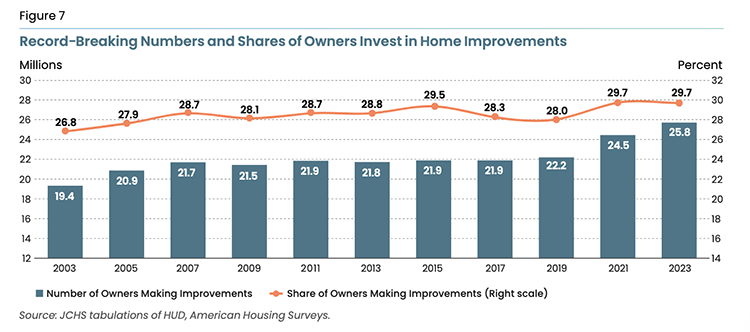
The shortage of affordable housing is unlikely to be resolved anytime soon. As affordable, move-in-ready housing solutions remain hard to find, the demand for construction and renovation loans is expected to increase. According to the JCHS, Harvard University, the US remodeling market soared above $600 billion in the wake of the pandemic and, despite recent softening, remains 50 percent above pre-pandemic levels.
Discover how to enhance borrower advantages through construction and renovation financing.
- Enhanced housing affordability.
- Housing options for aging or disabled borrowers.
- Housing solutions for borrowers caring for aging or disabled family members.
- Multi-generational housing solutions.
For any questions or inquiries regarding state education needs, please feel free to call.
Call Us Today! (866) 314-7586
Online self-study classes are available.
Sign up for 2025 Online self-study CE