
Why Haven’t Loan Officers Been Told These Facts?
UAD 3.6, More Than Just a New Appraisal Format
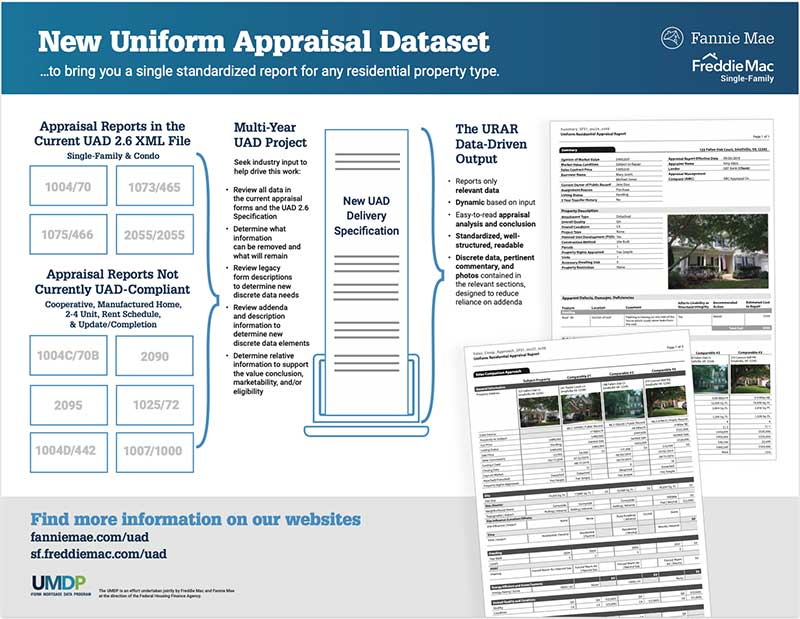
Fannie Mae and Freddie Mac, the government-sponsored enterprises (GSEs), have been actively redesigning the Uniform Appraisal Dataset (UAD) since 2018. A data set consists of a collection of related information, such as that required for a credit application (URLA/1003) or Uniform Residential Appraisal Report (URAR). The UAD constitutes the information collection to complete the URAR.
Differing versions of the data set necessitate naming conventions, hence the current 2.6 and the future 3.6.
By leveraging extensive stakeholder input, they are updating the appraisal dataset to align with the latest mortgage industry data standards (MISMO® v3.6). This initiative aims to eliminate the outdated GSE appraisal forms and introduce a single, data-driven, flexible, and dynamic appraisal report suitable for any type of residential property.
The UAD is part of an ongoing industry modernization called the Uniform Mortgage Data Program (UMDP). This project, undertaken jointly by Fannie Mae and Freddie Mac at the direction of the U.S. Federal Housing Finance Agency (FHFA), aims to enhance the quality and standardization of mortgage data.
UMDP comprises several initiatives that support the standardization of data sets, including UAD, loan applications (Uniform Loan Application Dataset, or ULAD), closings (Uniform Closing Dataset, or UCD), and loan delivery (Uniform Loan Delivery Dataset, or ULDD).
It’s essential to monitor these implementations and industry adoptions, as they will present opportunities for enterprising originators during and after these changes. Case in point, policies regarding accessory dwelling units (ADUs) are rapidly evolving, creating new opportunities for transactions in various areas. In certain locations, financing ADU transactions may serve as more than just a mere door opener.
ADU: Show Me The Money (Investors Need Not Apply)
The current UAD 2.6 policy differs from 3.6 in that only one ADU is permitted on the parcel of the primary one-unit dwelling. ADUs are not permitted with a two- to four-unit dwelling (B2-3-04, Special Property Eligibility Considerations (10/08/2025). There are some significant changes in 3.6, but only for primary residence (see page 26 et seq. of the 3.6 Guide).
Excerpted From FNMA 3.6 Policy:
FNMA is expanding the set of acceptable ADU transactions with UAD 3.6, providing lenders in the FNMA early adoption program a significant advantage over those not participating.
NOTE: For Fannie Mae- approved lenders not using UAD 3.6, the existing policies for completing appraisals under UAD 2.6 will remain in the current Selling Guide. Refer to Selling Guide Subpart B4, Underwriting Property, for complete policy guidance.
Fannie Mae occasionally releases information regarding policy updates ahead of their effective dates to provide lenders with sufficient time to prepare for implementation. The changes outlined below are effective for loans sold on or after March 31, 2026, and apply exclusively to lenders using UAD 3.6.
UAD 3.6 Expanded ADU Eligibility:
- Multi-Unit Properties: Updated eligibility criteria to allow 2- to 3-unit properties to include ADUs, provided the number of dwelling units in the primary structure plus the ADUs does not exceed four.
- Multiple ADUs on Single-Unit Properties: Extends eligibility to 1-unit properties with up to three ADUs.
- One ADU for Standard Manufactured Housing: Extends eligibility to single-unit MH (single-section or multi-section) as the primary dwelling with a single ADU classified as real property.
- Multiple ADUs for MH Advantage: Extends eligibility to MH Advantage (single-section or multi-section) as the primary dwelling, to include ADUs provided the number of dwelling units plus the ADUs (must all be classified as real property) does not exceed four.
UAD 3.6 FAQS FROM FNMA
See the recently updated FAQs at the link below.
1. What is UAD and why is it being updated?
The UAD is a standardized industry dataset for appraisal property reporting that is communicated electronically through the Uniform Collateral Data Portal® (UCDP®). Fannie Mae and Freddie Mac (GSEs) are updating the UAD to create a data-driven, dynamic reporting structure to capture property and market information. One limitation of the legacy forms is that additional required data is provided in a free-form commentary addendum. This update allows for one reporting structure that accounts for all property and inspection types. As part of this initiative, the GSEs are aligning to the latest version of the Mortgage Industry Standards Maintenance Organization (MISMO®) Reference Model 3.6.
UAD 3.6 will be mandatory for all new appraisal reports submitted to UCDP on or after November 2, 2026. Refer to the implementation timeline for details.
2. [NEW] How will the UAD 3.6 mandate be enforced?
UAD 3.6 becomes mandatory for all new appraisal reports submitted to UCDP on or after November 2, 2026. The November 2, 2026 mandate is based on the initial UCDP Submission Date of each report. If a UAD 2.6 appraisal report is submitted to UCDP on or after November 2, 2026, UCDP will return a Fatal message resulting in a “Not Successful” submission.
5. Are the appraisal report forms being replaced?
Yes. The appraisal report forms listed below are being retired and replaced with a single data-driven, flexible, dynamic structure for appraisal reporting. The redesigned Uniform Residential Appraisal Report (URAR), Restricted Appraisal Update Report, and Completion Report each have a similar look and feel to the Uniform Residential Loan Application (URLA) and the Closing Disclosure (CD).
- Uniform Residential Appraisal Report (1004 / 70)
- Uniform Residential Appraisal Report (Desktop) (1004 Desktop / 70D)
- Uniform Residential Appraisal Report (Hybrid) (1004 Hybrid / 70H)
- Individual Condominium Unit Appraisal Report (1073 / 465)
- Individual Condominium Unit Appraisal Report (Desktop) (1073 Desktop / 465D)
- Individual Condominium Unit Appraisal Report (Hybrid) (1073 Hybrid / 465H)
- Exterior-Only Inspection Individual Condominium Unit Appraisal Report (1075 / 466)
- Exterior-Only Inspection Residential Appraisal Report (2055 / 2055)
- Manufactured Home Appraisal Report (1004C / 70B)
- Individual Cooperative Interest Appraisal Report (2090)
- Exterior-Only Individual Cooperative Interest Appraisal Report (2095)
- Small Residential Income Property Appraisal Report (1025 / 72)
- Single Family Comparable Rent Schedule (1007 / 1000) * See FAQ # 8 for more information.
- Appraisal Update and/or Completion Report (1004D / 442)
6. Are form numbers going away?
Yes. With the new URAR, the data that describes the subject property drives the appraisal report, not a form type or number. Use the Functioning Without Form Numbers document to:
- Help understand how the URAR’s dynamic structure along with discrete and repeatable data replaces the legacy form numbers.
- Assist with transitioning to the redesigned report.
8. When is it acceptable to use the legacy Single-Family Comparable Rent Schedule (1007 / 1000)?
In most situations, the legacy Single-Family Comparable Rent Schedule form will not be completed separately, as estimating the monthly market rent will be part of the appraisal assignment and included in the new URAR under the Rental Information section.
When the need arises to establish a monthly market rent after the URAR has been completed, then the original appraiser must be engaged to amend the original URAR to include the Rental Information section.
In rare cases, the original appraiser will not be available to amend the appraisal report. In this situation, a different appraiser may complete the Single-Family Comparable Rent Schedule to satisfy the requirement for the loan. Please note, this form was never designed to be a standalone appraisal report and the alternate appraiser completing it must take the necessary steps to be compliant with the Uniform Standards of Appraisal Practice (USPAP).
9. [NEW] Can I use an operating income statement (216/998)?
There is no requirement by the GSEs to complete the Operating Income Statement. The GSEs have retired this form and do not expect to receive it through UCDP.
10. Does UAD 3.6 support different scopes of work for different types of appraisal assignments?
Yes. UAD 3.6 supports traditional, hybrid, desktop, and exterior appraisal assignments. Refer to the GSE Selling Guides for specific policies.
13. Does UAD 3.6 support FHA, VA, and USDA requirements?
Yes. The GSEs have worked closely with the government agencies – Federal Housing Administration (FHA), United States Department of Agriculture (USDA), and the Department of Veterans Affairs (VA) – to include their specific requirements in UAD 3.6. Contact each agency for their implementation plans.
Fannie Mae Selling Guide Supplement: Uniform Appraisal Dataset (UAD) 3.6 Policy, Published May 06, 2026
FNMA: Uniform Appraisal Dataset (UAD) 3.6 Frequently Asked Questions
BEHIND THE SCENES: REVENGE OF THE STATES
STATES ACT TO REMIND THE MORTGAGE INDUSTRY THAT FAIR LENDING AND DISPARATE IMPACT THEORY REMAIN ALIVE AND WELL
Recently, the LOSJ editor had an interesting exchange with a mortgage industry stakeholder. The stakeholder asserted that the Regulation B disparate impact rule change would “amend” the ECOA. I was sure they did not mean that an administrative rule amends a legislative act; rather, they were asserting that the Regulation B change was so profound that disparate impact, as an interpretation of prohibited conduct under the ECOA, would disappear. But then, I wouldn’t bet on that.
On April 22, 2026, the CFPB published its final version of the Regulation B rule change, holding that ECOA does not authorize disparate-impact liability (effects test). The rule change also redefines “discouragement” and adds prohibitions and conditions for Special Purpose Credit Programs. The LOSJ will unpack the final rule changes to “discouragement” and the special-purpose credit program at a later date.
Why These Changes Now
Executive Order 14281 of April 23, 2025
Restoring Equality of Opportunity and Meritocracy
Excerpted from the Executive Order: “Section 1 . Purpose. A bedrock principle of the United States is that all citizens are treated equally under the law. This principle guarantees equality of opportunity, not equal outcomes. It promises that people are treated as individuals, not components of a particular race or group. It encourages meritocracy and a colorblind society, not race- or sex-based favoritism. Adherence to this principle is essential to creating opportunity, encouraging achievement, and sustaining the American Dream.
But a pernicious [Word of the day] movement endangers this foundational principle, seeking to transform America’s promise of equal opportunity into a divisive pursuit of results preordained by irrelevant [Race, sex, religion, age, national origin, ethnicity, etc. are irrelevant? :0)] immutable [unchangeable] characteristics, regardless of individual strengths, effort, or achievement. A key tool of this movement is disparate-impact liability, which holds that a near insurmountable presumption of unlawful discrimination exists where there are any differences in outcomes in certain circumstances among different races, sexes, or similar groups, even if there is no facially discriminatory [purpose or intent to unlawfully discriminate] policy or practice or discriminatory intent involved, and even if everyone has an equal opportunity to succeed. Disparate-impact liability all but requires individuals and businesses to consider race and engage in racial balancing to avoid potentially crippling legal liability. It not only undermines our national values, but also runs contrary to equal protection under the law and, therefore, violates our Constitution.”
Is Disparate Impact Theory Dead
Executive Order 14281, titled “Restoring Equality of Opportunity and Meritocracy,” issued on April 23, 2025, and subsequent federal implementation of the executive order, do not invalidate the legal theory of disparate impact. Lawyers argue both sides of this argument with great alacrity (Hey, at a $1,000 an hour, why not?) and conviction. However, that hardly decides which way things will settle.
What the order does accomplish is to direct federal agencies responsible for administering these laws to make regulatory changes as are appropriate for the statutes they administer. As a result, agencies that must follow executive-branch edicts, such as the Department of Justice (DOJ), the Department of Housing and Urban Development (HUD), and the Consumer Financial Protection Bureau (CFPB), are amending their enforcement practices by executive fiat. Essentially, this means that federal regulators will not consider examinations, investigations, or enforcement actions based on the now-out-of-vogue theory of disparate impact.
For the mortgage industry, there are just a few flies in the ointment on this one. It goes without saying that as the legislative branch of the federal government, Congress still has a say. Consequently, without amendments to the Equal Credit Opportunity Act (ECOA) to unequivocally debar judicial acceptance of any disparate impact claim, or Supreme Court rulings on the theory’s validity under ECOA, the effects test remains a threat to mortgage lenders, permitting both state and private action, including class action lawsuits. Additionally, federal courts are far from beholden to the CFPB, HUD, or, for that matter, the executive branch.
Furthermore, some lenders may encounter real surprises when defending future federal disparate impact claims (Executive Orders, easy come, easy go). It remains uncertain whether a lender could avoid liability by relying on the en vogue fair lending interpretations when such interpretations are tenuous or even specious (Depending on who you talk to). In essence, the new ECOA final rule has constrained the application of disparate impact claims only insofar as the Consumer Financial Protection Bureau (CFPB) and other regulatory bodies are currently refraining from taking enforcement action based on such claims.
If the current attitude toward disparate impact theory changes back to its decades-old iteration (and why wouldn’t it?), will lenders be exposed even if they followed Regulation B rules in effect at the time of the infraction? Who wants to find that out?
In the proposal, the Bureau preliminarily determined that the interpretation in Regulation B that disparate-impact claims may be cognizable (applicable) under ECOA is not the best interpretation of ECOA. The Bureau noted that the Federal Reserve Board, the ECOA administrator before the CFPB, relied solely on the legislative history of ECOA to support its conclusion and failed to consider whether ECOA’s statutory language itself authorized disparate-impact liability. The Bureau preliminarily determined that ECOA’s statutory language does not authorize disparate-impact liability and that the application of disparate-impact liability in the credit context may undermine ECOA’s purposes.
The contrast between today and yesterday is notable. The CFPB’s argument that the ECOA does not explicitly authorize disparate impact liability is fundamentally at odds with the position the agency advanced a few years earlier in CFPB v. Townstone. In that instance, the lower court ruled contrary to the CFPB’s prior assertions regarding the statutory language and discouragement.
Discouragement and disparate impact are distinct concepts; however, they are related in that neither is explicitly characterized as unlawful discrimination in the legislative text, nor do alleged violations require an applicant, yet both have long been considered unlawful discrimination by jurists and legislators.
In CFPB v. Townstone, the lower court supported the CFPB’s current position, holding that the ECOA does not expressly prohibit discouragement. However, the appeals court ruled in favor of the old CFPB policy, overturning the lower court’s decision on the grounds that ECOA’s legislative intent permits this interpretation. The appeals court ruled that there need not be an applicant to violate ECOA.
The appeals court ruled that “The term ‘applicant’ cannot be read in a crabbed fashion that frustrates the obvious statutorily articulated purpose of the statute. Indeed, the ECOA’s scope of prohibition prohibits discrimination “with respect to any aspect of a credit transaction.” 15 U.S.C. § 1691(a) (emphasis added). Congress well understood that “any aspect of a credit transaction” had to include actions taken by a creditor before an applicant ultimately submits his or her credit application.
We shall see.
The Final Rule
The Bureau is making changes to § 1002.6(a) and its accompanying commentary. It is the Bureau’s responsibility to correctly interpret ECOA. The Supreme Court in Loper Bright Enterprises v. Raimondo confirmed that “statutes . . . have a single, best meaning” that is “ `fixed at the time of enactment.’ ” The Bureau has examined Regulation B, considered comments, and determined that, under the best reading of the statute, disparate-impact claims are not cognizable under ECOA. As a result, the Bureau is deleting language in § 1002.6(a) and its accompanying commentary indicating that disparate-impact liability, which is referred to in the rule as the “effects test,” may be applicable under ECOA, and adding language stating that the Act does not recognize the “effects test.” The Bureau is also deleting the language in comment 2(p)-4 referring to the “effects test.”
The State’s Revenge
The recent federal deregulation of consumer protection and fair lending laws is likely to prompt many states to take action. And many already have. This change will likely have a net negative impact on most stakeholders, except lawyers. Instead of having a unified approach, the mortgage industry now faces a complex patchwork of compliance risks. As a result, consumers will be harmed in multiple ways. Some lenders may reduce their credit offerings in states that become too risky to operate in. Those lenders who remain in the market will need to adjust their prices to account for the increased risk.
As mentioned, states have the freedom to interpret laws as they see fit. When it comes to prosecuting violations of the ECOA, there is no requirement to make claims in federal courts or to collaborate with federal law enforcement agencies. States have enacted laws that deem violations of federal consumer protection and fair lending laws as statutory offenses. Defending against such claims can be quite challenging.
States have learned to cooperate when taking on significant prosecutions involving persons with a national footprint. They will determine which jurisdiction is most favorable for pursuing disparate impact lawsuits and file their cases there, often joined by a dozen or more other states.
It is clear that when the cat is away, the mice will play. As a result, illegal discrimination and predation are likely to increase, setting the stage for another wave of both state and federal re-regulation.
For Example
Date: April 22, 2026
To: Entities Regulated by the New York State Department of Financial Services under the New York Banking Law
Re: New York Executive Law Section 296-a
The New York State Department of Financial Services (DFS) is issuing this industry letter to remind all entities regulated by the Department under the New York Banking Law of their obligations under New York State’s fair lending law, N.Y. Exec. Law § 296a (“Section 296-a”).
The Department is authorized to enforce state fair lending laws and to impose penalties for violations of federal fair lending laws. N.Y. Exec. Law § 296-a(8), N.Y. Banking Law § 9-d, N.Y. Fin. Serv. Law § 408(a)(1)(B).
Regulated Entities are reminded that under Section 296-a, covered credit decisions that result in a disparate impact may constitute an unlawful discriminatory practice.
Section 296-a prohibits discrimination in, among other things, the granting, withholding, extending, or renewing, or in the fixing of the rates, terms, or conditions of any form of credit on the basis of statutorily established characteristics. N.Y. Exec. L. § 296-a(1)(b). Discrimination is prohibited on the basis of race, creed, color, national origin, citizenship or immigration status, sexual orientation, gender identity or expression, military status, age, sex, marital status, status as a victim of domestic violence, disability, or familial status. Id.
Regulated Entities must comply with all applicable New York State laws, including Section 296-a. This industry letter does not impose any new requirements on Regulated Entities.

Tip of the Week: Sign up for 2026 CE
The LOSJ is celebrating five years of exceptional service to the mortgage industry, offering insights you won’t find anywhere else. To celebrate, enjoy our gift to you! Use the promo code “newsletter” when placing your class order.
Expanding your product offerings is an effective way to enhance your business’s vitality. This year, the Loan Officer School is surveying non-Qualified Mortgage (non-QM) financing options. We will review the various types of underwriting required for non-QM financing, including higher-priced mortgage loans (HPML), balloon-payment features, and interest-only options.
Presenting non-QM solutions to consumers improperly can lead to serious consequences. Understand the essentials of compliant and ethical subprime mortgage origination. Attend the Loan Officer School 2026 continuing education classes.
Please use the promo code “newsletter” when you sign up.
Have a Question About Operations, Sales, Marketing, or Compliance? Email Your Questions to the Loan Officer School Journal.
We invite LOSJ readers to submit questions on any topic to the editor. Topics can include compliance, sales, marketing, implementation, and other areas that may be helpful to our customers. If we use your question, we will include only your first name in our response. Please send your questions to: losjmailbag@gmail.com.
Necessary Mailbag Disclosure: The LOSJ is a periodic publication from LoanOfficerSchool.com designed to educate and inform our readers. Please note that we do not provide legal advice, and nothing in the LOSJ should be construed as a legal opinion on specific facts or circumstances. The content serves strictly for informational purposes. We strongly advise readers to consult legal counsel regarding any legal matters or specific questions.