
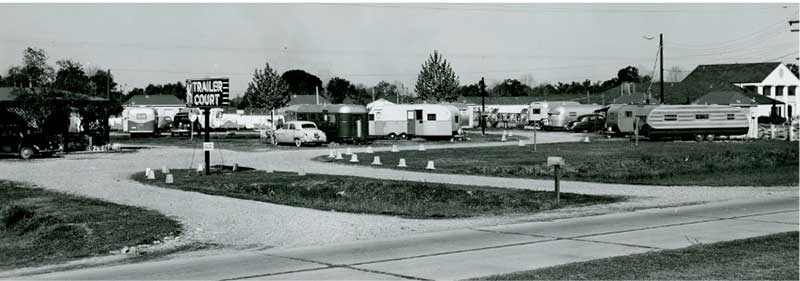
Manufactured housing has come a long way.
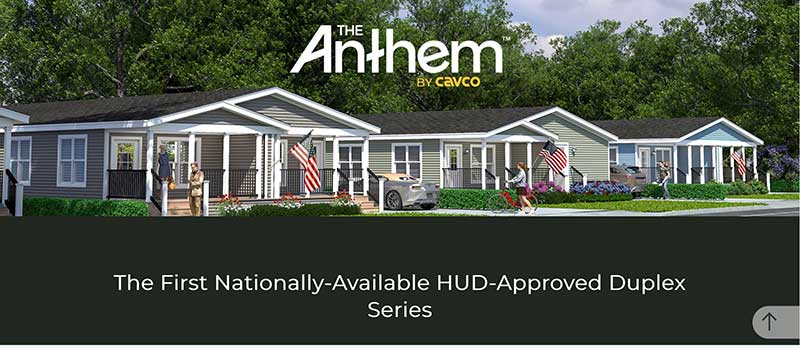
Image of a manufactured housing duplex, courtesy of CAVCO
Why Haven’t Loan Officers Been Told These Facts? Crossover Modern Homes, Manufactured Homes and Modular Housing; Where to Get Started
Factory-built housing refers to homes constructed in factories, often far off-site, unlike traditional “site-built” homes that are built on location. However, the term “factory-built” is not usually the term used by stakeholders to describe houses constructed in this manner. The common terminology used to differentiate factory-built homes has an interesting history. The most widely used and broadest differentiation for factory-built homes is “manufactured homes” and “modular homes.” What distinguishes one from the other is the standard to which the factory-built home is built.
Prior to 1976, most factory-built homes were characterized by their mobile nature, featuring smaller, lighter construction with a chassis like a car or truck and wheels that facilitated ease of relocation. These structures were commonly referred to as “trailers or mobile homes.” Rapid construction of mass-produced mobile homes often resulted in poorly built structures with inadequate insulation, thin roofs and walls, substandard windows, and inefficient heating and cooling systems. Leaks during inclement weather were common.
Excerpted From the Manufactured Housing Association of Oklahoma
The first manufactured home dates back to 1764 when a two-story panelized frame dwelling was shipped from London to Cape Ann, Massachusetts. By the early 1900s, the English were building custom vans; and an American devised a fifth-wheel hitch to attach a travel wagon to his roadster.
Assembly line production began in 1926 in New York, although most mobile homes were used for vacations. The first models had no indoor plumbing.
Campgrounds, or trailer parks, soon began sprouting up on the outskirts of many towns. During World War II, production increased as the U.S. government purchased mobile homes so workers could live near plants. By the late 1940s, trailer lengths had increased to more than 30 feet and small bathrooms were added. Some people also began making them their permanent homes.
In the 1960s, two-section mobile homes became popular, and the Mobile Home Craftsmen Guild developed a mobile home construction code. During the 1970s, one mobile home was built for every three site-built homes.
In 1978, the U.S. Department of Housing and Urban Development established a national building code for manufactured housing, which changed the industry to what we see today.
The Mobile Home Construction and Safety Standards Act of 1974
The HUD Code was established by the National Manufactured Housing Construction and Safety Standards Act of 1974. The law was originally titled the Mobile Home Construction and Safety Standards Act of 1974.
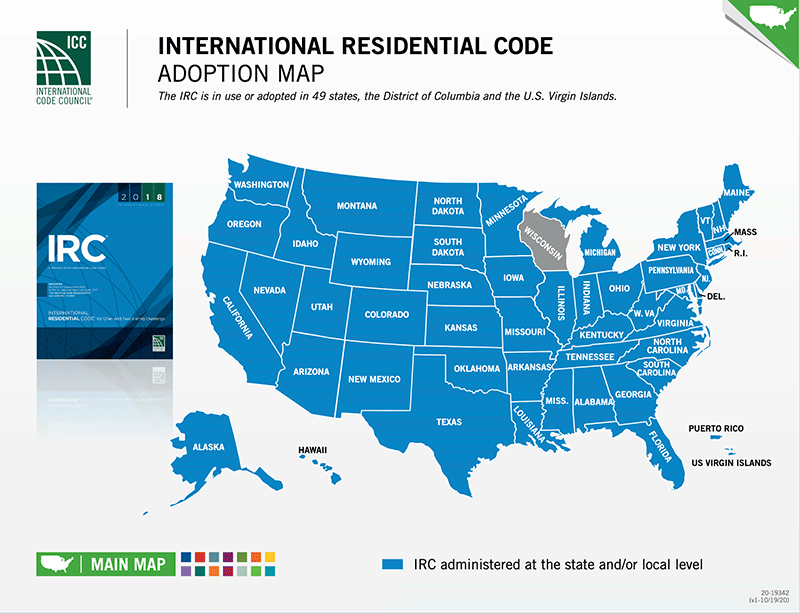
Mobile home build quality varied tremendously, with some units posing safety issues. Congress acted to impose minimum construction standards. Stakeholders generally consider homes built to the HUD Code to be of inferior quality to homes built to local building codes. Generally, local building codes are based on the International Residential Code (IRC), which was created to serve as a complete, comprehensive code regulating the construction of single-family houses, two-family houses (duplexes), and buildings consisting of three or more townhouse units. This code is used as the basis for laws and regulations in many communities in the US and other countries. The IRC is intended to be adopted in accordance with the laws and procedures of a governmental jurisdiction. As a model code, the IRC is adopted in 49 states (See IRC image).
As a federal law, the HUD Code preempts local building codes. The legal meaning of preemtion, according to Black’s Law Dictionary, founded on the United States Constitution, Article VI, Clause 2 (the Supremacy Clause,) declares that in “the [U.S.] Constitution, all laws made in furtherance of the Constitution, and all treaties made under the authority of the United States are the ‘supreme law of the land’” and supersede conflicting provisions in state laws or state constitutions.”
Build Characteristics and Mortgage Financing
To promulgate the National Manufactured Housing Construction and Safety Standards Act of 1974, HUD established the Manufactured Home Construction and Safety Standards (MHCSS) regulations, commonly referred to as the HUD Code (24 CFR 3280), in 1976. Consequently, builds after the HUD Code took effect are commonly referred to as manufactured housing. Builds from before the Code took effect are called mobile homes.
In the past, with the exception of Title I, mobile homes were financed like any other type of personal property, typically with longer loan terms. Title I is the oldest federal housing loan insurance program in the United States, established in 1934 as part of the National Housing Act. Its purpose was to allow the Federal Housing Administration (FHA) to insure loans for home improvements. In 1969, Congress expanded Title I insurance to include loans for manufactured housing. Under Title I, the FHA insures loans for manufactured homes that do not qualify as real estate.
Borrowers using Title I financing can purchase a manufactured home along with a land lot, finance only the home, or finance only the land lot. Importantly, Title I financing does not require the homebuyer to own the land where the manufactured home is situated, nor does the home need to be permanently affixed to the land. FHA-approved lenders provide Title I loans to eligible borrowers using their own funds, while the FHA insures these lenders against potential losses.
Manufactured Housing and Mortgage Loans
A modular home is the term used to describe a factory-built home that conforms to local building codes, generally the International Residential Code (IRC). The mortgage financing of a modular home differs little from site-built homes.
From FNMA B4-1.4-02, Factory-Built Housing: Modular, Prefabricated, Panelized, or Sectional Housing (10/06/2021)
Modular homes must be built under the International Residential Code (IRC) that is administered by the state agency that is responsible for adopting and administering building code requirements for the state in which the modular home is installed. Prefabricated, panelized, or sectional housing does not have to satisfy either HUD’s Federal Manufactured Home Construction and Safety Standards or the IRC that are adopted and administered by the state in which the home is installed. The home must conform to local building codes in the area in which it will be installed.
How Manufactured Housing Loans Differ from Site-Built and Modular Homes
To understand the associated financing risks and loan requirements of manufactured housing, loan officers need to adopt a lender’s perspective. Generally, manufactured homes are considered to be of lower quality compared to site-built homes. Whether or not this perception is accurate is debatable. This concern affects the market for these homes and consequently, their value. Therefore, concerns regarding property requirements and the suitability of these homes as collateral become significant factors to consider. Appraisal standards are where the lenders must be careful. For modular homes, the appraiser, as always, has wide discretion. Allowable comparables may be modular or site-built. Generally, with manufactured housing, the appraiser must use a different approach and chiefly rely on manufactured home comparables.
The CrossMod
The GSEs have addressed some of the financing hurdles with a new category of manufactured home financing that looks more like modular or site-built homes. These programs afford borrowers the same caliber of financing as modular homes. A “CrossMod” home is a new class of manufactured home introduced by the Manufactured Housing Institute that is built to construction, architectural design, and energy efficiency standards more consistent with site-built homes. The CrossMod home has aesthetics, architectural elements, and dwelling specifications that exceed the minimum standards required for traditional HUD-coded manufactured homes. These factory-built homes have features comparable to conventional, site-built properties. This is a substantive step for next-generation affordable housing.
Next week, the LOSJ will outline financing enhancements for CrossMod manufactured homes under FNMA’s MH Advantage® or FHLMC’s CHOICEHome®.
Manufactured Housing Institute
BEHIND THE SCENES: VA MORTGAGE FRAUD
DHS Employee Charged With Fraudulently Obtaining $478,000 VA-Backed Mortgage
Tuesday, July 21, 2026
From the U.S. Attorney’s Office, District of Massachusetts
BOSTON – A Department of Homeland Security (DHS) employee has been arrested and charged for allegedly committing wire fraud and submitting false statements in a mortgage application seeking a mortgage backed by the Department of Veteran’s Affairs (VA).
Schleider Aristhyl, 30, of Warwick, R.I., a military veteran and DHS employee, was charged with wire fraud and false statement in a mortgage application. The defendant was released on conditions following an initial appearance in federal court in Boston earlier today.
According to the charging documents, in October 2024, Aristhyl submitted two falsified documents that purported to be from the VA with his application seeking a VA-backed mortgage in the amount of $478,000 from private lender. The first fraudulent document stated that Aristhyl had received a VA disability rating of 100% and that he was receiving monthly disability benefits of over $3,000 per month. It is alleged that the document was falsified and that Aristhyl had no VA disability rating at the time of his application and he was not receiving any monthly disability benefits from the VA in October of 2024.
The second fraudulent document allegedly purported to be a VA certificate stating that Aristhyl was exempt from paying a “funding fee” to the VA. Veterans applying for a VA-backed mortgage are typically required to pay a funding fee to the VA, unless they are deemed exempt under VA rules. It is alleged that the document was falsified and that Aristhyl was not exempt from paying the funding fee, which was over $10,000.
Relying on the misrepresentations in these false documents the lender issued a mortgage loan in the amount of $478,000 to Aristhyl on Oct. 25, 2024 and the VA issued a loan guarantee backing a portion of the mortgage on Jan. 21, 2025.
The charge of wire fraud provides for a sentence of up to 30 years in prison, five years of supervised release and a fine of $250,000. The charge of false statement in a mortgage application provides for a sentence of up to 30 years in prison, five years of supervised release and a fine of $250,000. Sentences are imposed by a federal district court judge based upon the U.S. Sentencing Guidelines and statutes which govern the determination of a sentence in a criminal case.
United States Attorney Leah B. Foley and Special Agent in Charge Christopher Algieri with the Department of Veterans Affairs Office of Inspector General’s Northeast Field Office made the announcement today. Valuable assistance was provided by Immigration and Custom Enforcement’s Office of Professional Responsibility and the U.S. Customs and Border Protection’s Office of Professional Responsibility with the U.S. Department of Homeland Security. Assistant U.S. Attorney Julissa Walsh of the Major Crimes Unit is prosecuting the case.
The details contained in the charging document are allegations. The defendant is presumed to be innocent unless and until proven guilty beyond a reasonable doubt in the court of law.

Tip of the Week: Sign up for 2026 CE
The LOSJ is celebrating five years of exceptional service to the mortgage industry, offering insights you won’t find anywhere else. To celebrate, enjoy our gift to you! Use the promo code “newsletter” when placing your class order.
Expanding your product offerings is an effective way to enhance your business’s vitality. This year, the Loan Officer School is surveying non-Qualified Mortgage (non-QM) financing options. We will review the various types of underwriting required for non-QM financing, including higher-priced mortgage loans (HPML), balloon-payment features, and interest-only options.
Presenting non-QM solutions to consumers improperly can lead to serious consequences. Understand the essentials of compliant and ethical subprime mortgage origination. Attend the Loan Officer School 2026 continuing education classes.
Please use the promo code “newsletter” when you sign up.
Have a Question About Operations, Sales, Marketing, or Compliance? Email Your Questions to the Loan Officer School Journal.
We invite LOSJ readers to submit questions on any topic to the editor. Topics can include compliance, sales, marketing, implementation, and other areas that may be helpful to our customers. If we use your question, we will include only your first name in our response. Please send your questions to: losjmailbag@gmail.com.
Necessary Mailbag Disclosure: The LOSJ is a periodic publication from LoanOfficerSchool.com designed to educate and inform our readers. Please note that we do not provide legal advice, and nothing in the LOSJ should be construed as a legal opinion on specific facts or circumstances. The content serves strictly for informational purposes. We strongly advise readers to consult legal counsel regarding any legal matters or specific questions.