
Why Haven’t Loan Officers Been Told These Facts? New Construction Property Tax Escrow
The Loan Officer School Journal provides examples of enforcement actions for informational purposes only. The veracity of the complainant’s allegations is unknown, and such allegations should in no way be construed as legal facts. LoanOfficerSchool.com does not intend to imply that the Complainee has violated any laws or ethical boundaries, nor does it suggest that the Complainant possesses evidence of misconduct by the Complainee.
Last year, the LOSJ wrote about a class action lawsuit filed in Florida against the nation’s largest homebuilder, D.R. Horton, and its mortgage company subsidiary, DHI Mortgage. “The lawsuit alleges that D.R. Horton targets prospective homeowners by promising low, affordable monthly payments, and then works with DHI Mortgage to suppress the actual cost of the home by illegally excluding the majority of required property taxes from the initial monthly payment.”
“On December 4, 2025, this case was voluntarily dismissed. A new case, Robinson v. D.R. Horton, has been filed in the District of Nevada, pursuing similar claims for a broader group of homeowners who were harmed by the Defendants’ conduct nationwide.” – Announcement from Plaintiff’s counsel
Excerpts from the Nevada Filing: The Allegations
Defendant DR Horton, one of the country’s largest home builders, operates a deceptive bait-and-switch scheme that conceals the true monthly cost of purchasing its homes from unsuspecting homebuyers. This deception makes DR Horton’s homes appear more affordable than
competitors’ properties, while enabling homebuyers to qualify for loans on homes that cost more
than they understand they can afford.
To carry out its scheme, DR Horton works with its “preferred” mortgage lender, DHI Mortgage, to entice prospective homebuyers—predominately middle- and working-class Americans—by promising them low, affordable monthly payments. In reality, Defendants create artificially low monthly mortgage payment quotes by deliberately including only a fraction of required property taxes in their payment calculations, while knowingly excluding the remaining taxes. Through this “Monthly Payment Suppression Scheme,” DR Horton and DHI Mortgage mislead homebuyers into believing their total monthly housing costs will fit within their monthly budget. But Defendants have actual knowledge of the true property tax amounts throughout the entire home sales and financing process, and they know what homebuyers’ monthly payments will actually be; however, they prominently and repeatedly center the suppressed monthly payment to homebuyers.
It is not until well after closing that homebuyers learn the truth, when their monthly payments increase by hundreds of dollars. By this time, DHI Mortgage has transferred the loan, and a new mortgage servicer delivers the bad news.
Defendants are able to obscure their misleading property tax estimates from borrowers because of their integrated business model, which allows for the knowing cooperation of the home builder and seller, DR Horton, and its “preferred” mortgage lender, DHI Mortgage. By working together, defendants have devised uniform marketing practices, in which their sales agents focus homebuyers on artificially suppressed monthly payments, a tactic that flows through every step of the process, from the initial pitch to closing. Defendants jointly profit from the scheme, through increased home prices and increased fees charged as a percentage of home price. Consumers lose substantially. They overpaid for their homes and now must pay substantially more out of pocket each month than they were promised.
For example, Defendants promised the Santorii-Whitney Family a monthly payment of $2,878.57. Based on this payment, the Santorii-Whitney Family chose a DR Horton home with a DHI Mortgage loan because the monthly payment was—according to Defendants—lower than other homes with similar sales prices. But, less than a year after closing, the Santorii-Whitney Family payment skyrocketed from $2,878.57 to $3,968.84 per month when the new servicer conducted an escrow analysis that included all of their property taxes as well as the amounts the Santorii-Whitney Family now had to cover for back taxes due to this scheme.
Defendants execute this scheme through a deliberate bait-and-switch, designed to avoid detection until after purchase. First, DR Horton, through its sales agents, and DHI Mortgage, through its loan officers, solicit from the Homebuyer the amount they are able to pay on a monthly basis (the “Target Monthly Payment”). Then, prior to and at closing, DHI Mortgage provides the Homebuyer with written disclosures that confirm that the final monthly payment will match the Target Monthly Payment. DHI Mortgage does this by including in the disclosures a “Suppressed Estimate” of the amount that will be included in the Homebuyer’s monthly escrow payment using the low property tax assessment for the unimproved land before DR Horton built the home. Defendants know that this Suppressed Estimate is not correct for the property after the home is built, but rather, dramatically, and falsely depressed.
Through their Monthly Payment Suppression Scheme, Defendants systemically cut the amount escrowed for property taxes by up to 80% annually. For example, DHI Mortgage might include in the escrow payment taxes of $1,500 per year instead of a good faith and legally required estimate of $7,500 per year that it reasonably anticipates, and has actually calculated in the True Estimate, will be charged. The end result is that the monthly payment estimate is off by up to $500 per month or $6,000 per year—plus any extra cushion the servicer can collect.
By focusing the Homebuyer on Defendants’ ability to sell them a home and mortgage that will conform to the Homebuyer’s Target Monthly Payment, Defendants’ advertising and sales efforts take advantage of a common pattern of consumer behavior which psychologists have called an “anchoring and adjustment heuristic.” This heuristic is an observed cognitive bias where people beginning a transaction “anchor” on information about the transaction that they consider the most important, and use that anchor as a mental benchmark, or starting point, for estimating value. This ultimately leads the consumer to overlook, discount, or insufficiently adjust for information provided later. Where the most important information is price, consumers anchor their decision to the price the lender first presented, and overlook, discount, or insufficiently adjust their decision-making when surcharges or additional cost information is disclosed. In this case, DR Horton anchors the Target Monthly Payment in the Homebuyers’ minds by assuring them that any home will fit in their budget, a detail repeated by DHI Mortgage during the lending process.
This is further reinforced with another common pattern of consumer behavior which psychologists have called “confirmation bias,” which is the tendency to interpret new evidence as confirmation of one’s existing beliefs. DR Horton and DHI Mortgage exploit confirmation bias to ensure that any conflicting information provided in fine print is overlooked.
Count I: Racketeer Influenced and Corrupt Organizations Act (RICO Act)
Invoking the RICO Act for what amounts to violations of civil statutes is serious business.
The RICO Act allows plaintiffs to file a lawsuit because DHI Mortgage and D.R. Horton are allegedly considered an association-in-fact of individuals, which is necessary to demonstrate a conspiracy between two or more parties. Given the interstate nature of their collaboration, its duration, and the frequency of alleged misconduct—including wire transfers, interstate commerce, and fraud resulting in injury—the plaintiffs believe they have standing to initiate a RICO action. The act permits private individuals to sue when they have been harmed by such violations.
A Brief Diversion, A History of the RICO ACT, From the U.S. Department of Justice
RICO was enacted in 1970 as Title IX of the Organized Crime Control Act. The roots of RICO, however, extend as far back as 1950, when the problem of criminal infiltration of legitimate business was documented. In the 1960’s, antitrust laws were used to attack this criminal activity in business. The extent of the problem motivated Congress to develop direct criminal legislation to combat patterned infiltration of legitimate business by ‘organized’ and ‘nonorganized’ criminal activity. RICO is the result of the assimilation of several strong Senate bills modified by the House of Representatives.
RICO proscribes:
(1) the use of income or proceeds from a pattern of racketeering activity by a principal in the commission of that activity to acquire an interest or establish an enterprise engaged in interstate commerce,
(2) the acquisition of any enterprise engaged in interstate commerce through a pattern of racketeering activity,
(3) the operation of an enterprise engaged in interstate commerce through a pattern of racketeering activity, and
(4) conspiracy to commit any of the above prohibitions.
District courts may restrain violations of these prohibitions by issuing orders of divestment, prohibitions on business activities, and orders of dissolution or reorganization. Unrestrained violations may be punished by fine, imprisonment, and criminal forfeiture of the offender’s interest in the enterprise. Victims of RICO violations may also bring civil treble-damages actions. RICO makes provision for nationwide venue and service of process, expedition of Government civil actions, and civil investigative demands.
RICO 18 U.S.C.Section 1962(c) makes it unlawful for any person employed by or associated with any enterprise engaged in, or the activities of which affect, interstate or foreign commerce, to conduct or participate, directly or indirectly, in the conduct of such enterprise’s affairs through a pattern of racketeering activity.
Count II Nevada Deceptive Trade Practices Act
Nev. Rev. Stat. §§ 598.0903 through 598.0999; Nev. Rev. Stat. § 41.600
This scheme is deceptive as defined by DTPA because Defendant has an unfair advantage over Plaintiffs and the Nevada Subclass as well, as they were not fully informed of the details of the transaction at the time they compared the monthly payment or PITI of an existing home with the DR Horton home.
COUNT III Florida Deceptive and Unfair Trade Practices Act (“FDUTPA”) Fla. Stat. § 501.201, et seq.
Defendants violated FDUTPA in three distinct ways, each of which, standing alone, is a violation of FDUTPA: (i) Defendants engaged in per se violations of rules intended to protect consumers; (ii) Defendants engaged in deceptive acts or practices; and/or (iii) Defendants engaged in unfair acts or practices, committed an unfair, immoral, and unethical practice that is substantially injurious to consumers. By violating FHA, RESPA, and/or TILA, Defendants engaged in a per se violation of
FDUTPA.
COUNT IV Negligence (On behalf of Plaintiffs and the Class)
Defendants owed a duty of care to Plaintiffs and Class members in Defendants’ marketing and sales of homes; and in Defendants’ marketing, sales, and origination of home loans. Defendants breached this duty by failing to accurately calculate the PITI payment, by failing include all taxes in the escrow analysis; and by thereby failing to disclose an accurate payment to borrowers. The Truth in Lending Act (“TILA”) requires that the Closing Disclosure must accurately disclose projected payments, including accurately estimated escrow payments. 12 C.F.R. § 1026.38(c).
COUNT V Unjust Enrichment (On behalf of Plaintiffs and the Class)
The circumstances, as alleged herein, including that Defendants suppressed the true monthly payment from Plaintiffs and the Class and led Plaintiffs to believe that the monthly payments would be substantially lower, leading ultimately to payment shock for Plaintiffs and the Class, make it inequitable for Defendants to retain the benefits of their scheme.
Next week, the LOSJ will further examine the plaintiff’s specific complaints.
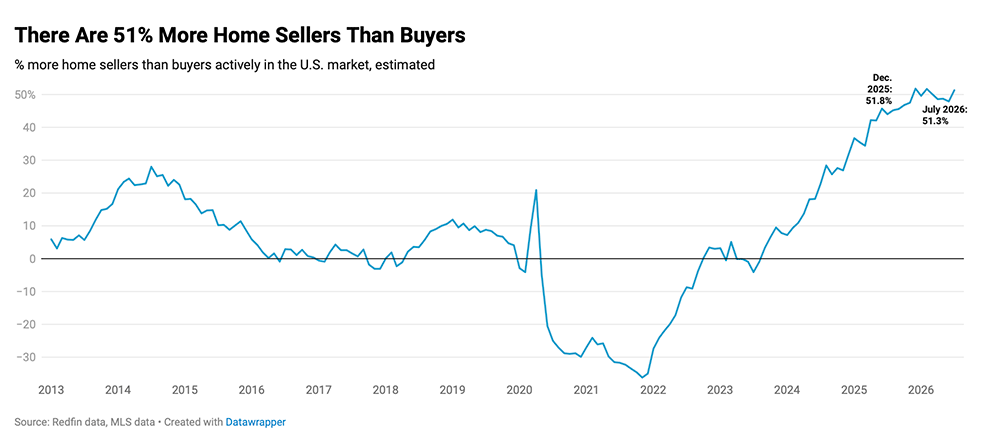
BEHIND THE SCENES: REDFIN REPORT INDICATES SELLER-TO-BUYER RATIO INCREASING
The Number of U.S. Homebuyers Just Dropped to a Record Low, Shifting the Market Further in Buyers’ Favor
-
Sellers outnumbered buyers by 51% in July—just shy of December’s record high—giving buyers more negotiating power.
-
The number of buyers in the market fell to a record low of about 967,000 amid historically high housing costs, almost half a million fewer than the 1,463,000 sellers.
-
Nearly 80% of major U.S. metros are now buyer’s markets, led by Miami (154% more sellers than buyers), Nashville and a trio of Texas cities. House hunters in those places have a lot of negotiating power.
-
There are just 6 seller’s markets in the U.S., led by New York City suburbs, where demand is relatively strong.
Most buyer’s markets got even more buyer-friendly in July, with 34 of 39 metros seeing bigger seller surpluses, led by Miami, Seattle and Fort Worth.
With sellers outnumbering buyers, why are high prices remaining so stubborn? The answer may be simpler than one might think. One key concept to understand is the “absorption rate.”
The absorption rate is a statistical measure that describes the relationship between the number of homes for sale and how long they take to sell. Low absorption rates can pose challenges for sellers. As housing inventory builds, prices tend to come under downward pressure. As the time it takes to sell a home lengthens, and assuming a level supply of new listings, the overall housing stock may increase exponentially, leading to greater downward price pressure.
For example, if the average time on market is 120 days and the seller hopes to sell in 60, the seller generally must make the selling price stand out absent any other compelling selling features. As the number of homes for sale increases, the number of competing homes with comparable compelling selling features also increases. A percentage of these sellers will always put a premium on “time.” As new entrants arrive in the seller field, without seller-buyer parity, inventory continues to build. Consequently, the number of time-sensitive sellers increases, putting real price pressure on other sellers.
In markets such as those identified in the Redfin Report with triple-digit seller-to-buyer ratios, 20 to 25 houses are available for every 10 buyers. Any rapid inventory increase in these markets deserves careful attention.
Typically, a relatively low absorption rate is considered to be less than 15%. The absorption rate refers to the percentage of houses sold each month compared to the total number of single-family homes available for sale in the market.
For instance, a 15% absorption rate works like this: If there are 100 homes for sale and 15 homes close in a month, it would take over 6.5 months to sell all the homes currently on the market. The calculated absorption rate in this example does not account for the effect of the trending seller-to-buyer dynamic. As commonly used, the absorption rate is an overly broad and clumsy market indicator.
Using trend analysis, modeling future absorption rates in a market with a significant imbalance between sellers and buyers is critical. While we won’t go into the algebraic details, it’s important to note that decreasing absorption rates lead to decreasing absorption rates. Therefore, lenders and investors must understand the fundamentals of absorption modeling. Remember, the trend is your friend.
Using a standard absorption rate as a blanket measure fails to account for trend nuances and market dynamics. In some areas, a 20% absorption rate might indicate a buyer’s market. Keep an eye on the trends.
Professional investors are acutely aware of absorption rates as they relate to their holdings. Much like in the stock market, as an investor, you want to avoid being late to the party if prices begin to fall below historic support levels. Absorption rate trends are critical in this analysis.
Check out the full Redfin report below.
See the Full Report: Redfin August 13 Report

Tip of the Week: Sign up for 2026 CE
The LOSJ is celebrating five years of exceptional service to the mortgage industry, offering insights you won’t find anywhere else. To celebrate, enjoy our gift to you! Use the promo code “newsletter” when placing your class order.
Expanding your product offerings is an effective way to enhance your business’s vitality. This year, the Loan Officer School is surveying non-Qualified Mortgage (non-QM) financing options. We will review the various types of underwriting required for non-QM financing, including higher-priced mortgage loans (HPML), balloon-payment features, and interest-only options.
Presenting non-QM solutions to consumers improperly can lead to serious consequences. Understand the essentials of compliant and ethical subprime mortgage origination. Attend the Loan Officer School 2026 continuing education classes.
Please use the promo code “newsletter” when you sign up.
Have a Question About Operations, Sales, Marketing, or Compliance? Email Your Questions to the Loan Officer School Journal.
We invite LOSJ readers to submit questions on any topic to the editor. Topics can include compliance, sales, marketing, implementation, and other areas that may be helpful to our customers. If we use your question, we will include only your first name in our response. Please send your questions to: losjmailbag@gmail.com.
Necessary Mailbag Disclosure: The LOSJ is a periodic publication from LoanOfficerSchool.com designed to educate and inform our readers. Please note that we do not provide legal advice, and nothing in the LOSJ should be construed as a legal opinion on specific facts or circumstances. The content serves strictly for informational purposes. We strongly advise readers to consult legal counsel regarding any legal matters or specific questions.
[/fusion_text][/fusion_builder_column][/fusion_builder_row][/fusion_builder_container]