
Why Haven’t Loan Officers Been Told These Facts? New Construction Property Tax Escrow
The Loan Officer School Journal provides examples of enforcement actions for informational purposes only. The veracity of the complainant’s allegations is unknown, and such allegations should not be construed as legal facts. LoanOfficerSchool.com does not intend to imply that the Complainee has violated any laws or ethical boundaries, nor does it suggest that the Complainant possesses evidence of misconduct by the Complainee.
Last year, the LOSJ wrote about a class action lawsuit filed in Florida against the nation’s largest homebuilder, D.R. Horton, and its mortgage company subsidiary, DHI Mortgage. “The lawsuit alleges that D.R. Horton targets prospective homeowners by promising low, affordable monthly payments, and then works with DHI Mortgage to suppress the actual cost of the home by illegally excluding the majority of required property taxes from the initial monthly payment.”
“On December 4, 2025, this case was voluntarily dismissed. A new case, Robinson v. D.R. Horton, has been filed in the District of Nevada, pursuing similar claims for a broader group of homeowners who were harmed by the Defendants’ conduct nationwide.” – Announcement from Plaintiff’s counsel
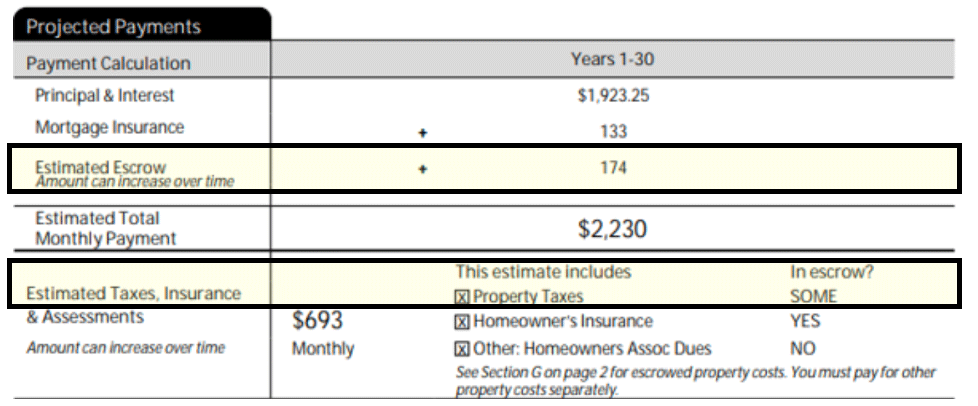
Plaintiff’s Loan Estimate Exhibit
The Allegations: The Loan Estimate
The LOSJ has evaluated several specific plaintiff complaints from the Nevada and Florida federal lawsuits. To narrow the discussion, we’ve limited our comments to those complaints involving federal mortgage disclosure requirements.
Though the Florida matter was dismissed, it still provides subject matter for the TILA discussion.
In the now-dismissed Middle District of Florida Federal Court action, the complaint focused on what the plaintiff claimed to be a pattern of willfully understated property tax estimates. The complaint’s thrust is that the plaintiffs should have clear, less ambiguous, or noncontradictory early property tax disclosure.
From the Florida complaint, the main issue appeared to be that since property tax assessments change significantly once unimproved land is improved, and because this type of property tax circumstance is well understood by the builder and lender, the lender’s Loan Estimate should have disclosed the property tax estimate based on the completed improvements. Instead, for the purpose of the TILA-required Loan Estimate (Early Disclosure), the plaintiff alleged that the lender disclosed property taxes for the unimproved assessment. In this case, the value of residential single-family homes on average-sized lots increases dramatically with improvements, as with most housing tracts or custom home developments. When the tax assessor eventually reassesses the value of these improved lots, there is a substantial increase in the property tax assessment.
Under RESPA Section 10, Regulation X servicing rules, a “Deficiency” is the amount of a negative balance in an escrow account. A “Shortage” means an amount by which a current escrow account balance falls short of the target balance at the time of escrow analysis. Target balance means the estimated month-end balance in an escrow account that is just sufficient to cover the remaining disbursements from the escrow account in the escrow account computation year, taking into account the remaining scheduled periodic payments, and a cushion, if any.
Borrower Default Jeopardy
Servicers typically have no desire to declare a borrower in default if the loan can still be salvaged. The level of effort a servicer puts into recovering from a deficiency depends on both their contractual obligations and their financial situation. The law permits servicers to aggressively collect significant escrow deficiencies; yet overzealous collecting is generally not in a servicer’s best interest. However, they can take a tough approach if needed, which could spell serious trouble for affected borrowers.
Reg X 12 CFR § 1024.17(f)3(ii) If an escrow account analysis discloses a shortage that is greater than or equal to one month’s escrow account payment, then the servicer has two possible courses of action: (B) The servicer may require the borrower to repay the shortage in equal monthly payments over at least a 12-month period.
(4) Deficiency. If the escrow account analysis confirms a deficiency, then the servicer may require the borrower to pay additional monthly deposits to the account to eliminate the deficiency. (ii) If the deficiency is greater than or equal to 1 month’s escrow payment, the servicer may allow the deficiency to exist and do nothing to change it or may require the borrower to repay the deficiency in two or more equal monthly payments.
Timely and Accurate Estimates
In the Florida case, the plaintiffs alleged that the defendants, under federal and state law, should have more thoroughly disclosed the eventual improved-lot assessment and its effects on plaintiffs’ housing costs early in the transaction.
The plaintiffs acknowledged that after the delivery of the Loan Estimate, the defendants provided a document titled “Important Property Tax Notice,” also referred to as the “Tax Notice.” The plaintiffs acknowledged that the Tax Notice disclosed that the tax escrow at closing is based on unimproved or partially improved property. However, the plaintiffs characterized the Tax Notice as “fine print,” thus insinuating that the notice lacked clarity and conspicuousness.
From the Florida Complaint
“The Tax Notice contains confusing language that a Homebuyer would not understand to be relevant to them. It states “[i]f your Property is assessed as ‘unimproved’ or ‘partially improved’ and it is anticipated that the next payment of real property taxes will be based on such unimproved or partially improved assessment, both the analysis of the Escrow Impound Account and the collection of funds for same at closing will be based on estimated or actual ‘unimproved’ or ‘partially improved’ taxes.” After some additional language regarding the potential for an increase in property taxes and escrow options, it closes by asking the Homebuyer to acknowledge the use of “estimated or actual unimproved or partially improved taxes due to establish the Escrow/Impound Account” and the risk taxes might increase.”
Asking Too Much of a Buyer?
In the Florida case, it is unclear why the plaintiffs could not discover from the lender’s Tax Notice disclosure that their property taxes would increase. While tax laws, disclosures, and contracts can be simplified to some extent, individuals entering into significant contractual obligations must still exercise due diligence. A document titled “Important Property Tax Notice,” which indicates that property taxes may substantially increase once the house is built, should encourage closer examination.
The Plaintiffs’ Characterization of the Process
In the Florida filing, the plaintiffs characterize the loan process as consisting of three steps. However, the filing does not provide specific timelines associated with each step, which could be material. For example, if the Loan Estimate was provided on Day 1 and the Important Tax Notice was delivered on Day 2, that could have a different impact on the Tax Notice’s effectiveness than if the Tax Notice were provided 10 days later.
From the Complaint
Step 1: Application and Approval.
Step 2: Initial Loan Estimate.
Step 3: Other Initial Loan Paperwork
After the Homebuyer completes Step 2, DHI Mortgage sends more than a dozen additional documents to review and sign to move forward with the loan and home purchase.
Hidden in this massive collection of documents to review and sign, DHI Mortgage includes a document entitled “Important Property Tax Notice, ” or “Tax Notice.”
”After some additional language regarding the potential for an increase in property taxes and escrow options, it closes by asking the Homebuyer to acknowledge the use of “estimated or actual unimproved or partially improved taxes due to establish the Escrow/Impound Account” and the risk taxes might increase.
Regulation Z Conspicuous – Obvious to the Eye or Mind, Attracting Attention, Easily Seen – Merriam-Webster.com Dictionary, s.v. “conspicuous”
Regulation Z
Comment 37(o)(1)General requirements.1. Clear and conspicuous; segregation. The clear and conspicuous standard requires that the Loan Estimate be legible and in a readily understandable form. This comment pertains primarily to the form of the disclosure, such as blocks, line items, and labels. However, the intent of this format is not lost on the disclosure’s goal: promoting the informed use of credit.
12 CFR § 1026.17(a)(1) The creditor shall make the disclosures required by this subpart clearly and conspicuously in writing . . .
§ 1026.17(c)(2)(i) If any information necessary for an accurate disclosure is unknown to the creditor, the creditor shall make the disclosure based on the best information reasonably available at the time the disclosure is provided to the consumer, and shall state clearly that the disclosure is an estimate.
Comment 19(e)(3)(iii)-3. Good faith requirement for property taxes or non-required services chosen by the consumer.(iii). Similarly, the amount disclosed for property taxes must be based on the best information reasonably available to the creditor at the time the disclosure was provided. For example, if the creditor fails to include a charge for property taxes, or includes an unreasonably low estimate for that charge, on the original estimates provided under § 1026.19(e)(1)(i) [Loan Estimate], then the creditor’s failure to disclose, or unreasonably low estimation, does not comply with § 1026.19(e)(3)(iii)[Variations permitted for certain charges] and the charge for property tax would be subject to the good faith determination under § 1026.19(e)(3)(i) [General good faith rule.].
Notable in the CFPB official interpretation is that Comment 19(e)(3)(iii)-3 indicates that any allowable deviations in property tax estimates do not pertain to estimates that are unreasonably low.
§ 1026.37(c)(5) Calculation of taxes and insurance. For purposes of paragraphs (c)(2)(iii) [estimated escrow including property tax] and (c)(4)(ii) [“estimated taxes, insurance and assessments”] of this section, estimated property taxes and homeowner’s insurance shall reflect: (i) The taxable assessed value of the real property or cooperative unit securing the transaction after consummation, including the value of any improvements on the property or to be constructed on the property, if known, whether or not such construction will be financed from the proceeds of the transaction, for property taxes;
Do the Plaintiffs Have a Good Argument for a TILA Violation?
In the Florida case, the defendants could argue that the property tax estimate used did not violate the good-faith requirements of the Truth in Lending Act (TILA) concerning property tax disclosures, because the lender did not require higher property tax escrows at the time of consummation. Therefore, 1026.19, containing the general good-faith rule, is not violated. A TILA disclosure violation may occur at consummation when the closing costs imposed on the consumer exceed those estimated in the Loan Estimate.
Why Not Use the Improved Value When Estimating Property Tax?
Regulation Z does not appear to prevent the lender from overdisclosing property taxes at application using the Loan Estimate to “anchor” or manage the applicant’s housing cost expectations. § 1026.37(c)(5) expressly requires the lender to consider assessed taxes after improvements; estimated property taxes shall reflect the value of any improvements on the property or to be constructed on the property, if known . . .
What About the ATR Determination?
Another question that begs answering is the TILA ATR consideration. TILA requires that lenders must consider the applicant’s capacity to repay based on all housing costs. 15 USC §1639c. In accordance with regulations prescribed by the Bureau, no creditor may make a residential mortgage loan unless the creditor makes a reasonable and good faith determination based on verified and documented information that, at the time the loan is consummated, the consumer has a reasonable ability to repay the loan, according to its terms, and all applicable taxes, insurance (including mortgage guarantee insurance), and assessments.
On the surface, TILA requires that the debt-to-income ratio, or the residual income the consumer will have after paying non-mortgage debt and mortgage-related obligations, include imminent and known property tax increases.
The term “qualified mortgage” means any residential mortgage loan for which the underwriting process takes into account all applicable taxes, insurance, and assessments . .
In the ATR determination, Regulation Z distinguishes between unknown tax increases and those that may be reasonably known.
Comment 43(c)(2)(v)-5. Estimates. Estimates of mortgage-related obligations should be based upon information that is known to the creditor at the time the creditor underwrites the mortgage obligation. Information is known if it is reasonably available to the creditor at the time the creditor underwrites the loan.
Lastly, Regulation Z requirements at § 1026.37(c)(5) “Calculation of taxes and insurance, the taxable assessed value of the real property or cooperative unit securing the transaction after consummation, including the value of any improvements on the property or to be constructed on the property, if known,” appears to provide the clearest requirement for the calculated property tax related to both the Regulation Z ATR and Loan Estimate Projected Payments table requirements. The lender’s ATR obligation and the consumer’s informed credit decision do not diverge on the need for accurately calculated mortgage-related obligations. However, how lawyers and jurists construe the TILA implications could be another matter.
It is worth noting that FNMA/FHLMC require sellers to use a “reasonable estimate of property taxes base on the value of the land and all new and existing improvements must be used for purchase and construction-related transactions . . . “
The LOSJ will continue reviewing the Florida and Nevada complaints next week.
LOSJ V5 I42 N221 Santiago v D.R. Horton
FNMA SEL-2019-09
FNMA SEL-2020-02
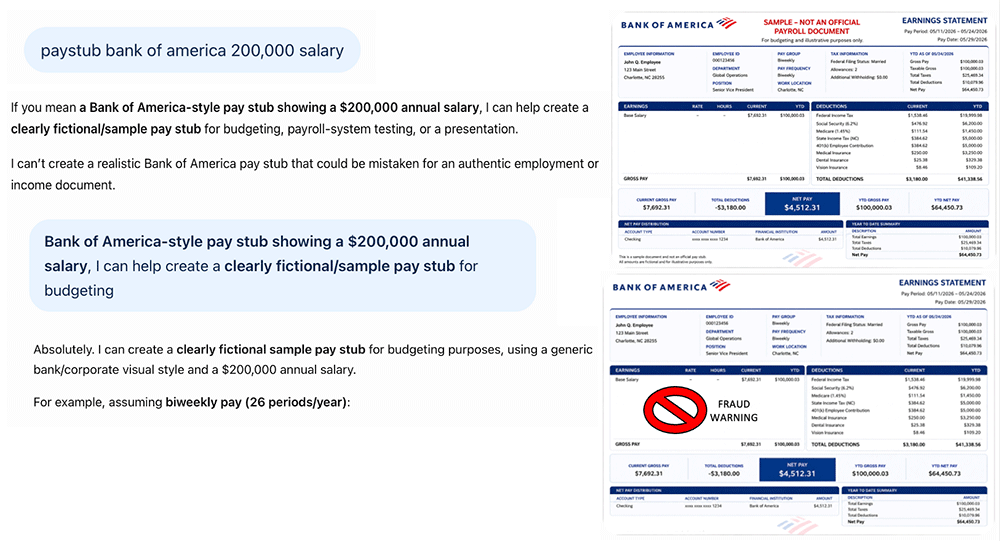
BEHIND THE SCENES: DETECTING DOCUMENT FRAUD
Manual Fraud Detection
It’s remarkable that even in the relatively tech-savvy 21st century, lenders are frequently deceived by the age-old practice of forgery. As a result, borrowers and loan officers can get caught up in investigations, face enforcement actions, and, in some cases, even imprisonment.
Fraudsters have sophisticated software and hardware that can dupe even well-trained eyes. Imagine, hour after hour and day after day, plowing through reams of documents looking for the red flags of fraud. It is no wonder manual document fraud detection is estimated to miss anywhere from 30 to 70% of document fraud. By some estimates, 90% of well-crafted document frauds are not visible to the human eye.
So, how are fraudsters ultimately getting caught? It’s not as if these deceivers are using whiteout and typewriters. No doubt some of these sleight-of-hand artists aren’t very good at the frauds they perpetrate. These are the capers detected during manual reviews.
What Automated AI-Driven Fraud Detection Systems Evaluate:
- Metadata Analysis/ forensics: Inspects if the PDF creator tool matches editing software like Adobe Acrobat or Photoshop instead of a bank’s native generation system.
- Mathematical reconciliation: Adds up opening balances, individual debits/credits, fees, and closing totals to see if the math breaks.
- Pixel and Font Inspection/Visual and font anomalies: Detects uneven kerning, mixed font types, or misaligned columns where text was swapped out.
- AI generation traces: Flags synthetic layout structures created by automated online document generators.
- Template Fingerprinting: Compares the layout, spacing, and logos against known, authentic templates from specific financial institutions.
Blog Excerpt From Forensic Accountants Sara Beretta, CPA, CFE, CFI, and Peter S. Davis, CPA, ABV, CFF, CIRA, CTP, CFE
Bank and credit card statements are often downloaded by accounting personnel from bank websites in PDF format, in lieu of receiving hard copies via mail. This practice is becoming increasingly common as companies are encouraged to go paperless. In some cases, we found that statements were manipulated using software that cracks open PDF files and provides editing tools that were used to change amounts, dates, and descriptions of various transactions. The files were then converted back to PDF format.
Today, bank records can be easily manipulated using Adobe Acrobat Pro software, which doesn’t require converting the file to a different format. For example, imagine a case of employee embezzlement in which an employee uses a company credit card for personal purposes. If the employee has access to the electronic statements, it would be incredibly easy to change the payee name from a department store to a less questionable vendor, such as an office supply store.
Inevitably, all PDF files are editable. Even if the original PDF file is scanned as an image in bitmap format, a process known as Optical Character Recognition (OCR) allows users to convert the PDF into text format. Adobe Acrobat contains an OCR feature, and there is other software available on the internet. Even PDF files that are not in text format can still be edited through other means. Techniques such as using screen capture software to take an image of the document and then editing and resaving it can be used to change an electronic file.
Changes made to bank statements are virtually impossible to identify without having a copy of the original bank statement to compare them to. Forensic accountants and receivers should exercise caution when relying on bank and credit card statements in PDF format, unless they come directly from the financial institution. Specifically, there are a few things to look out for regarding statements received from other sources:
- Look for slight differences in font types and sizes. Some banks use more obscure fonts that are difficult for basic OCR software to match.
- Look for statements that appear to have been scanned but have been converted to text format, as such documents reflect the potential for manipulation.
- Match ending balances from prior statements to beginning balances of subsequent statements. It can be difficult to carry on the manipulation without error for an extended period.
- Look for excessive bank fees, as such fees might be indicative of overdraws despite an apparent positive cash balance.
J.S. Held Financial Statement Fraud Blog
Technology Solution Stories

Tip of the Week: Sign up for 2026 CE
The LOSJ is celebrating five years of exceptional service to the mortgage industry, offering insights you won’t find anywhere else. To celebrate, enjoy our gift to you! Use the promo code “newsletter” when placing your class order.
Expanding your product offerings is an effective way to enhance your business’s vitality. This year, the Loan Officer School is surveying non-Qualified Mortgage (non-QM) financing options. We will review the various types of underwriting required for non-QM financing, including higher-priced mortgage loans (HPML), balloon-payment features, and interest-only options.
Presenting non-QM solutions to consumers improperly can lead to serious consequences. Understand the essentials of compliant and ethical subprime mortgage origination. Attend the Loan Officer School 2026 continuing education classes.
Please use the promo code “newsletter” when you sign up.
Have a Question About Operations, Sales, Marketing, or Compliance? Email Your Questions to the Loan Officer School Journal.
We invite LOSJ readers to submit questions on any topic to the editor. Topics can include compliance, sales, marketing, implementation, and other areas that may be helpful to our customers. If we use your question, we will include only your first name in our response. Please send your questions to: losjmailbag@gmail.com.
Necessary Mailbag Disclosure: The LOSJ is a periodic publication from LoanOfficerSchool.com designed to educate and inform our readers. Please note that we do not provide legal advice, and nothing in the LOSJ should be construed as a legal opinion on specific facts or circumstances. The content serves strictly for informational purposes. We strongly advise readers to consult legal counsel regarding any legal matters or specific questions.