
Why Haven’t Loan Officers Been Told These Facts?
More than 80 years ago, C.S. Lewis, the noted British scholar, writer, and Christian apologist, penned the famed satire, “The Screwtape Letters.” In the spirit of late medieval Christian spiritual notions, Lewis sought to expose and mock the wicked shenanigans of two fictional evil spirits who do everything in their power to make an ape of man (their “patient”). The book introduces the reader to two spirits: Screwtape, the more accomplished and seasoned spirit; and his protégé, Wormwood.
In the spirit of the season- Halloween, Reformation Day, and the 88th anniversary of Orson Welles’s radio rendition of H.G. Wells War of the Worlds- the LOSJ borrows from Lewis’s satire, with hopes of encouraging and amusing the many honest, hardworking mortgage loan originators who commit themselves to serving their customers with honor, integrity, competence, and love.
Though Mr. Mendax was one of his era’s most prolific originators, the LOSJ sincerely hopes mortgage loan originators will find his practices and guidance to young Eva abhorrent.
Mendax and His Message
Eva,
After reviewing several of your Loan Estimates, I’ve noticed patterns worth refining to strengthen your loan presentations. Currently, the estimates appear to exaggerate closing costs, prepaids, and escrows, which might undermine your or the borrower’s positive experience.
It’s common to think high-side figures build trust with clients; the problem is, what good is customer trust if you don’t close the deal? Rather, someone else will build trust and close the deal. Being transparent about costs is essential, but trying to impress clients at closing by exaggerating estimated costs at the start—often called sandbagging—doesn’t reflect the qualities of top producers. Let’s focus on understanding what our prospects genuinely want and deliver that to them.
Consumers really appreciate feeling like they’re getting a great deal and knowing that their best interests are our top priority. Remember, origination is about building relationships while also closing the deal. Let’s work together to make the process positive for everyone involved! By making a few small adjustments, I believe you can significantly strengthen your connections with potential borrowers.
Let me share a few straightforward steps I’ve used successfully and taught to many top producers to help them advance their careers. Keep loan presentations clear and uncomplicated. One effective strategy is to proactively address potential concerns or objections, particularly the most common one: price. Many prospects may struggle to assess how competitive different credit offers are. It’s clear that the architect of the disclosure rules was probably a lawyer, as their focus tends to be on self-protection rather than genuine communication. Vulnerable consumers rely on us to navigate and interpret the information that empowers their decision-making. The Loan Estimate, unless carefully managed and presented, is like giving a child a microscope and expecting them to cure a disease!
People really love buying at a sale. The experience of getting a bargain is exciting. Eva, you must create the feeling of the sale. The average loan officer fails to capitalize on the bargain feeling, let alone create the buzz! Instead, by delivering a plodding, laboriously overwhelming loan presentation, the loan officer buries them in details and kills the bargain excitement. Why? Because they lack imagination and have never been properly trained.
Let’s be honest: many folks find it hard to grasp a basic loan analysis. It’s totally understandable! No one likes to feel stupid! That’s why it’s important for us to recognize that most people prefer a simpler approach. By meeting them where they are, we can make the process smoother and more enjoyable for everyone!
The jawbone of an ass can sometimes be a salesperson’s greatest challenge. Approach conversations with prospects thoughtfully, because well-intentioned discussions can unintentionally push them away from making a decision. For example, avoid getting into too much detail. Lead the conversation by LISTENING, aim to encourage your prospects to express their thoughts and concerns. By actively listening and showing you genuinely care about their needs, you foster respect and trust. Many prospects appreciate support from someone who can guide them through the process, as it simplifies decision-making. Remember, a tired brain is a grumpy, hostile brain. Minimize their need to think, and you will own them for life! This collaborative approach leads them to accept our counsel hook, line, and sinker.
Blah, blah, blah. What do all those line items matter to these people? 6.00 or 6.50 percent. Who cares. They want to BELIEVE they are getting a good deal. All you need to do is deliver what they want. Keep it simple, dismiss unnecessary complexity, and give them the easy button. Product satisfaction is making them feel like, through their due diligence, they are making a sound decision. Sound decisions are impossible with a focus on the details. They can’t make a sound decision when overwhelmed with data.
Many homebuyers and those refinancing often feel that shopping for a mortgage is just as appealing as a root canal! But they’ll still venture out to find the right option, especially when faced with confusing loan presentations from other lenders. Following another loan officer’s lackluster presentation can create an opportunity for you to shine. If your clients connect with you and believe they’re getting a great deal, they’re likely to stop looking elsewhere. Focusing on these two points is key to winning them over, and you have the power to do it!
The Mendax Way
Here are some friendly tips for presenting loan options:
1. Keep it simple by offering no more than three options. In most cases, two options will work just fine!
2. In your presentations, keep the interest rate difference between the 15-year and 30-year loans to no more than 0.25%. If you think the prospect might be interested in a 15-year loan, get aggressive on price by discounting the 15-year rate-sheet price by 0.25% and halving the points. That makes the 15-year fixed rate option look like a no-brainer.
3. We can go over these details more in-depth later!
The main thing to remember is to make the decision process as easy as possible for the prospect. Keeping a small rate spread between the 15-year and 30-year loan options minimizes the 15-year benefit. If they are torn between two solutions, that is a clear signal that your presentation failed because of poor pricing options.
Sequencing the Options
First, present the 15-year fixed-rate loan, emphasizing that it typically offers the lowest projected finance costs over the term. You might say, “However, it’s important to consider the associated monthly payments with a 15-year term.” The understatement of the year! It’s like finding a dirty old shoe at the bottom of the punch bowl. Next, introduce the 30-year fixed-rate loan as a more manageable option. Lastly, provide a moderately detailed overview of an adjustable-rate mortgage (ARM), highlighting potential payment variations that could arise. By comparing the ARM to the fixed-rate payments, you will help them see the advantages of longer-term stability. By highlighting the potential challenges of an adjustable-rate mortgage (scaring the hell out of them!) and showing that the option with the lowest projected finance charges (the 15-year fixed rate) may not be the best choice, you can help them make an easy selection and appreciate the simple benefits of a 30-year fixed-rate mortgage. Tell them, “And by the way, the 30-year loan is a Qualified Mortgage. The loan is considered the safest and soundest financing solution.”
This approach encourages a well-informed decision, supported by careful research and consideration. And when they’re getting a bargain too, nuff said!
The Devil is in the Details
The worst of the deal-killing activities: DETAILS. In our Origination 201 discussion (Next week), I’ll show you how bypassing the details lets you manufacture a bulletproof presentation. Please be cautious not to become overly focused on details. Avoid discussing page 2, subheadings B and C, and completely disregard the “Other Costs” section. Simply characterize these costs as “par for the course” and move on to the BOTTOM LINE. Unnecessarily reviewing the details in these sections often confuses and overwhelms the borrower, which goes against the KISS (Keep It Simple, Stupid) principle. I’ll explain more next week. You won’t believe the magic of making better escrow and prepaid estimates.
For each financing solution, highlight no more than four key points: the estimated interest rate, estimated points, estimated total housing costs, and estimated cash-to-close. These are the bottom line. Keep in mind, you are defining and delivering the bottom line. Keep using the phrase, “Let’s get to the bottom line.”
You always want to present before the competition is even in the ballpark. 99% of the time, when you do the job right, the prospect won’t want to talk to other loan officers. Suppose the borrower has endured one of your competitors’ bumbling, cringe-worthy loan presentations- good! Your presentation will feel as fresh as mountain air compared to the competitor’s clumsy, tiresome ramblings.
Start by noting that some lenders who genuinely want to help may unintentionally overwhelm borrowers with too much information. Rather than criticizing these lenders, compare confusing loan presentations to an inconvenience, like a cold sore before the prom. Then emphasize the importance of focusing on the “bottom line,” since that is the clear, simple solution customers want.
Again, remember the winning sequence. Start with the projected monthly payment for the 15-year option, which sets up the no-brainer selection—the 30-year solution. When they see the higher payment for the 15-year estimate, it will make them uncomfortable (make them sick, then give them the cure!), but when you reveal the lower estimated payment for the 30-year loan, they will feel delighted and relieved.
Be sure to highlight the cash-to-close figure as well. Remember, your enthusiasm and excitement are contagious! Smile and compliment them on their excellent timing; they are buying a home just as rates have dropped. This is the perfect moment to mention that rates generally improve as they get closer to closing. Remember, we do not want them locking. That is the poison pill for them and us.
Sometimes, you might misinterpret what a prospect really wants. If someone is genuinely interested in a 15-year mortgage and you accidentally quote a higher 15-year rate to make the 30-year option look more appealing, you could lose the deal over pricing if they have another quote. This is especially important to keep in mind with older borrowers.
If you notice that a prospect shows real interest in the 15-year fixed-rate loan after you’ve explained the options, that’s okay! You can say with a friendly tone, “You know, there’s really no better financing than a 15-year fixed-rate loan—truly. But I do want to mention that the payment can be quite high for many people.” Then ask, “What are your thoughts on the payment for a 15-year loan?” If they lean toward the 15-year option, that’s your cue to move forward with the special-deal solution!
The special deal solution is another easy button. Tell prospects that because of “X,” you can offer a lower rate on the 15-year loan. “X” is whatever the prospects are most proud of—usually exemplary credit scores or payment history. Then announce, “Let’s do it!” with the biggest smile you can muster.
At this point, most prospects are ready to be closed, and this is how you seal the deal. As I mentioned, I got you on the store gift card program. This is when you announce the gift card. Make a big deal out of it. Announce: “You will probably be spending so much time at the furniture or home improvement store after closing, and I don’t want you to forget about me; would a $500 gift card be helpful? Just one condition: before the closing, you must refer at least one friend or coworker to me for a mortgage! I’ll have the card for you at the closing. Which would you prefer, the furniture or home improvement store card?” SAY THIS WITH THE BIGGEST SMILE YOU CAN MUSTER.
Just picture Peter Dinklage trying to stop Shaquille O’Neal on the way to the bucket! That’s you going to the hoop, Eva! Consider information overload, confusion, and paralysis by analysis as your opponents. Eva, you’re going to be amazing out there—just full of awesome layups and slam dunks!
Next week we tackle Loan Presentation 201. I’ll explain how to bulletproof your presentation by making better escrow and prepaid estimates.
Cheers,
Mendax
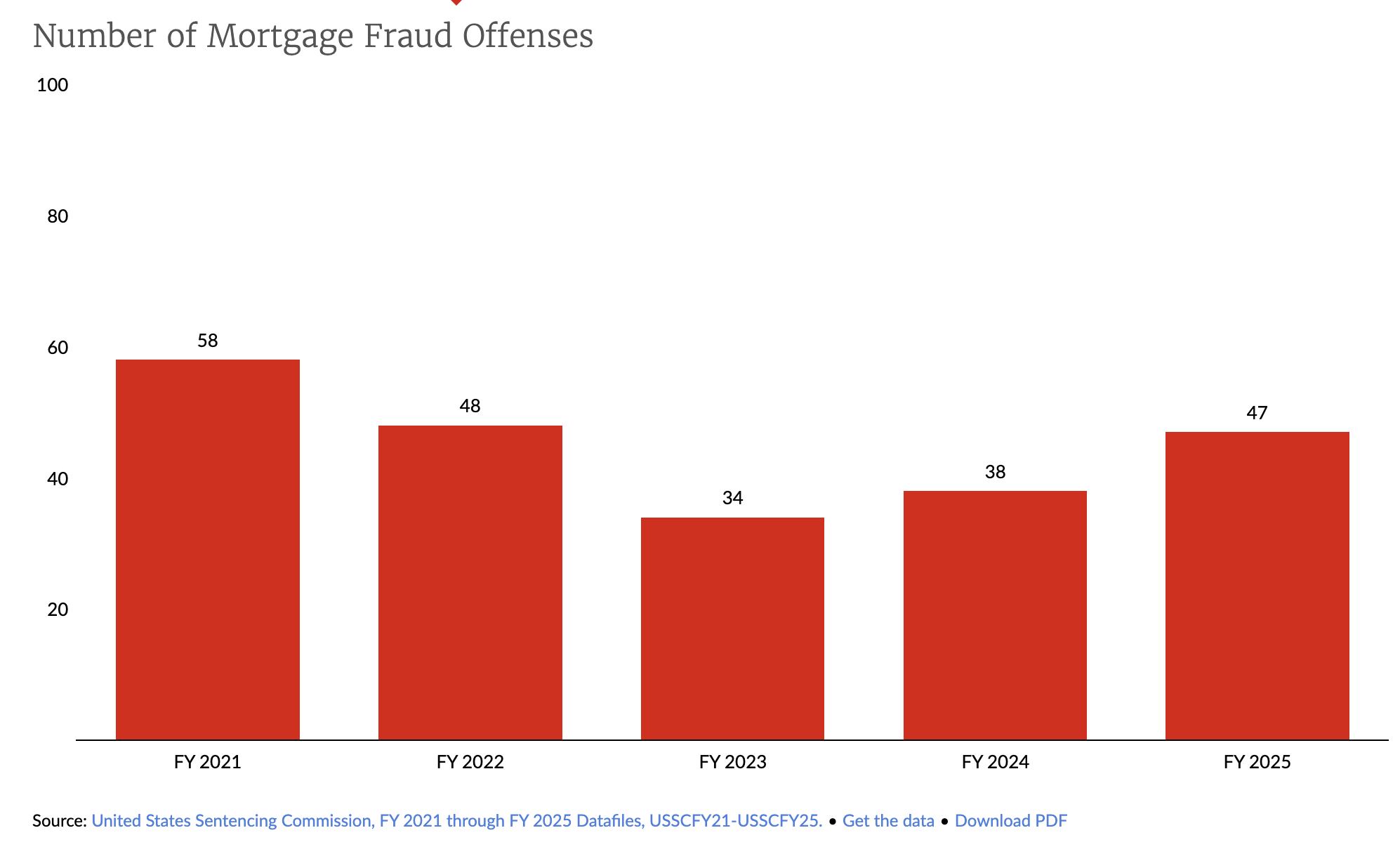
GRAPH DEPICTS SENTENCES FOR FISCAL YEAR OCTOBER 1, 2024 TO SEPTEMBER 30, 2025
BEHIND THE SCENES: MORTGAGE FRAUD SENTENCING DOWN, NEW INITIATIVES, INVESTIGATIONS, INDICTMENTS UP
NEW FRAUD DIRECTIVE HAS FINANCIAL CRIMES IN THE CROSSHAIRS
Thursday, October 8, 2026, Directive 26-13: A Comprehensive Approach in the Fight Against Fraud
Assistant Attorney General Colin M. McDonald of the Justice Department’s National Fraud Enforcement Division (the Fraud Division) today released Directive 26-13, outlining the Division’s comprehensive approach in the fight against fraud.
Expanding on earlier guidance regarding the Division’s priorities and corporate enforcement policy, Directive 26-13 sets out the Division’s prosecutorial methodology for investigating, disrupting, and prosecuting fraud. This directive marks a significant operational shift, requiring the Division’s prosecutors to attack fraud from all angles using the Division’s tax, securities fraud, consumer fraud, and cybercrime authorities.
This directive also requires Division prosecutors to deploy early, pre‑indictment asset seizures and digital‑infrastructure takedowns to halt fraud schemes and freeze assets in real time. Finally, this directive urges Division prosecutors to develop practice cooperators, zealously prosecute corporate bad actors, seek arrest and detention in appropriate cases, and deliver fulsome advocacy at sentencing. This new, comprehensive approach will drive the Division forward in its mission to preempt, disrupt, and dismantle fraudulent networks before they can inflict widespread harm.
The Fraud Division has a clear mission: to prosecute fraud in the United States, no matter its size or complexity. This mission is critical to restoring public confidence in the federal government’s ability to responsibly steward taxpayer dollars. The Government Accountability Office recently estimated that the federal government loses between $233 billion to $521 billion annually to fraud — with other models showing even higher annual losses. Accordingly, Fraud Division personnel will work tirelessly to bring to justice individuals and corporations who have defrauded the public fisc, and threaten the health, safety, security, and prosperity of Americans.
The public may contact the Corporate Enforcement Section with information about corporate fraud at corporate.enforcement@usdoj.gov.
Press Release
Thursday, September 3, 2026
For Immediate Release
U.S. Attorney’s Office, Middle District of Florida
Tampa, FL – Kenneth Blair (54, Clermont) has been sentenced by U.S. District Judge John L. Badalamenti to 30 months in federal prison for bank fraud. Blair pleaded guilty on May 15, 2024. As part of his sentence, the court also entered an order of forfeiture in the amount of $15,475, the proceeds of the charged criminal conduct. U.S. Attorney Gregory W. Kehoe made the announcement.
According to court documents, from as early as August 2020, and continuing through July 2021, in the Middle District of Florida and elsewhere, Blair and others devised a scheme to defraud financial institutions by making materially false and fraudulent representations.
Blair’s role in the bank fraud scheme included preparing and submitting fictitious and fraudulent paystubs for his clients in the names of companies to show fabricated income from employers as well as altered bank statements showing vastly overstated account balances. This caused the mortgage lenders to approve and fund mortgage loans for otherwise unqualified borrowers in exchange for undisclosed payments to Blair from his clients. The fraudulent mortgage loans were subsequently purchased and guaranteed by government-sponsored entities Fannie Mae and Freddie Mac, as well as the Federal Housing Administration.
This case was investigated by the Federal Housing Finance Agency – Office of Inspector General and the U.S. Department of Housing and Urban Development – Office of Inspector General. It was prosecuted by Special Assistant United States Attorney Chris Poor. The forfeiture is being handled by Assistant United States Attorney Blain Goff.
On April 7, 2026, the Department of Justice announced the creation of the National Fraud Enforcement Division. The core mission of the Fraud Division is to zealously investigate and prosecute those who steal or fraudulently misuse taxpayer dollars. Department of Justice
efforts to combat fraud support President Trump’s Task Force to Eliminate Fraud, a whole-of-government effort chaired by Vice President J.D. Vance to eliminate fraud, waste, and abuse within Federal benefit programs.
Directive 26-13: A Comprehensive Approach in the Fight Against Fraud

Tip of the Week: Sign up for 2026 CE
The LOSJ is celebrating five years of exceptional service to the mortgage industry, offering insights you won’t find anywhere else. To celebrate, enjoy our gift to you! Use the promo code “newsletter” when placing your class order.
Expanding your product offerings is an effective way to enhance your business’s vitality. This year, the Loan Officer School is surveying non-Qualified Mortgage (non-QM) financing options. We will review the various types of underwriting required for non-QM financing, including higher-priced mortgage loans (HPML), balloon-payment features, and interest-only options.
Presenting non-QM solutions to consumers improperly can lead to serious consequences. Understand the essentials of compliant and ethical subprime mortgage origination. Attend the Loan Officer School 2026 continuing education classes.
Please use the promo code “newsletter” when you sign up.
Have a Question About Operations, Sales, Marketing, or Compliance? Email Your Questions to the Loan Officer School Journal.
We invite LOSJ readers to submit questions on any topic to the editor. Topics can include compliance, sales, marketing, implementation, and other areas that may be helpful to our customers. If we use your question, we will include only your first name in our response. Please send your questions to: losjmailbag@gmail.com.
Necessary Mailbag Disclosure: The LOSJ is a periodic publication from LoanOfficerSchool.com designed to educate and inform our readers. Please note that we do not provide legal advice, and nothing in the LOSJ should be construed as a legal opinion on specific facts or circumstances. The content serves strictly for informational purposes. We strongly advise readers to consult legal counsel regarding any legal matters or specific questions.