


Why Haven’t Loan Officers Been Told These Facts? Lawfully Paying Referral Fees?
If you haven’t yet chosen to pursue investor transactions through focused and robust marketing, including products offered by non-QM lenders, now might be the time to consider it. A recent report from the capital markets vendor Optimal Blue indicates that non-QM lending continues to grow, even amid a slowdown in agency originations. Importantly, under Optimal Blue’s broad definition of non-QM lending, investor transactions have surpassed those related to consumer bank statement lending.
From the Optimal Blue 10/13/26 announcement, available here: Optimal Blue Announcement
Non-QM bucks broader decline: Non-QM lock volume increased 8% MoM even as total lock volume declined 2%. Non-QM loans accounted for 12% of September production, up 117 bps MoM, 357 bps over the past three months and 478 bps YoY. Investor and debt service coverage ratio (DSCR) loans represented 33% of non-QM activity, bank statement loans accounted for 30% and other expanded guideline programs made up the remaining 37%.
Getting Started with Non-QM and Exempt Transactions
Non-QM has emerged as a broad term for mortgage products or services that do not fit within traditional origination channels. Arguably, QM and non-QM solutions refer to transactions subject to the minimum standards for residential mortgages outlined in the Truth in Lending Act, specifically 15 USC § 1639c, and the implementing Regulation Z § 1026.43. The Truth in Lending Act (TILA) and the implementing Regulation Z cover consumer loans, not business-purpose loans. Under TILA, a lender’s federal obligation to determine business-purpose borrower qualifications is the same as it always has been: non-existent. Likewise, the Real Estate Settlement Procedures Act (RESPA) requirements, including prohibited payments, do not apply to business-purpose loans. This raises the question: if targeting business-purpose loans and other exempt transactions, can I and should I pay referral fees?
The definitions outlined in RESPA, specifically 12 USC 2602, along with the prohibitions in section 2607 (RESPA 8(a)) and the exemptions in section 2606, can be quite confusing.
Originating business-purpose mortgages and other exempt mortgages may require a different approach than marketing to, and originating for, consumer-purpose mortgagors. When examining business-purpose solutions (including 1-4 unit non-owner-occupied residential transactions), note that debt service coverage ratio loans (DSCR) and other investor transactions are categorized under the Real Estate Settlement Procedures Act (RESPA) and Truth in Lending Act (TILA) as business or commercial loans. As such, business-purpose loans are not subject to these laws. As mentioned, the TILA is the source of the ability-to-repay requirements. Therefore, the distinctions and requirements between a qualified mortgage (QM) and a non-qualified mortgage (non-QM) are irrelevant for commercial transactions. As are the relationships between persons referring business loans and settlement service providers. From a federal perspective, exempt loans are, to an extent, an old-fashioned let-the-buyer-beware environment. Heck, under federal law, this activity is even licensing-free. FREEEEEEEEDOM!
However, stakeholders have divergent views on whether the Real Estate Settlement Procedures Act (RESPA) applies in part to business purpose loans. Despite this law’s clear objectives to protect consumers and Congress’s directive to harmonize the exemptions in RESPA’s Regulation X with those in TILA’s Regulation Z, confusion persists regarding the prohibitions on finder’s fees under section 8(a) of RESPA, particularly in relation to specific business-purpose transactions. While paying finder’s fees or referral fees is common and legal in the business sector (and is sometimes subject to disclosure regulations), it presents significant challenges for many stakeholders.
While lawful finder’s fees are not strictly necessary for a successful referral-based marketing plan, if payment of such fees is common and lawful, competing in those markets could prove overly challenging without adequate compensation for commercial loan finders.
Sometimes, an ethical debate surrounds finder’s fees; however, the commercial world operates differently from the consumer market. Because of specific vulnerabilities, Congress rightly bans referral fees for consumers in connection with real estate settlement services. Yet, in the business world, why shouldn’t professionals who provide valuable B2B leads to mortgage providers share in the mortgage origination profits? Their hard work and years of effort ultimately led to the deal. Additionally, by monetizing the referrals, it creates opportunities for more compelling value propositions. This marketing structure allows for efficient scaling.
Some stakeholders incorrectly claim that business-purpose loans secured by one to four units fall under the Real Estate Settlement Procedures Act (RESPA). They often argue that these loans are federally related mortgage loans and therefore, according to federal law, you cannot pay a finder’s fee. They further assert that the business exemption does not apply to natural persons but only artificial persons (E.g., LLC, Corp). This is simply incorrect. In fact, you can pay a finder’s fee for federally related loans, provided those loans qualify for the same exemption from the prohibition. The confusion surrounding lawful finder’s fees on business purpose loans may stem from the fact that at one time, some investor transactions were subject to RESPA.
RESPA: The Long Version
(If you’d rather skip the RESPA Section 8(a) history, go to the “Short Version” below)
The federal government provides extensive consumer protection laws with graduated levels of protection based on the stakes. Business law is different. Business transactions place greater emphasis on the buyer’s burden of due diligence. In passing RESPA, Congress intended to curtail unnecessarily high settlement charges for consumer mortgage transactions.
12 U.S.C. § 2601. Congressional Findings and Purpose (a) The Congress finds that significant reforms in the real estate settlement process are needed to insure that consumers throughout the Nation are provided with greater and more timely information on the nature and costs of the settlement process and are protected from unnecessarily high settlement charges caused by certain abusive practices that have developed in some areas of the country.
So where is the confusion? The trouble stems from the perceived overarching prohibition against finder’s fees for “federally related mortgage loans” and its implications for exempt transactions.
RESPA section 8(a), 12 USC §2607. Prohibition Against Kickbacks and Unearned Fees
No person shall give and no person shall accept any fee, kickback, or thing of value pursuant to any agreement or understanding, oral or otherwise, that business incident to or a part of a real estate settlement service involving a federally related mortgage loan shall be referred to any person.
2607(a) sounds pretty definitive. But just what is a federally related mortgage loan?
Excerpt: 12 USC 2602 RESPA Definitions
The term “federally related mortgage loan” includes any loan (other than temporary financing such as a construction loan) which is secured by a first or subordinate lien on residential real property (including individual units of condominiums and cooperatives) designed principally for the occupancy of from one to four families, . . . is made in whole or in part by any lender the deposits or accounts of which are insured [or regulated] by any agency of the Federal Government . . is intended to be sold by the originating lender to the Federal National Mortgage Association, the Government National Mortgage Association, the Federal Home Loan Mortgage Corporation, or a financial institution from which it is to be purchased by the Federal Home Loan Mortgage Corporation . . .
There is more to “federally related” than the excerpt from 2602, but that is the general notion. Loans that have a nexus with federal supervision or sponsorship.
The Young Man Knows the Rules, but the Old Man Knows the Exceptions – Oliver Wendell Holmes, Sr. (Father of U.S. Supreme Court Justice Oliver Wendell Holmes, Jr)
When legislatures enact laws, they often include specific exemptions to clarify the law’s scope and applicability. This clarification involves both positive and negative language. Positive language typically describes the individuals and transactions the law covers, while negative language outlines the law’s limits by specifying exemptions.
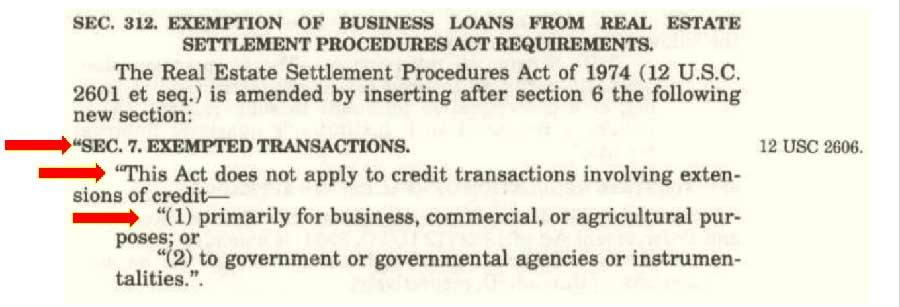
RESPA 12 USC §2606 Exempted Transactions
(a) In general
This chapter does not apply to credit transactions involving extensions of credit—
(1) primarily for business, commercial, or agricultural purposes; or
(2) to government or governmental agencies or instrumentalities.
(b) Interpretation
In prescribing regulations under section 2617(a) of this title, the Bureau shall ensure that, with respect to subsection (a) of this section, the exemption for credit transactions involving extensions of credit primarily for business, commercial, or agricultural purposes, as provided in subsection (a)(1) 1 of this section shall be the same as the exemption for such credit transactions under section 1603(1) of title 15.
15 USC TILA §1603. Exempted transactions
This subchapter does not apply to the following: (1) Credit transactions involving extensions of credit primarily for business, commercial, or agricultural purposes, or to government or governmental agencies or instrumentalities, or to organizations.
From the CFPB: RESPA FAQ V1 October 2020
QUESTION: “Which individuals, entities, and transactions are covered by RESPA Section 8?
ANSWER: RESPA Section 8 prohibitions generally apply to any person, which RESPA defines to include individuals, corporations, associations, partnerships, and trusts. 12 USC § 2602(5). RESPA does not apply to extensions of credit to government or governmental agencies or instrumentalities. It also does not apply to extensions of credit primarily for business, commercial, or agricultural purposes. 12 USC § 2606.”
In the CFPB FAQ, the Bureau’s language does not distinguish between Section 8 prohibitions and RESPA exemptions in general. Furthermore, Congress specifically instructed the CFPB to align Regulation X exemptions with those of Regulation Z. 12 USC 2606 (b) states, “In prescribing regulations under section 2617(a) of this title, the Bureau shall ensure that, with respect to subsection (a) of this section [RESPA exemptions in general], the exemption for credit transactions involving extensions of credit primarily for business, commercial, or agricultural purposes, as provided in subsection (a)(1) of this section shall be the same as the exemption for such credit transactions under section 1603(1) of title 15.”
The TILA language makes no coverage exceptions for federally related mortgage loans in describing the exempt transactions. Again, why would a consumer-protection law extend to business-purpose loans? Some stakeholders will compare ECOA coverage of business-purpose loans to RESPA. This is poor reasoning. First, ECOA is an anti-creditor-discrimination law, not a consumer-protection law.
Note the ECOA’s instructions for the administrative rulemaking: Title 15 USC §1691b. Promulgation of Regulations by the Bureau: Exempt transactions, such regulations may exempt from the provisions of this subchapter any class of transactions that are not primarily for personal, family, or household purposes, or business or commercial loans made available by a financial institution . . .
Regulation B 12 CFR § 1002.1 (b) Purpose. The purpose of this part is to promote the availability of credit to all creditworthy applicants without regard to race, color, religion, national origin, sex, marital status, or age. . . The regulation prohibits creditor practices that discriminate on the basis of any of these factors.
RESPA Evolved to Exclude 1-4 unit Transactions 30 Years Ago
At one point, business-purpose loans secured by 1-4 units that met the designation of “federally related mortgage loan” were subject to RESPA. Congress changed that; HUD, the administrator at the time, acknowledged this in its Regulation X proposed rule change published in the Federal Register in November 1996.
[Federal Register Volume 61, Number 222 (Friday, November 15, 1996)]
[Rules and Regulations]
[Pages 58472-58479]
From the Federal Register Online via the Government Publishing Office
[FR Doc No: 96-29278]
The second revision also conforms the regulation to the Act. Section 2103(b) of the Act requires the Department, in [Page 58474] prescribing regulations under RESPA, to conform the exemption of business, commercial, or agricultural loans under RESPA to the exemption of such loans under the Truth In Lending Act (TILA) (15 U.S.C. 1601 et seq.). The primary effect of this legislative requirement is to eliminate RESPA coverage for 1- to 4-family residential properties used by individuals for rental purposes. Accordingly, this final rule amends Sec. 3500.5(b) to delete the sentence providing that the exemption to RESPA for business purpose loans “does not include any loan to one or more persons acting in an individual capacity (natural persons) to acquire, refinance, improve, or maintain 1- to 4-family residential property used, or to be used, to rent to other persons.” By deleting this sentence, Regulation X, with respect to the coverage of business, commercial, or agricultural loans under RESPA now conforms to the coverage of such loans under TILA, as required. Section 3500.5(b), as revised by this rule, defers to TILA for interpretation of the coverage of business purpose loans. This final rule also withdraws RESPA Interpretive Rule 1995-1, published in the Federal Register on February 27, 1995 (60 FR 10762). That interpretive rule had reaffirmed the determination set forth in the Department’s RESPA rule, published on February 10, 1994 (59 FR 6505), and amended on March 30, 1994 (59 FR 14748), that transactions by individuals involving 1- to 4-family residential rental properties are covered by RESPA. This interpretation does not survive the statutory amendment and no longer represents the Department’s position.
RESPA: The Short Version
For those who just want the bottom line, the current version of Regulation X clarifies the business purpose exemption for federally related mortgage loans:
12 CFR § 1024.5 Coverage of RESPA.
(a) Applicability. RESPA and this part apply to federally related mortgage loans, except as provided in paragraphs (b) and (d) of this section.
(b) Exemptions.
(1) [Reserved]
(2) Business purpose loans. An extension of credit primarily for a business, commercial, or agricultural purpose, as defined by 12 CFR 1026.3(a)(1) of Regulation Z. Persons may rely on Regulation Z in determining whether the exemption applies.
Other Considerations
Yet finder fees may raise several compliance issues. First, states may impose greater requirements and prohibitions than the federal law. Consequently, you must understand state requirements related to finder’s fees in addition to federal law. Second, compliance with stakeholder contractual obligations may be called into question. For example, if the lender or investor believes finder’s fees on business-purpose transactions violate RESPA, and you agree to comply with all applicable laws, you may have a problem. Furthermore, mortgage buyers or insurers may choose to include contractual provisions that expressly or implicitly bar payment of finder fees.
While business purpose loans are not subject to RESPA and TILA, federal laws concerning fiduciaries, self-dealing, and disclosure remain applicable in a commercial context. Consult qualified legal counsel before launching such a campaign.
Marketing to Non-QM and Exempt Borrowers
The same lenders that offer non-QM loans typically offer DSCR and other commercial solutions. When building your marketing plan for non-QM and exempt transactions, it may help to segment these markets into two or more groups:
- TILA/RESPA covered transactions
- TILA/RESPA exempt transactions
In a marketing services agreement (MSA), a lender may compensate a person to promote or market its services. Ensuring compliance with an MSA involves several important steps, with record-keeping being crucial. You must provide evidence that the person receiving marketing compensation genuinely earned it and that it is not merely a referral fee tied to referral profitability.
Under RESPA, there is no such burden for a finder’s fee paid in connection with a business-purpose loan. In practice, the affiliate should cast a broad net. Real estate investors also buy properties to live in. Consequently, a hybrid model could be ideal if able to meet the compliance burden. In other words, an MSA that provides service-based compensation coupled with finder’s fees for exempt loans.
Consult a skilled attorney to create and manage MSAs and finder’s fee agreements. Lenders should handle these matters with awareness, competence, integrity, and compliance. While freedom is a wonderful concept, moving forward without proper foundations can lead to bondage. Remember, Wallace was onto something with a free Scotland. However, for William Wallace, things got a wee dicey.
In the coming weeks, the LOSJ will construct several marketing models to target referral sources for QM, non-QM, and business-purpose loans.
BEHIND THE SCENES: CFPB Sued for Violations Related to Rulemaking
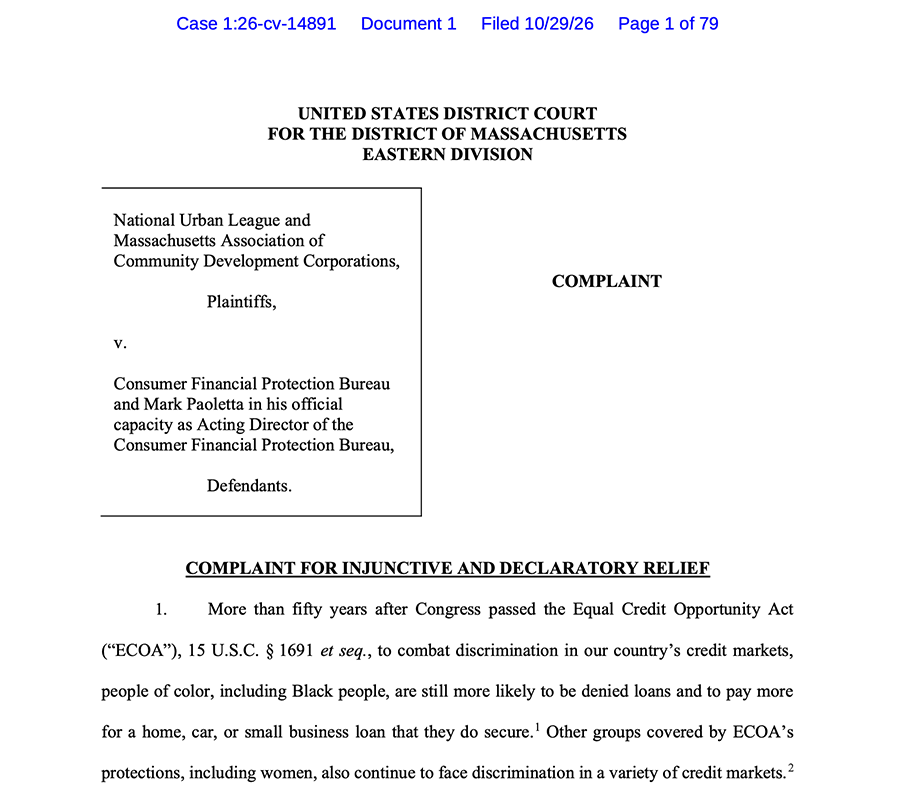
NEW YORK (October 29, 2026) — The National Urban League and the Massachusetts Association of Community Development Corporations today filed a lawsuit challenging the administration’s efforts to undermine equal access to credit.
The suit challenges the Consumer Financial Protection Bureau (CFPB)’s elimination or narrowing of three critical, longstanding protections of Regulation B, which implements the Equal Credit Opportunity Act (ECOA). ECOA and Regulation B have long protected people of color, women, and other groups from discrimination and have been important tools for driving homeownership and small business growth in the United States. The lawsuit seeks to stop the administration’s efforts to abandon these protections.
“This administration has waged a war on pathways to social and economic opportunity for communities of color and other groups,” said Marc H. Morial, President and CEO of the National Urban League. “Regulation B historically has served as a tool for growth and equal access to credit. The administration is wrong to try to set us back 50 years, and we will fight to stop these changes.”
The plaintiffs are represented by the Legal Defense Fund and the National Consumer Law Center. The lawsuit was filed in the United States District Court for the District of Massachusetts and asks the court to vacate three changes to Regulation B.
“This administration is attempting to upend anti-discrimination law,” said John Fowler, Senior Counsel and Manager of Professional Development at the Legal Defense Fund. “This regulation has long protected Black communities and other communities of color from unlawful discrimination and promoted programs that help reduce the racial wealth gap. But equal opportunity is impossible when the government uses its power to impose new barriers to credit. We all deserve better.”
“Fair access to credit allows families to buy homes, entrepreneurs to start businesses, and communities to build wealth,” said Emily Haber, President and CEO of the Massachusetts Association of Community Development Corporations. “Our members are mission-driven organizations committed to breaking down barriers to economic opportunity, particularly in communities of color and historically underserved neighborhoods. At a time when significant racial disparities in access to capital and wealth persist, weakening Regulation B’s protections risks creating additional obstacles for the families, small businesses, and communities our members serve.”
“Since the 1970s, Regulation B and ECOA have effectively reduced credit discrimination, but it still persists, sometimes in new and disguised ways in the age of AI-enhanced financial products,” said Odette Williamson, Director of Racial Justice Advocacy at the National Consumer Law Center. “The CFPB is turning its back on economic equality by dismantling this powerful tool that is still necessary to reduce barriers to wealth building for Black communities, communities of color, women, and other protected groups.”
The protections enshrined in ECOA and Regulation B remain as important today as they were in the 1970s when they first became law. As of 2023, applicants of color continue to be denied home mortgages at higher rates than white applicants, regardless of credit score, income, size of the loan, and other factors. And, as of 2022, the Black-white homeownership gap stands at 30 percentage points—wider than it was in 1960. Today, some lenders target women with predatory loan products, such as subprime loans. These predatory policies disproportionately harm women of color, with Black women 256% more likely than white men to receive subprime loans. Despite this ongoing discrimination, the CFPB opted to roll back protections that mitigate some of this harm.
- First, the changes to Regulation B narrow a prohibition on discouraging people from applying for credit. These protections have, for example, banned lenders from choosing to avoid placing bank branches in or marketing to Black communities.
- Second, the changes to Regulation B prohibit lenders from using certain types of special purpose credit programs that address documented racial and other disparities, and have been an important tool for expanding access to credit and help to overcome the effects of historical and modern-day discrimination in lending.
- Third, the changes reverse a longstanding ban on lending policies and practices that have discriminatory effects and also have no legitimate business justification—which is called disparate-impact liability.
Discrimination in the country’s credit markets is also costly. One study estimates that financial institutions would see an increase of $2 billion in annual incremental revenue if they offered Black customers access to financial products at the same rates as white customers.
These changes are part of a broader attack by the administration on efforts to reduce unjustified racial disparities in lending and other aspects of economic life.
From the Complaint
Plaintiffs assert: “The Final Rule is therefore arbitrary and capricious in violation of the APA [Administrative Procedure Act, the rulemaking law governing all regulation]. It is not the product of reasoned decision-making. The Final Rule ignores and fails to adequately respond to comments, lacks the cost-benefit analysis required by the Dodd-Frank Wall Street Reform and Consumer Protection Act (the “Dodd-Frank Act”), and lacks the analyses required by the Small Business Regulatory Enforcement Fairness Act of 1996. The CFPB also failed to consult with other agencies as required by the Dodd-Frank Act. The Final Rule, and in particular its discouragement provision, is also contrary to law in violation of the APA because it contradicts the text of ECOA and exceeds the CFPB’s rulemaking authority.
Finally, the Final Rule was issued without lawful authority for then-Acting Director Russell Vought to serve in his role, rendering the entire rulemaking process invalid under the Federal Vacancies Reform Act and Appointments Clause. Plaintiffs will be irreparably harmed by Defendants’ unlawful action. As detailed below, each organization works to ensure that Black Americans and other groups enjoy fair and equal access to credit, and by extension, the opportunity to pursue economic prosperity. Regulation B serves as a critical tool in advancing this work.”

Tip of the Week: Sign up for 2026 CE
The LOSJ is celebrating five years of exceptional service to the mortgage industry, offering insights you won’t find anywhere else. To celebrate, enjoy our gift to you! Use the promo code “newsletter” when placing your class order.
Expanding your product offerings is an effective way to enhance your business’s vitality. This year, the Loan Officer School is surveying non-Qualified Mortgage (non-QM) financing options. We will review the various types of underwriting required for non-QM financing, including higher-priced mortgage loans (HPML), balloon-payment features, and interest-only options.
Presenting non-QM solutions to consumers improperly can lead to serious consequences. Understand the essentials of compliant and ethical subprime mortgage origination. Attend the Loan Officer School 2026 continuing education classes.
Please use the promo code “newsletter” when you sign up.
Have a Question About Operations, Sales, Marketing, or Compliance? Email Your Questions to the Loan Officer School Journal.
We invite LOSJ readers to submit questions on any topic to the editor. Topics can include compliance, sales, marketing, implementation, and other areas that may be helpful to our customers. If we use your question, we will include only your first name in our response. Please send your questions to: losjmailbag@gmail.com.
Necessary Mailbag Disclosure: The LOSJ is a periodic publication from LoanOfficerSchool.com designed to educate and inform our readers. Please note that we do not provide legal advice, and nothing in the LOSJ should be construed as a legal opinion on specific facts or circumstances. The content serves strictly for informational purposes. We strongly advise readers to consult legal counsel regarding any legal matters or specific questions.