
Why Haven’t Loan Officers Been Told These Facts? Discover New Business Opportunities with Reverse Mortgages
An Overview of the Demographics and Trends Currently Influencing the Reverse Mortgage Market
(Article provided courtesy of the National Reverse Mortgage Lenders Association)
Reverse mortgages present a significant opportunity. Americans are living longer, and most older adults prefer to stay in their homes. Additionally, homeowners aged 62 and older possess record levels of housing wealth. For mortgage professionals, these trends create an opportunity to help qualified homeowners explore how their home equity can boost retirement cash flow, meet housing needs, and provide financial flexibility.
The federally insured Home Equity Conversion Mortgage (HECM) remains the foundation of the U.S. reverse mortgage market; however, proprietary reverse mortgages are playing an increasingly significant role in the growth of the overall market, serving as the primary driver of the industry’s 54% growth from 2023 to 2025, according to a recent analysis by New View Advisors (NVA).
The current opportunity for originators is to broaden awareness and use of reverse mortgages beyond the traditional niche market, making home equity a more widely understood, discussed, and accepted element of retirement and housing planning.
Future Demand for Reverse Mortgages
The long-term driver of the reverse mortgage market is the combination of population aging, homeownership and the desire to age in place. AARP’s 2024 Home and Community Preferences Survey found that 75% of adults age 50 and older want to remain in their current homes for as long as possible, while U.S. Census Bureau statistics estimate the percentage of adults 55 and older who own their homes is just under 80%. Many older homeowners have also accumulated substantial equity.
The National Reverse Mortgage Lenders Association (NRMLA) and RiskSpan reported that housing wealth held by homeowners age 62 and older reached a record $15.34 trillion in the second quarter of 2026, topping $15 trillion for the first time. The National Association of Realtors (NAR) also reported that 49% of all home buyers in 2025 were over age 60 and that the median age of repeat buyers reached a record 62, underscoring that older households remain active participants in the housing market. Reverse for Purchase remains an underutilized option within this large and active demographic, creating a significant opportunity to introduce more older buyers – and the real estate professionals who serve them – to a financing strategy that can help them purchase the home they want while preserving more of their other retirement assets.
Why Home Equity Matters in Retirement
For many older households, the retirement challenge is not a lack of wealth, but a mismatch between where wealth is held and where cash flow is needed. Much of their net worth may be tied up in the home, while Social Security, pensions, and investment withdrawals must cover food, utilities, property taxes, homeowners’ insurance, health care, transportation, home maintenance, and other recurring expenses.
AARP’s 2026 Financial Security Trends Survey found that 69% of adults aged 50 and older said prices were rising faster than their income, 60% worried about having enough money to remain financially secure throughout retirement, and 52% said monthly health-care expenses were higher than a year earlier. These pressures can intensify as homeowners face repairs, accessibility improvements, caregiving, and other costs associated with aging. AARP and the National Alliance for Caregiving also reported in a 2025 study that home-care costs had risen 39% since 2021.
For qualified homeowners, a reverse mortgage can help address this imbalance by converting a portion of accumulated home equity into usable funds without requiring monthly principal and interest payments as with a traditional forward mortgage.
HECM proceeds may be structured as a line of credit, monthly advances, a lump sum (available with the fixed-rate HECM), or a combination of available options. HECM borrowers must be at least 62, and first-year disbursement limits apply.
Funds can help supplement cash flow, pay for repairs or accessibility improvements, manage healthcare or caregiving costs, replace higher-payment debt, or create a financial reserve.
Borrowers must continue to meet loan obligations, including paying property taxes and homeowners’ insurance and maintaining the home. A reverse mortgage is not a substitute for long-term care insurance, health insurance, or professional retirement planning, but it can provide meaningful flexibility for some homeowners.
For 2026, HUD lists the HECM maximum claim amount at $1,249,125. HUD determines available proceeds based on principal-limit factors and borrower-specific circumstances, including age, expected interest rate, and property value.
Proprietary Reverse Mortgages: An Additional Opportunity
Proprietary reverse mortgages are an increasingly important complement to HECMs. New View Advisors reported that proprietary volume increased from approximately $1.1 billion in 2023 to $3.8 billion in 2025, while unit originations rose from 1,774 to 6,979.
Depending on the state and product, the minimum eligible age for a proprietary reverse mortgage can be as low as 55, compared with 62 for a HECM. These products may also provide an alternative for homeowners whose properties do not qualify for FHA financing, including certain condominiums and planned unit developments, as well as homeowners with higher-value properties, often valued at more than $1 million.
View the opportunity as additive: compare needs and alternatives, then use the product that best fits the homeowner.
Consumer Protections and Borrower Responsibilities
Reverse mortgages include important consumer protections and borrower responsibilities, although requirements differ between FHA-insured HECMs and proprietary products. HECM borrowers must complete HUD-approved counseling before closing, and HECM lenders conduct a financial assessment of the borrower’s ability to meet ongoing property-related obligations. Many proprietary programs also require independent counseling and use their own underwriting standards, with state law or product guidelines sometimes imposing additional requirements.
Borrowers generally must continue to pay property taxes and homeowners insurance, maintain the property, and meet occupancy and other loan requirements. HECMs are FHA-insured, non-recourse loans; many proprietary reverse mortgages are also structured as non-recourse loans, although protections should be reviewed for the specific product. With either type, interest and applicable fees accrue over time and reduce remaining home equity.
Reverse Mortgage Alternatives
A reverse mortgage is only one way to address retirement cash-flow needs. Alternatives may include a traditional mortgage, home equity loan or HELOC, selling and purchasing a less expensive home, using savings or investments, assistance programs, or changes in household spending. Traditional home-equity products generally require monthly payments, while selling may free equity but conflict with a homeowner’s preference to remain in place. A responsible reverse mortgage professional helps consumers understand the product, obligations, alternatives, and how the loan may fit within broader goals.
Business Opportunity
Current demographic and financial trends present several business development opportunities for mortgage professionals. The HECM is particularly important due to its FHA insurance, non-recourse feature, mandatory independent counseling, and flexible proceeds options, making it a unique tool for financial planning. This creates an excellent opportunity to help consumers and their advisors assess how a HECM might fit into their overall retirement and home equity strategies.
Reverse for Purchase creates an additional growth channel for mortgage professionals. They can help older buyers who want to downsize, relocate closer to family, move to a more accessible home, or enter communities better suited for retirement. The FHA-insured HECM for Purchase is the most widely recognized option, while proprietary reverse mortgages offer alternative purchase solutions for some borrowers and higher-value properties. NRMLA has emphasized purchase lending as a promising area for outreach to REALTORS®, builders, and developers. Data from the National Association of Realtors (NAR) on buyers over age 60 underscores this opportunity.
The referral opportunity goes beyond just the traditional mortgage network. Financial advisors, estate-planning attorneys, elder-law attorneys, REALTORS®, CPAs, insurance professionals, and other trusted advisors frequently meet clients whose financial plans are influenced by housing wealth. By clearly explaining reverse mortgages, comparing alternatives, and collaborating with other professionals, these advisors can stand out in a market where education and trust matter most.
Existing forward-mortgage relationships naturally lead into reverse lending opportunities. Mortgage professionals often have databases of clients they assisted in the past. As these clients near retirement, the conversation can shift from just building home equity to exploring how to use that equity strategically. This approach strengthens lifetime client relationships instead of treating reverse lending as a separate business line. Reach out to former clients with educational information rather than a sales pitch, and ensure you stay within your company’s marketing and compliance guidelines.
For many older homeowners, their home serves as both a significant financial asset and the focal point of family and community life. Mortgage professionals knowledgeable about HECMs, reverse mortgage purchase options, and suitable proprietary solutions are well equipped to support this growing demographic. As housing wealth plays a more crucial role in retirement planning, diverse mortgage expertise becomes increasingly valuable.
Article provided courtesy of the National Reverse Mortgage Lenders Association
- NRMLA, Annual HECM Production Numbers; NRMLA/RiskSpan Reverse Mortgage Market Index; Proprietary Reverse Mortgage Production Index; and 2025-2026 industry programming on purchase lending and referral outreach.
- AARP, 2024 Home and Community Preferences Survey; 2026 Financial Security Trends Survey; Public Policy Institute research on home-care costs; and AARP Policy Book, Reverse Mortgages.
- National Association of REALTORS®, 2025 Profile of Home Buyers and Sellers and 2026 analysis of buyers age 60+.
- U.S. Department of Housing and Urban Development/Federal Housing Administration, HECM program materials, counseling guidance and 2026 HECM maximum claim amount.
- U.S. Census Bureau; Annual Homeownership Rates for the United States By Age Group 1982-2025
NRMLA
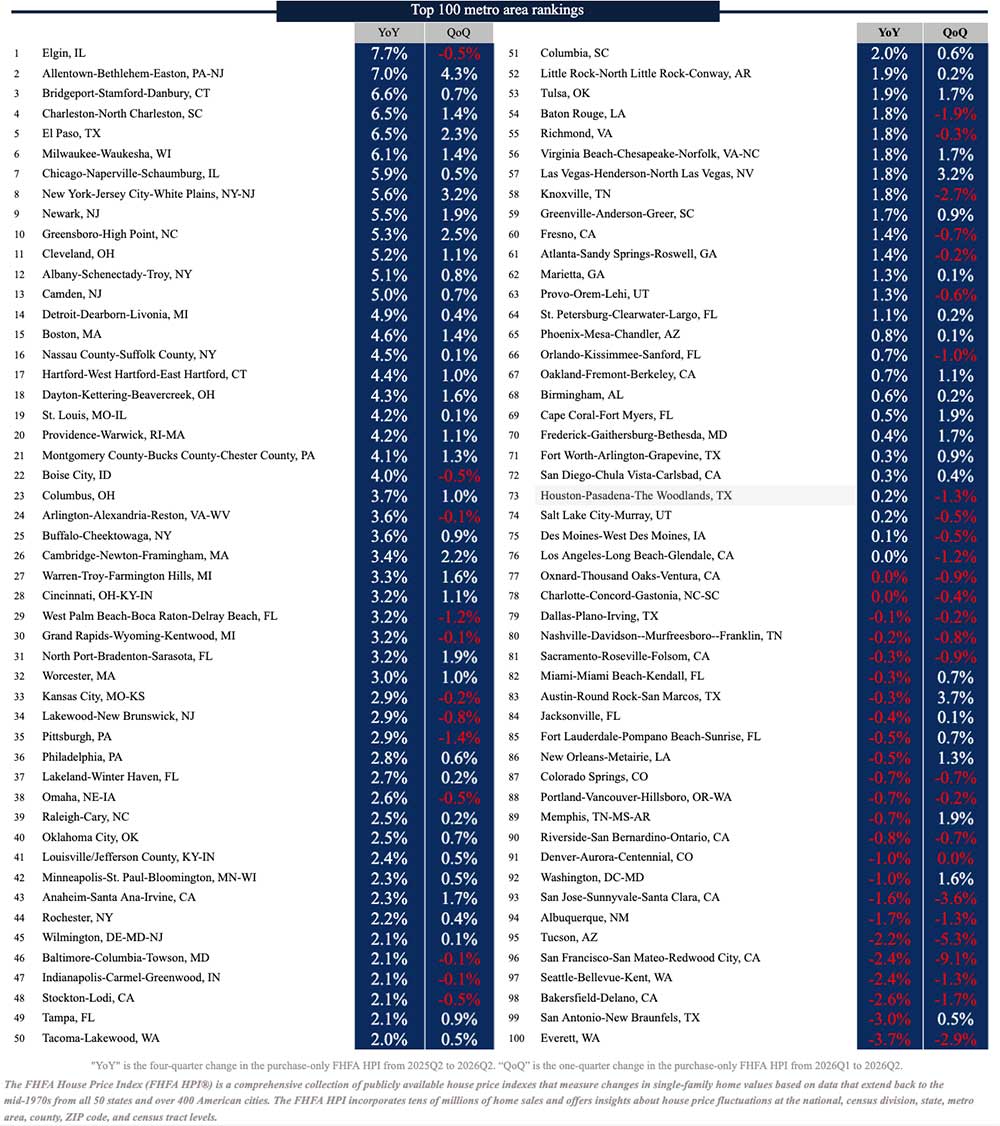
BEHIND THE SCENES: HOUSING PRICES MIXED
Be Alert to Appraisal Time Adjustment Impacts
As many local markets see noticeable declines in residential property values, appraisers, lenders, investors, and other stakeholders increasingly need to consider appropriate time adjustments. These decreases typically stem from an oversupply of homes, driven by more sellers than buyers. When comparable sales require time adjustments, lenders must ensure that appraisers make the proper adjustments. Failing to do so can lead to more closing delays, last-minute loan reductions, and dissatisfied buyers.
Longer marketing times also drive declining values in buyer’s markets. For example, homes that once sold in under 90 days now average 120 days. This phenomenon can complicate the sales comparison approach used in residential appraisal valuations, requiring appraisers to use older comparable sales because of limited sales activity. Using older comparables in a declining market may require some valuation gymnastics.
Last year, the GSEs instituted mandatory 12-month trend analysis for subject markets. This means that, as the slowdown continues, more markets will fall under the rubric of declining markets.
This can be a demanding analysis. Mortgage originators must be diligent in anticipating time adjustments and their attendant challenges, e.g., lenders wanting rework or added narratives. Transaction impacts from this valuation process can add significant time to the loan manufacture. Avoid late starts on the valuation process, and consider the impact of a higher LTV if the valuation is below the sales price. This is known as risk management. If you serve declining markets, MLOs must practice effective risk management. The LOSJ will cover this topic in coming issues.
Refer to the links LOSJ V6 I33 and the latest Redfin article for additional information. Observe the growing buyer market since the summer months.
From FHLMC
In 2025, Freddie Mac and Fannie Mae (the GSEs) introduced a pivotal requirement for appraisers to enhance the accuracy and reliability of property valuations. This requirement states that appraisers must report market analyses that substantiate both the indicated overall market trend and the market-derived adjustments for changes in market conditions (commonly referred to as “time adjustments”).
Key Requirements for Appraisers:
- Minimum Time Frame: The overall market trend must be derived using a minimum time frame of 12 months to provide a comprehensive view of market dynamics over a significant period.
- Dynamic Market Trends: It’s essential to recognize that the overall market trend may differ from the adjustments applied to individual comparable sales, as markets are inherently dynamic.
- Illustrative Methodology: An illustration of the methodology used to determine specific comparable sale time adjustments for changes in market conditions must be provided. This offers transparency into the rationale behind adjustments.
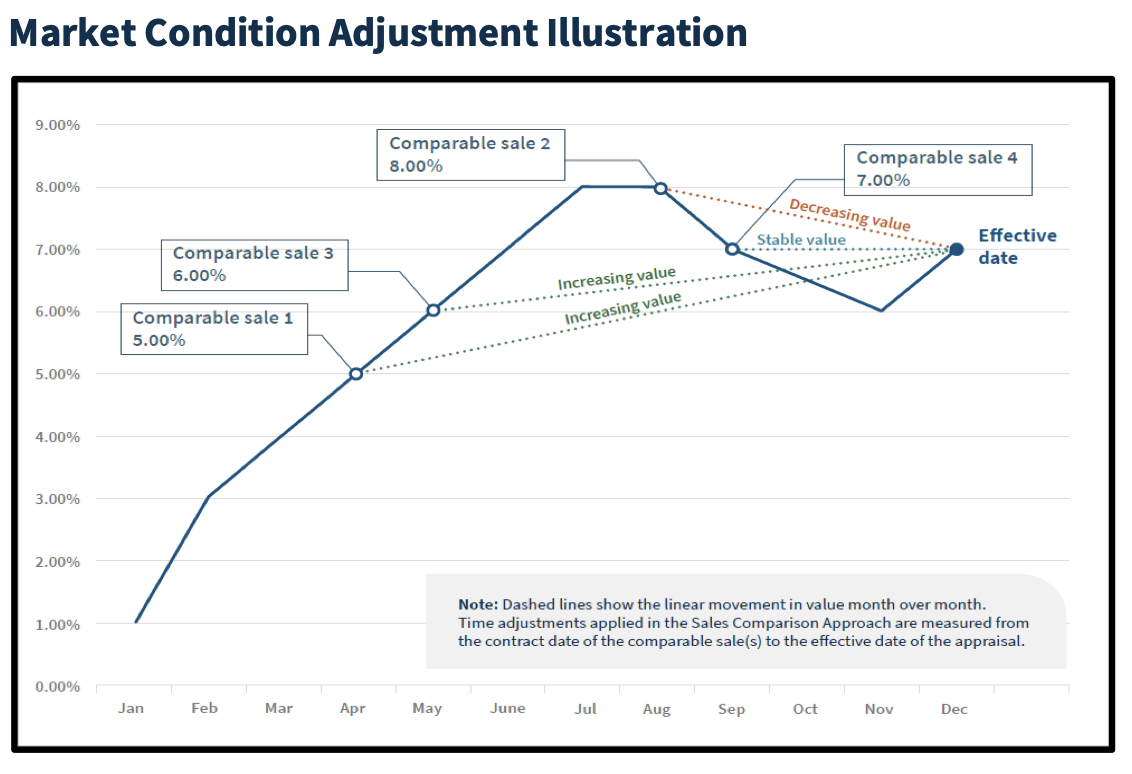
Image Courtesy of FNMA
From FNMA B4-1.3-09, Adjustments to Comparable Sales (06/04/2025)
Market Conditions Analysis and Time Adjustments
Measuring and analyzing market conditions is critical to determining an accurate value because the appraisal is based on a specific date (the effective date of the appraisal). The comparable sales being considered must be analyzed by the appraiser to determine if there have been any changes in market conditions from the time the comparable went under contract to the effective date of the appraisal. This analysis will determine whether a time adjustment is warranted. A specific time adjustment to a comparable sale(s) may differ from the identified market trend since the determination of whether an adjustment is made to a comparable sale is based on market changes between the contract date of the comparable sale and the effective date of the appraisal. For example, the 12-month value trend may indicate a positive overall trend; however, the market may have been stable (or declining) between the comparable’s contract date and the appraisal’s effective date. See this illustration for Market Condition Adjustments. Comparable(s) sales with a contract date that is recent in relation to the effective date of the appraisal will likely not have a time adjustment given the inability to identify a change in the market. The appraisal report must contain the market analysis that supports the indicated market trends, and any adjustments made for market conditions.
Because the appraisal is for a specific point in time (the effective date of the appraisal), the appraiser must analyze comparable sales for any changes in market conditions from their contract dates through the effective date to determine whether time adjustments are warranted. Time adjustments, or the lack thereof, must be supported by evidence. Use of home price indices (HPIs) to support time adjustments is consistent with our policy. The adjustment rates can also be determined through statistical analysis, modeling, paired sales, or other commonly accepted methods. The appraisal report must, at a minimum, summarize the supporting evidence and include a description of the data sources, tool(s), and technique(s) used.
Time adjustments should be supported by other comparables (such as sales, contracts) whenever possible; however, in all instances, the appraiser must provide an explanation for the time adjustment in the appraisal report.
When completing Fannie Mae appraisal reports, the appraiser should provide the sales contract date and the settlement or closing date. Report only the month and year. For example, appraisers may use “s04/10” or “c02/10” where “s” reflects the settlement or closing date and “c” reflects the contract date. If the exact date is necessary to understand the adjustments, it must be explained elsewhere in the report or in an addendum. If the contract date is unavailable to the appraiser in the normal course of business, the appraiser must enter the abbreviation “Unk” for unknown, in place of the contract date.
UAD 3.6
Market Trends
The appraiser must report the primary indicators of market conditions for properties in the subject property’s market area as of the effective date of the appraisal by noting the information in the table below.
Demand/Supply
- Oversupply
- In balance
- Shortage
Marketing Time
- Under three months
- Three to six months
- Over six months
The appraiser’s analysis of a property must consider all factors that affect value. Fannie Mae purchases loans in all markets, this is particularly important for market areas experiencing significant fluctuations in property values including sub-markets for specific types of housing. Therefore, lenders must confirm the appraiser analyzes active listings, pending sales, and settled sales based on their defined lookback period. The appraiser must also demonstrate or provide commentary on how the market trends were determined for competitive properties within the defined market area. If the price trend includes the use of multiple data sources, the appraisal report must include the sources used to determine the price trend and a reconciliation of these sources.
When completing the Housing Trends portion of the appraisal report, the trends must be reflective of those properties deemed to be competitive to the property being appraised. If the market area contains properties that are truly competitive (that is, market participants make no distinction between the properties), then all the properties within the market area would be reflected in the Housing Trends.
The appraiser’s analysis of housing and price trends must include factual data from information sources such as, but not limited to, market data, home price indices, multiple listing services, public records, and/or models, and include market commentary. The trend indicated in the appraisal report must reflect the overall movement of the market based on a minimum of 12 months of data. Special attention should be given to sales or financing concessions and distressed market competition in market areas with declining property values, an oversupply of properties, or marketing times over six months and the appraiser must provide the reasons these market conditions exist when present.
LOSJ V6 I33
Redfin Article: Home Sellers Now Outnumber Buyers By 63%, the Biggest Gap Since the Post-Recession Housing Crash

Tip of the Week: Sign up for 2026 CE
The LOSJ is celebrating five years of exceptional service to the mortgage industry, offering insights you won’t find anywhere else. To celebrate, enjoy our gift to you! Use the promo code “newsletter” when placing your class order.
Expanding your product offerings is an effective way to enhance your business’s vitality. This year, the Loan Officer School is surveying non-Qualified Mortgage (non-QM) financing options. We will review the various types of underwriting required for non-QM financing, including higher-priced mortgage loans (HPML), balloon-payment features, and interest-only options.
Presenting non-QM solutions to consumers improperly can lead to serious consequences. Understand the essentials of compliant and ethical subprime mortgage origination. Attend the Loan Officer School 2026 continuing education classes.
Please use the promo code “newsletter” when you sign up.
Have a Question About Operations, Sales, Marketing, or Compliance? Email Your Questions to the Loan Officer School Journal.
We invite LOSJ readers to submit questions on any topic to the editor. Topics can include compliance, sales, marketing, implementation, and other areas that may be helpful to our customers. If we use your question, we will include only your first name in our response. Please send your questions to: losjmailbag@gmail.com.
Necessary Mailbag Disclosure: The LOSJ is a periodic publication from LoanOfficerSchool.com designed to educate and inform our readers. Please note that we do not provide legal advice, and nothing in the LOSJ should be construed as a legal opinion on specific facts or circumstances. The content serves strictly for informational purposes. We strongly advise readers to consult legal counsel regarding any legal matters or specific questions.