
Why Haven’t Loan Officers Been Told These Facts? New Construction Property Tax Escrow
The Loan Officer School Journal provides examples of enforcement actions for informational purposes only. The veracity of the complainant’s allegations is unknown, and such allegations should not be construed as legal facts. LoanOfficerSchool.com does not intend to imply that the Complainee has violated any laws or ethical boundaries, nor does it suggest that the Complainant possesses evidence of misconduct by the Complainee.
Last year, the LOSJ wrote about a class action lawsuit filed in Florida against the nation’s largest homebuilder, D.R. Horton, and its mortgage company subsidiary, DHI Mortgage. “The lawsuit alleges that D.R. Horton targets prospective homeowners by promising low, affordable monthly payments, and then works with DHI Mortgage to suppress the actual cost of the home by illegally excluding the majority of required property taxes from the initial monthly payment.”
“On December 4, 2025, this case was voluntarily dismissed. A new case, Robinson v. D.R. Horton, has been filed in the District of Nevada, pursuing similar claims for a broader group of homeowners who were harmed by the Defendants’ conduct nationwide.” – Announcement from Plaintiff’s counsel
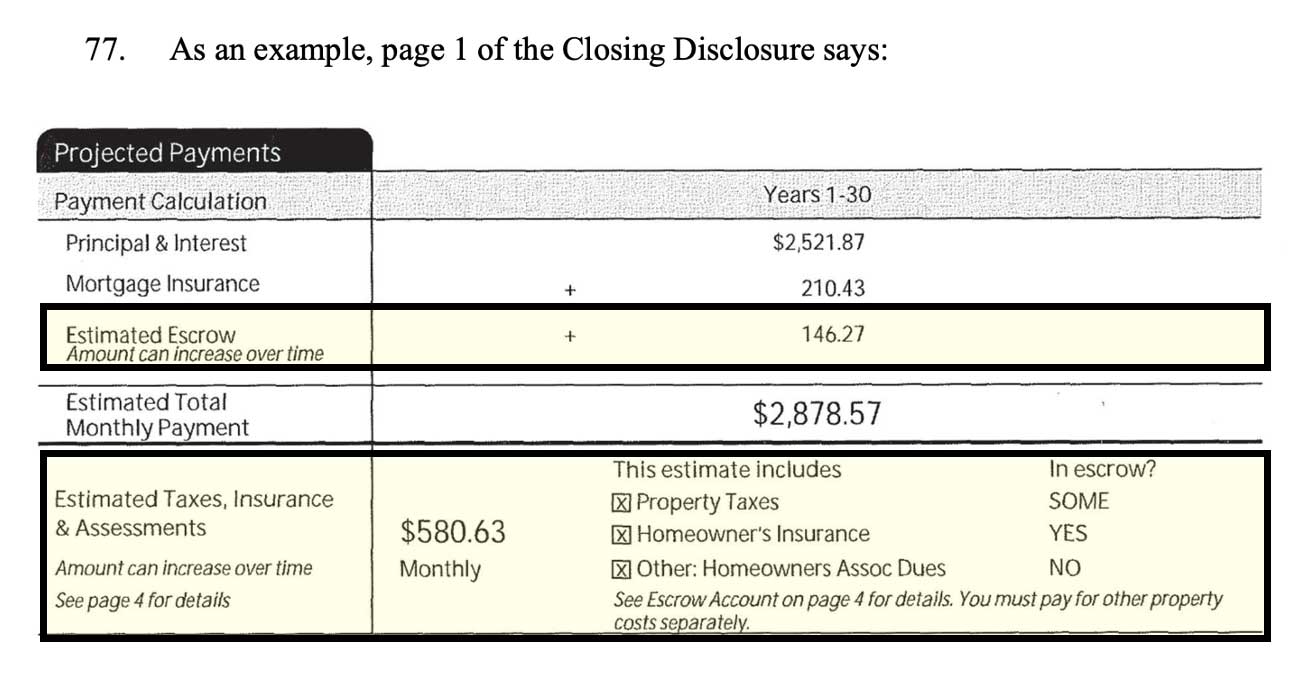
Plaintiff’s CD Exhibit Page 1, Projected Payments
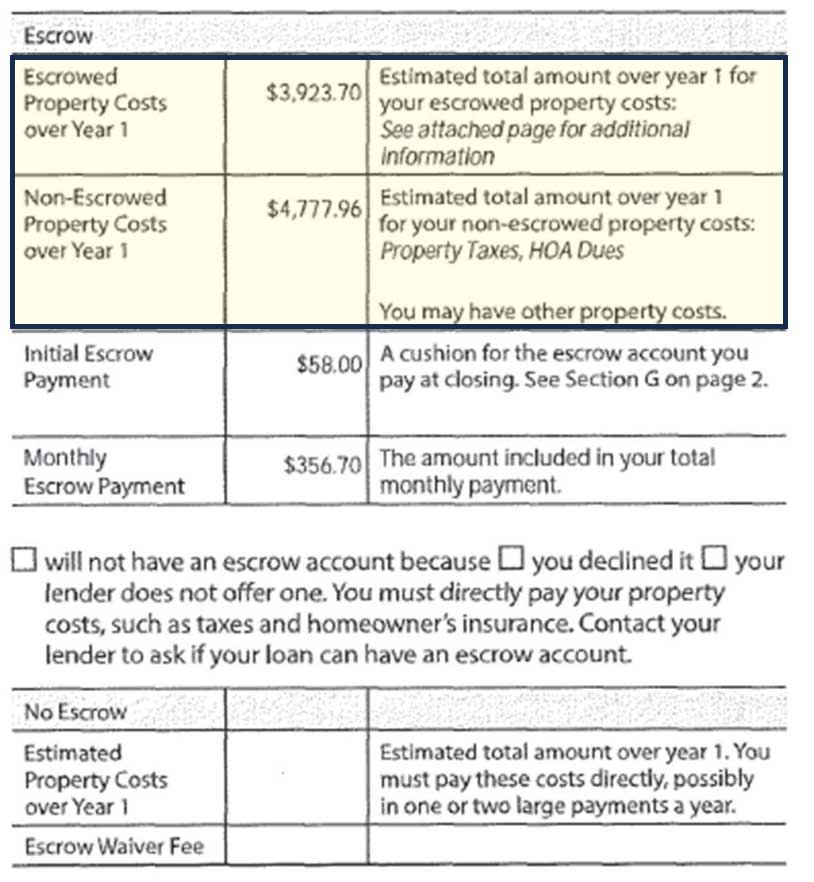
Plaintiff’s Closing Disclosure Exhibit
The Allegations: The CD
Excerpted from the Nevada Complaint
. . . Defendants promised the Santorii-Whitney Family a monthly payment of $2,878.57. Based on this payment, the Santorii-Whitney Family chose a DR Horton home with a DHI Mortgage loan because the monthly payment was—according to Defendants—lower than other homes with similar sales prices. But, less than a year after closing, the Santorii-Whitney Family payment skyrocketed from $2,878.57 to $3,968.84 per month when the new servicer conducted an escrow analysis that included all of their property taxes as well as the amounts the Santorii-Whitney Family now had to cover for back taxes due to this scheme.
. . . Defendants promised Mr. Radtke, a veteran of the United States Military, a monthly payment of $1,888.69. Based on this payment, Mr. Radtke chose a DR Horton home with a DHI Mortgage loan because the monthly payment was—according to Defendants— lower than other homes with similar sales prices. But, less than one year after closing, Mr. Radtke’s payment skyrocketed from $1,888.69 to $2,717.72 per month when the new servicer conducted an escrow analysis that included all the property taxes as well as the amounts Mr. Radtke now had to cover for back taxes due to this scheme.
– DHI Mortgage uses the Suppressed Estimate in final Closing Disclosures and when setting up the initial escrow account, contrary to both the intent and requirements of federal law.
– Defendants know that the Suppressed Estimate will lead to the Homebuyer’s escrow account not covering the full property taxes when they come due, which the new servicer will pay out of the escrow account.
– Through their Monthly Payment Suppression Scheme, Defendants systemically cut the amount escrowed for property taxes by up to 80% annually.
Plaintiff’s Characterization of Complaint CD Exhibit, Page 4, 12 CFR 1026.38(l)(7) Loan Disclosures, Escrow Account
“Obscured on page 4 of the Closing Disclosure, DHI Mortgage lists escrowed and non-escrowed amounts, but nowhere in this document is it clear that the Homebuyer has to pay these amounts and do so separately. And at no time does either Defendant explain that the “Estimated Total Monthly Payment” is inaccurate because of this extra amount that would have to be paid.”
“This document states that there will be an escrow account and does not explain what “Non-Escrowed Property Costs” means, nor does it advise a Homebuyer how or where they might pay these costs, even if they understood what this language meant. This document does not explain that the amount listed as “Estimated Total Monthly Payment” was inaccurate and will be significantly higher when correctly calculated.”
The plaintiff’s description of the disclosed borrower’s additional property tax and HOA Dues obligations is misleading. “Obscured on page 4 of the Closing Disclosure” mischaracterizes the plaintiff’s compliance with Regulation Z disclosure requirements. If the plaintiff’s obligation to pay Property Taxes and HOA Dues is obscure, that would be the fault of the CFPB and the CFPB’s vendor that designed the CD, Kleimann Communication Group, now operating as Kingsley-Kleimann Group.
Development and Testing of the Closing Disclosure
While testing the proposed final disclosure (CD), Kleimann Communication Group (Kleimann) identified the disclosure’s limitations. In its 533-page testing report to the CFPB, Kleimann’s testing of the page 4 Escrow Account disclosure revealed this could be a problem area.
- The particular loan example we tested included a partial escrow on the Settlement Disclosure. The full amount of the escrow was listed in the Escrow Information for Taxes, Insurance, and Assessments on page 4. However, the amount listed in the Estimated Escrow in the Payment Calculation was lower because it did not include the HOA fees that the homeowner would be required to pay.
- Both experienced and inexperienced participants expressed confusion when they noticed those differences and could not always tell what wasn’t being covered. Only a few consumer participants could articulate that the difference was due to the HOA fees referenced on page 4.
Kleimann cited, “Industry participants thought the Escrow information would be confusing for consumers, particularly the concept of partial escrow.”
“They’ll probably have questions as far as what every single number [in escrow] means. Non-escrow property cost, they’re going to want to explain that since they are opting to have escrow. A bunch of people would look at that and not understand it.” (TX-Lender-001)
Maybe include a little clearer visual breakdown of what the $842 goes to literally on a monthly basis, so you’ve got $400 going towards taxes, $250 going towards insurance, and etc., etc.” (TX-Settlement Agent-004)
Do the Plaintiffs Have a Good Argument for a TILA Violation?
Plaintiff objects that “This document (the CD) states that there will be an escrow account and does not explain what ‘Non-Escrowed Property Costs’ means.“
Frankly, the plaintiff’s objection borders on the fantastic. The term “Non-Escrowed Property Costs” is self-explanatory. The sum of $4777.96 for “Property Tax and HOA Dues” is as conspicuous as the required disclosure can make it. Plaintiff’s objection to the statement would be a complaint about the required disclosure and its required form under Regulation Z.
Comment 38(l)(7)(i)(A)(2)-1. Estimated costs not paid by escrow account funds. Section 1026.38(l)(7)(i)(A)(2) requires the creditor to estimate the amount the consumer is likely to pay during the first year after consummation for the mortgage-related obligations described in § 1026.43(b)(8) that are known to the creditor and that will not be paid using escrow account funds. The creditor discloses this amount only if an escrow account will be established.
Comment 43(b)(8)-1. General. Section 1026.43(b)(8) defines mortgage-related obligations, which must be considered in determining a consumer’s ability to repay . . .
§ 1026.38(l)(7)(i)(A)(2) The estimated amount the consumer is likely to pay during the first year after consummation for the mortgage-related obligations described in § 1026.43(b)(8) that are known to the creditor and that will not be paid using escrow account funds, labeled “Non-Escrowed Property Costs over Year 1,” together with a descriptive name of each such charge and a statement that the consumer may have to pay other costs that are not listed;
Comment 38(l)(7)(i)(A)(2)-2. During the first year. Section 1026.38(l)(7)(i)(A)(2) requires disclosure based on payments during the first year after consummation.
Under Regulation Z, the lender may be limited to disclosing known non-escrowed property costs the borrower will likely incur within the first 12 months after consummation or beginning with the borrower’s initial payment date. In the case study, it is unclear if the improved value assessment would fall wholly or partially within the 12 months post-consummation.
The plaintiff also raises concerns that the CD does not inform homebuyers about the methods or locations for paying property taxes and HOA fees. Regulation Z makes no such disclosure demands. Lenders are not required to advise homeowners on how to pay these fees. The law mandates disclosure of the payment obligation, but it does not specify whether the payment should be made in cash, by check, or electronically. For some borrowers, such information might be helpful, but failing to provide information the law does not require does not constitute a violation.
Plaintiffs assert, “Upon information and belief, no other mortgage lender in the United States engages in the practice of partially escrowing property taxes by deliberately including only a small portion of a Homebuyer’s property taxes in their monthly payment.”
The plaintiff’s assertion that no other mortgage lender in the United States partially escrows property taxes may be ill-informed. Some originating lenders do establish escrows based on current tax assessments. Closing practices regarding escrows for new construction vary by state. Additionally, RESPA limitations on collecting property taxes lead many lenders to adopt a conservative approach (collecting a lesser rather than a greater sum) when establishing escrow accounts.
Relevant Regulations (Regulations Z and X)
Regulation Z CD Page 1, Subheading Projected Payments
§ 1026.38(c)(1) Projected payments or range of payments (Estimated Escrow). The information required to be disclosed pursuant to § 1026.37(c)(1) through (4), other than § 1026.37(c)(4)(vi) (Required Loan Estimate disclosure).
In other words, the Regulation Z section that governs the CD preparation (1026.38(c)(1)) for the projected escrow payment is derived in the same manner as that section that prescribes the LE projected payments disclosure (1026.37(c)).
Regulation X Escrow Administration
§ 1024.17(c)(1)(i) Escrow accounts. Charges at settlement or upon creation of an escrow account. At the time a servicer creates an escrow account for a borrower, the servicer may charge the borrower an amount sufficient to pay the charges respecting the mortgaged property, such as taxes and insurance, which are attributable to the period from the date such payment(s) were last paid until the initial payment date.
Limits on payments to escrow accounts. § 1024.17(c)(7) Servicer estimates of disbursement amounts. To conduct an escrow account analysis, the servicer shall estimate the amount of escrow account items to be disbursed. If the servicer knows the charge for an escrow item in the next computation year, then the servicer shall use that amount in estimating disbursement amounts.
For more background on the story, see the links to past LOSJ reports below.
LOSJ V5 I42 N221 Santiago v D.R. Horton
BEHIND THE SCENES: FAILURE TO DISCLOSE IRS DEBT ON THE LOAN APPLICATION CAN SPELL BIG TROUBLE
Excerpted from the U.S. Department of Justice July Press Release
SCOTUSblog Founder Hid Millions in Gambling Income and Debts
Thomas C. Goldstein, a prominent appellate attorney who argued more than 40 cases before the U.S. Supreme Court and co-founded the widely read legal website SCOTUSblog, was sentenced to 72 months in prison today for tax crimes and mortgage fraud. The Court additionally revoked Goldstein’s bond and remanded him into custody.
In 2021, Goldstein submitted false mortgage applications to two separate mortgage lending companies, seeking financing to purchase a $2.6 million dollar home in Washington, D.C. On those mortgage applications – which required Goldstein to list all his liabilities and debts – Goldstein omitted millions of dollars of liabilities, including more than $14 million he owed for poker-related debts, as well as taxes he owed the IRS. Goldstein’s false statements to one of the mortgage lenders enabled him to obtain a $1.98 million loan.
On Feb. 25, a federal jury convicted Goldstein of tax evasion, assisting in the preparation of false tax returns, willful failure to timely pay taxes and making false statements to mortgage lenders. In addition to the term of imprisonment, U.S. District Judge Lydia Kay Griggsby for the District of Maryland ordered Goldstein to serve five years of supervised release, pay $3,103, 427 in restitution, and ordered forfeiture but at an indeterminate amount.
IRS Criminal Investigation and the FBI investigated the case.
On April 7, the Department of Justice announced the creation of the National Fraud Enforcement Division (“Fraud Division”). The Fraud Division is laser-focused on investigating and prosecuting those who commit fraud against the American people. The Department’s work to combat fraud supports President Trump’s Task Force to Eliminate Fraud, a whole-of-government effort chaired by Vice President J.D. Vance to eliminate fraud, waste, and abuse within Federal benefit programs.

Tip of the Week: Sign up for 2026 CE
The LOSJ is celebrating five years of exceptional service to the mortgage industry, offering insights you won’t find anywhere else. To celebrate, enjoy our gift to you! Use the promo code “newsletter” when placing your class order.
Expanding your product offerings is an effective way to enhance your business’s vitality. This year, the Loan Officer School is surveying non-Qualified Mortgage (non-QM) financing options. We will review the various types of underwriting required for non-QM financing, including higher-priced mortgage loans (HPML), balloon-payment features, and interest-only options.
Presenting non-QM solutions to consumers improperly can lead to serious consequences. Understand the essentials of compliant and ethical subprime mortgage origination. Attend the Loan Officer School 2026 continuing education classes.
Please use the promo code “newsletter” when you sign up.
Have a Question About Operations, Sales, Marketing, or Compliance? Email Your Questions to the Loan Officer School Journal.
We invite LOSJ readers to submit questions on any topic to the editor. Topics can include compliance, sales, marketing, implementation, and other areas that may be helpful to our customers. If we use your question, we will include only your first name in our response. Please send your questions to: losjmailbag@gmail.com.
Necessary Mailbag Disclosure: The LOSJ is a periodic publication from LoanOfficerSchool.com designed to educate and inform our readers. Please note that we do not provide legal advice, and nothing in the LOSJ should be construed as a legal opinion on specific facts or circumstances. The content serves strictly for informational purposes. We strongly advise readers to consult legal counsel regarding any legal matters or specific questions.
[/fusion_text][/fusion_builder_column][/fusion_builder_row][/fusion_builder_container]