
Why Haven’t Loan Officers Been Told These Facts? New Construction Property Tax Escrow
The Loan Officer School Journal provides examples of enforcement actions for informational purposes only. The veracity of the complainant’s allegations is unknown, and such allegations should not be construed as legal facts. LoanOfficerSchool.com does not intend to imply that the Complainee has violated any laws or ethical boundaries, nor does it suggest that the Complainant possesses evidence of misconduct by the Complainee.
Last year, the LOSJ wrote about a class action lawsuit filed in Florida against the nation’s largest homebuilder, D.R. Horton, and its mortgage company subsidiary, DHI Mortgage. “The lawsuit alleges that D.R. Horton targets prospective homeowners by promising low, affordable monthly payments, and then works with DHI Mortgage to suppress the actual cost of the home by illegally excluding the majority of required property taxes from the initial monthly payment.”
“On December 4, 2025, this case was voluntarily dismissed. A new case, Robinson v. D.R. Horton, has been filed in the District of Nevada, pursuing similar claims for a broader group of homeowners who were harmed by the Defendants’ conduct nationwide.” – Announcement from Plaintiff’s counsel
Final Thoughts on the D.R. Horton Lawsuit
In recent weeks, the LOSJ has reviewed the class action complaint against D.R. Horton and its mortgage subsidiary, DHI Mortgage. If you missed the previous articles on this class-action lawsuit, you can find the hyperlinks at the bottom. The plaintiffs have alleged several federal and state violations; however, the LOSJ has focused its analysis specifically on the alleged federal disclosure violations. Central to the plaintiffs’ lawsuit is the allegation that property taxes were inaccurately represented in the Loan Estimate and further obscured in subsequent disclosures, including the Closing Disclosure.
Particular to new construction, the RESPA and TILA objectives collide to some extent in Regulations Z and X, which govern the disclosures necessary for informed credit use, as well as RESPA section 10 requirements, which limit excessive escrow collections.
The lawsuit may also shed light on TRID disclosure limitations that intend to help consumers of new residential construction make informed decisions and avoid unwise mortgage credit.
Regulators know that shoehorning too much information into necessary disclosure is generally counterproductive. Sometimes less is more, but sometimes less is less. Disclosure is an art, not a science, and effective disclosure depends not only on the good faith and expertise of the person making it, but equally on the diligence of the person receiving it to understand what has been disclosed and what has not.
In the case study, by the plaintiff’s own admission, several flags were present that a diligent consumer would not have missed. The confusing Projected Payment table and subsequent property tax notice the lender provided should have prompted the plaintiffs to ask more about the property tax escrow and the higher assessment for the improved lot.
Given the current disclosure requirements and limitations, could the defendant have made things clearer? Most mortgage originators with some experience know that consumers typically have two main concerns: housing costs and the cash needed to close the deal. A good MLO will address these concerns as early as possible in the conversation. If potential increases in housing cost estimates are known, disclose them in the Loan Estimate whenever possible.
The Loan Estimate serves several important purposes. First, it clearly communicates the overall cost of credit. Second, it provides enough information for consumers to assess whether the credit offer is suitable for them. Loan options that may involve potentially significant payment changes may not be appropriate for everyone. The Projected Payment table, along with the Adjustable Payment and Adjustable Interest Rate tables (when applicable), helps consumers understand financing uncertainties by disclosing, in clear dollar amounts, the range of possible payment changes. Balloon payments and other loan features may prove toxic to some consumers. Thirdly, the Loan Estimate equips the consumer to comparison shop.
When the Loan Estimate contains inaccurate disclosures or is not delivered on time, it becomes nearly useless or, worse, misleading. This undermines informed credit use and compromises the disclosure’s effectiveness.
Regulation Z does not require the Loan Estimate to match the Closing Disclosure. The Loan Estimate’s accuracy concern surrounds understated settlement and finance costs. The Closing Disclosure is more complex. In the Closing Disclosure, costs such as prepaids and escrows are assumed to be known. Clearly, the TRID disclosures could be revised to better disclose how new construction property tax escrows are calculated. Confusing the consumer at closing is never a good idea. Yet unnecessarily allowing false impressions at the onset of the transaction may be worse.
Nothing prohibits the lender from providing, in the Loan Estimate, a concise, conservative property tax estimate when the property is assessed unimproved at the time of the disclosure. If Regulation Z and X conspire to limit the escrow collection at consummation, so be it. But in this scenario, at the earliest opportunity, the consumer’s housing cost expectations must align with reality to enable informed use of credit.
If there is a substantive gap between the Loan Estimate’s overstated property tax escrow and the RESPA-limited Closing Disclosure, the lender must disclose to the consumer at or near closing that the estimated property tax escrowed at closing is much lower than the actual amount that will be owed and provide an estimate of the projected escrow gap and available remedies to avoid unnecessarily burdensome catch-up escrow payments.
It’s crucial to set clear expectations for consumers regarding property tax escrows at the beginning of the origination. Lenders must also clearly communicate the limitations of escrow accounts, including potential future deficits and their consequences. If future tax assessments on improved lots are not disclosed as early as possible during the loan origination process, it can impede consumers’ informed use of credit, especially if they do not fully understand the transaction details. This is especially concerning for more vulnerable populations, such as first-time buyers.
The RESPA statutory language implies that the lender can collect more than it will disburse when it knows of a future deficiency. However, if a lender wants to limit its RESPA violation exposure, it will not exceed the Regulation X escrow collection limit and may let the deficiency materialize, even if it puts the borrower in a jam.
In the case study, it appears the defendant attempted to provide the scope of future tax increases within the limitations of the TRID disclosure rules. Yet one wonders why a more accurate property tax estimate was not included in the Loan Estimate Projected Payment table.
ABCs of New Construction Property Tax Escrow
In some cases, a borrower’s tax liability may be calculated to include a portion of both improved and unimproved assessments. Lenders must avoid excessive escrow collections.
A. (Sales Price/Value) – Exemptions = Assessed Value
B. (Assessed Value * mill levy) plus non-ad valorem assessments equal the total property tax for escrow.
C. The lender should determine when the property tax liability for the improved lot begins. The new assessment could start on the date the certificate of occupancy is issued, at the end of the tax year, or at some other time under local code. Naturally, prorations may apply.
LOSJ V5 I42 N221 Santiago v D.R. Horton
LOSJ V6 I32 Pt 1
LOSJ V6 I33
LOSJ V6 I34
LOSJ V6 I35
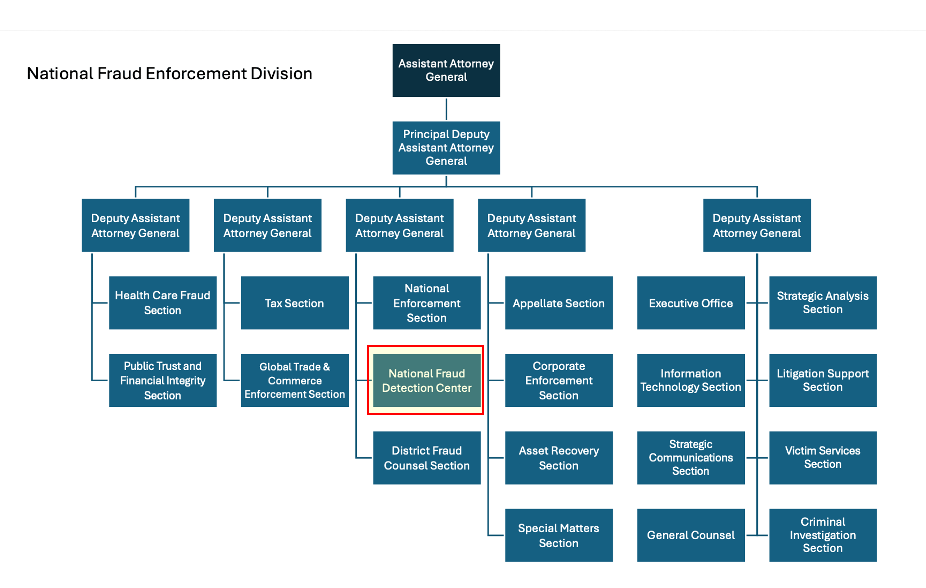
BEHIND THE SCENES: MORE FEDERAL ANTI-FRAUD MEASURES, THE NATIONAL FRAUD DETECTION CENTER (NFDC)
Federal authorities have announced a new alliance to combat fraud. The National Fraud Detection Center (NFDC) has been established as part of the new U.S. Department of Justice’s National Fraud Enforcement Division’s enforcement priorities.
This initiative will connect federal law enforcement agencies and prosecutors through shared data and coordinated investigations. In a way, the NFDC objective resembles that of the PATRIOT Act passed in response to the 911 attacks: an effort to break down bureaucratic barriers that often lead to isolated information gathering. Another parallel example of information sharing would be the founding of the NMLS and NMLSR. The NMLS gives state regulators visibility into licensee events across jurisdictional boundaries that did not exist before.
What does this mean for mortgage fraud investigations or False Claims Act violations? We shall see.
HUD OIG Announcement
WASHINGTON DC— The U.S Department of Housing and Urban Development, Office of the Inspector General (HUD OIG) is proud to announce its partnership with the U.S. Department of Justice (DOJ) in the launch of the National Fraud Detection Center (NFDC). As a signatory of the NFDC Charter, HUD OIG has committed dedicated investigators and analysts to the prosecutor-led effort to strengthen interagency coordination to detect and dismantle complex fraud schemes. “The National Fraud Detection Center represents the power of government working together with one purpose: to protect the American people from fraud. For millions of Americans, homeownership is the foundation of the American Dream, and we have zero tolerance for those who seek to steal that dream through fraud, deception, or abuse of federal housing programs. By combining the expertise, intelligence, and investigative strength of HUD OIG, DOJ, and our law enforcement partners, the NFDC will allow us to identify fraud faster, strike it harder, and better protect families, taxpayers, and the integrity of our nation’s housing programs,” stated Acting Inspector General Brian D. Harrison.
The NFDC serves as a centralized, collaborative space bringing together federal law enforcement, the Inspector General community, and state partners. By joining forces with the DOJ’s Fraud Division, fellow OIGs, and federal law enforcement agencies, HUD OIG reinforces its commitment to holding accountable those who seek to defraud federal programs and abuse public trust.
From the U.S. Department of Justice
NFDC Opens with Widespread Collaboration with Inspectors General and Law Enforcement Agencies
Today, the U.S. Department of Justice announced the launch of the National Fraud Detection Center (NFDC), a prosecutor-led, multi-agency team designed to investigate the most harmful actors defrauding federal government programs, including illicit actors overseas and those operating fraud schemes across federal programs. The NFDC will bring together law enforcement agencies and analytical capabilities to generate criminal leads to drive more impactful prosecutions and enhance fraud-fighting results for the American people.
“The creation of the NFDC marks a decisive shift in how the federal government detects and investigates complex fraud,” said Assistant Attorney General Colin McDonald of the Justice Department’s National Fraud Enforcement Division. “By breaking down institutional silos, embedding analysts from across the IG community, and leveraging shared technology, the NFDC is actively closing the window of opportunity for bad actors who seek to exploit taxpayer dollars. Today’s announcement sends a clear message: if you defraud federal programs, we have the tools and the law enforcement partners to find you.”
The NFDC solves for a lack of cross-program visibility that has long hindered efforts to deter fraud on taxpayer-funded programs and has enabled some fraud actors to further perpetrate schemes across multiple taxpayer-funded programs without detection. The NFDC closes this gap by bringing partners across federal and state government together to break down silos and work collaboratively in a whole-of-government approach to eliminate fraud.
The NFDC’s success relies directly on the collaborative strength of our partners across federal and state government. The inaugural members of the NFDC include the Federal Bureau of Investigation, Homeland Security Investigations, IRS Criminal Investigation, FinCEN, the Pandemic Response Accountability Committee, the Treasury Department, and the Offices of Inspector General for the Departments of Agriculture, Education, Health and Human Services, Homeland Security, Housing and Urban Development, Interior, Labor, Veterans Affairs, Department of War Office of Inspector General’s Defense Criminal Investigative Service (DCIS), the Treasury Inspector General for Tax Administration, Small Business Administration, and Social Security Administration. The NFDC presents a unified front to identify fraud across agencies and prosecute the most nefarious criminals, domestic and abroad.
The Department also extends its sincere gratitude to our state partners whose efforts further power the NFDC. We proudly acknowledge the leadership and contributions of the Secretaries of State of Alabama, Florida, Georgia, Louisiana, Mississippi, Ohio, and South Carolina; the State Treasurers of Florida, Mississippi, Ohio, and South Carolina; and the South Carolina Department of Social Services. These partnerships strengthen our capacity to detect fraud and protect taxpayer dollars.
This Fraud Division initiative is being led by Acting Assistant Director Amanda Riedel of the Executive Office for U.S. Attorneys and Acting Chief Cody Matthew Herche of the Global Trade & Commerce Enforcement Section.

Tip of the Week: Sign up for 2026 CE
The LOSJ is celebrating five years of exceptional service to the mortgage industry, offering insights you won’t find anywhere else. To celebrate, enjoy our gift to you! Use the promo code “newsletter” when placing your class order.
Expanding your product offerings is an effective way to enhance your business’s vitality. This year, the Loan Officer School is surveying non-Qualified Mortgage (non-QM) financing options. We will review the various types of underwriting required for non-QM financing, including higher-priced mortgage loans (HPML), balloon-payment features, and interest-only options.
Presenting non-QM solutions to consumers improperly can lead to serious consequences. Understand the essentials of compliant and ethical subprime mortgage origination. Attend the Loan Officer School 2026 continuing education classes.
Please use the promo code “newsletter” when you sign up.
Have a Question About Operations, Sales, Marketing, or Compliance? Email Your Questions to the Loan Officer School Journal.
We invite LOSJ readers to submit questions on any topic to the editor. Topics can include compliance, sales, marketing, implementation, and other areas that may be helpful to our customers. If we use your question, we will include only your first name in our response. Please send your questions to: losjmailbag@gmail.com.
Necessary Mailbag Disclosure: The LOSJ is a periodic publication from LoanOfficerSchool.com designed to educate and inform our readers. Please note that we do not provide legal advice, and nothing in the LOSJ should be construed as a legal opinion on specific facts or circumstances. The content serves strictly for informational purposes. We strongly advise readers to consult legal counsel regarding any legal matters or specific questions.